

5 Flop Songs From 1978 We Can't Help But Love
We all feel protective about certain songs that hold personal value no matter the opinions of the general public, including flop songs. Maybe you think "Yellow Submarine" is the Beatles' best album no matter its status as a critical and fan failure. Maybe you think "Sour Girl" is Stone Temple Pilots' best song, not "Plush," "Creep," "Interstate Love Song," "Wicked Garden," etc. Every year and musical era has created such differences between personal and public taste, critic and fan, chart impact and long-lasting cultural footprint. 1978 was no exception.
This means that the word "flop" covers a wide variety of circumstances. A song can flop in the eyes of critics, justifiably or not, but win over the common listener. It could also do the opposite. A song could also flop in comparison to other songs from an artist, especially if an artist followed up a hit with a bomb, even if the "bomb" might have been considered a hit for a lesser-known artist. Same goes for singles released from the same album — one might have caught on, but another tanked. Then there's the disparity between chart-topping songs and songs that made a cultural impact. Nirvana's generation-defining "Smells Like Teen Spirit," for instance, peaked at No. 6 on the Billboard Hot 100, not No. 1 like you'd expect.
Looking to our favorite 1978 flops, we've got a music-changing, overlooked song from Judas Priest and a derided song from Grateful Dead. We've also got two songs off debut albums by Van Halen and Dire Straits that never charted, and a song from the perpetually overlooked genre-of-one, Tom Waits.
Red Shoes by the Drugstore - Tom Waits
By virtue of vocal gravel alone, Tom Waits makes our list. Okay, not only the most smokestack-like vocal gravel around (though it helps), but a legitimately cool, hip song (in a poetry slam kind of way) that went absolutely nowhere on release in 1978 and still only has 1.4 million total listens on Spotify: "Red Shoes by the Drugstore" from "Blue Valentine." The entire album debuted about as high as it ever got, at No. 184 on the Billboard 200, with a high of No. 181, but none of its songs broke the Billboard Hot 100. In fact, none of Waits' songs ever have.
Out of all the songs on "Blue Valentine," the extremely sad "Christmas Card from a Hooker in Minneapolis" tends to get all the attention, right down to the jazz covers. But "Christmas Card from a Hooker in Minneapolis" was never a single, while "Red Shoes by the Drugstore" was released as the second track on the admittedly languorous and boring "Somewhere (From 'West Side Story')" single, which might have hindered its chances.
Regardless, "Red Shoes by the Drugstore" has a sick percussive roll and groove, a bouncy and sparse bassline, some offbeat (in a musical sense) clean electric guitar strums, weird chime-like synth arpeggios, and a classic noir story about a robbery gone wrong. It's great stuff, and something any Waits fan could get behind. So what if a site like Only Solitaire describes "Red Shoes by the Drugstore" as one of Waits' typical "beatnik rants"? That's just another reason to love it.
Exciter - Judas Priest
To metal diehards, it'd be ludicrous to call anything Judas Priest released a "flop" simply by virtue of their legendary status and role as a bridge between '70s heavy metal and faster, heavier '80s galloping thrash metal. They've sold somewhere from 47 and 50 million records over their 50-plus year career, placing them within the top 10 best-selling metal artists of all time. Their most widely listened-to song on Spotify, "Breaking the Law," has over 350 million listens. But, Priest's success has been one of longevity and a slow, gradual accumulation of respect over time. They've had exactly one song across 19 studio albums breach the Billboard Hot 100, "You've Got Another Thing Comin'," at No. 67. That makes 1978's "Exciter" off "Stained Class" a certified commercial flop.
The modern ear might not detect anything exceptional about "Exciter" on first listen, no matter that it's a solid, radio-friendly track that straddles the line between hard rock and light metal. The most stand-out thing besides Rob Halford's absolutely nutso high notes is an exquisite, neoclassical chord progression after the song's second guitar solo (with the line "But you will taste the fire upon your tongue"). But it's the song's tight songwriting and execution, especially its use of double-kick drums courtesy of Les Binks, that elevates "Exciter" from undeserved flop to one of Priest's most kick-ass tracks. It's one of the most important songs in rock and metal history to influence double kicks.
The extra cool thing about "Exciter" is that, in the years and decades following the song's release, it transformed into a vigorous, gritty, rough live song that outstripped its studio version. It's enough to make you question why Billboard charts even matter at all.
Shakedown Street - Grateful Dead
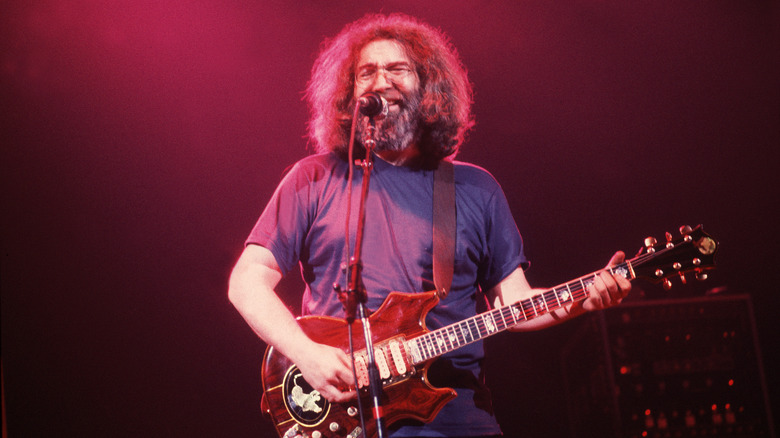
You might figure that with 13 studio albums and 233 live albums under their belt, but only six Billboard Hot 100 songs, we could qualify most Grateful Dead singles as flops no matter the band's iconic status. This includes "Shakedown Street" from 1978's album of the same name, which also flopped amongst Deadheads who derided its shift from psychedelic, jam-session rock to late-'70s, disco-infused pop, calling it "disco Dead." But like the Rolling Stones' disco-saturated hit "Miss You" from that same year (which went to No. 1 on the Billboard Hot 100), we consider the blatant disco influence in "Shakedown Street" to be a plus, as artists naturally evolve and soak up influences over time.
Musically, "Shakedown Street" starts out sounding like "Another Brick in the Wall, Pt. 2" from Pink Floyd, though it came out before Floyd's hit. The song shortly goes full disco, complete with a groovy, syncopated bassline, highly-pitched guitar work, and harmonizing background singers. It's even blatantly catchy in a way that might annoy Deadheads, but which we can't help but love. You can also still hear Dead songcraft on display in "Shakedown Street," right down to instrumental solos reminiscent of live performances to come.
Speaking of those performances, "Shakedown Street" reached its peak in later live versions that far surpass the studio version. This is often the case with the Dead, who were primarily a live band built around improv. So it was that a live version of "Shakedown Street" got released on "Dick's Picks Volume Five: Oakland Auditorium Arena 12/26/79," clocking in at almost 14 minutes long. This version ranks within the Dead's best songs from the '70s.
Water of Love - Dire Straits
It's wild to think that "Sultans of Swing" was Dire Straits' very first single. Released on their 1978, eponymous debut, it pretty much made Mark Knopfler and company's entire career, driving the band's eventual 118 million in combined album sales and digital downloads (and granting us a killer guitar solo imprinted on classic rock fans for life). The song's also got a gonzo 1.7 billion Spotify listens at the time of writing. So what is a mere 78 million listens in comparison? It's the 1978 flop "Water of Love." No, it's not as good as "Sultans of Swing," but that's a pretty high bar.
Like with Tom Waits' "Red Shoes by the Drugstore," the chances of "Water of Love" being a success were hindered by its release, which only happened in the Netherlands and Australia. Why this limited release? Was there something about windmills and koalas that made Dire Straits' label think the song would catch on in those countries and not elsewhere? We've got no clue and no insight into the arcane mechanisms underpinning international music distribution rights. Maybe some exec rolled a five on a D20. Regardless, "Water of Love" never charted on the Billboard Hot 100, unlike "Sultans of Swing" at No. 4.
Still, "Water of Love" deserves some love. It's smooth, groovy, and has a Latin-influenced rhythmic sense overlaying its blues-rock structure. It's perfect for a slow afternoon, and even features some Knopfler-played slide work on the lead guitar (the metal tube thing used to make notes sound warbly).
Jamie's Cryin' - Van Halen
Our music cred might take a hit because of this, but we don't just have a hate-hate relationship with Van Halen — sometimes it's love-hate (but never love-love). On one hand, it's easy to characterize Van Halen as a bunch of preening, cocky, insufferable cheeseballs, especially David Lee Roth. Worst-case scenario, they craft godawful, annoyingly repetitive '80s tracks like 1984's "Jump," that we never want to hear again (but which stayed at No. 1 on the Billboard Hot 100 for a full five weeks). But sometimes — sometimes — they're loveably dumb in a golden retriever kind of way (especially considering the hair). So it was with "Jamie's Cryin'" from the band's 1978, self-titled debut album, which never breached the Billboard Hot 100.
On the surface, "Jamie's Cryin'" might seem like a strange song to get behind. It's a bit mellow, unforced, and makes decent, hummable background music. But that's why we like it: It's chill. Sure, the music contains the same Roth shrieks as always, plus shirtless stage-strutting in the song's music video. Yes, it relies on a hooky chorus to implant its earworm. Yes, it delivers a trite, played-out conceit about a jaded girl who just needs to find the right man. But, all of these elements are far less irritating than they would be otherwise, to the point where the whole Van Halen shtick settles into something tolerable.
The public, though, didn't take to the song. "You Really Got Me," from the same album, made it to No. 36 on the Billboard Hot 100, while the non-single "Eruption" left the biggest mark on rock history that year thanks to Eddie Van Halen's pioneering, two-handed tapping technique. "Jamie's Cryin'," though, fell off the map.