

Musicians Who Rescued Their Dying Careers With One Song
One of the most delightful and triumphant occurrences in music: When a nearly forgotten or seemingly washed-up rock star or pop act of the past re-emerges out of nowhere and scores a massive hit. With just one undeniable smash single, they reinvent themselves and reinvigorate a dying career. This is a music world phenomenon that has happened occasionally since the 1970s or so. By that point, the first generation of rock stars had come and gone and been replaced in the public consciousness with newer, younger acts with different styles. And then just like that, here they come storming back with one remarkable song, banking on the goodwill that made them famous and showing their true mettle with a newly recorded piece just as good or even better than their older hits.
Everybody loves a comeback, and every so often, a musical dynamo of the past hits the Top 10 with an fresh hit. Here are the most notable examples of the musicians who saved a dying career (or revived a completely dormant or defeated one) with one perfect song.
George Harrison - Got My Mind Set on You
After the breakup of the Beatles, George Harrison enjoyed a great solo career in the 1970s. "My Sweet Lord" / "Isn't It a Pity" and "Give Me Love (Give Me Peace on Earth)" hit No. 1, and he won the Album of the Year Grammy for 1971's "The Concert for Bangla Desh." After the tragic murder of John Lennon, Harrison recorded the Beatles reflection "All Those Years Ago," a No. 2 hit in 1981. Following the commercial failure of the 1982 album "Gone Troppo," Harrison didn't release any music for half a decade and focused instead on family life and producing movies.
When Harrison was ready to return, he recorded his version of "Got My Mind Set On You Part One / Part Two," a song released by R&B singer James Ray that he'd first heard in 1963. He asked Electric Light Orchestra leader Jeff Lynne to produce it, and in January 1988, "Got My Mind Set On You" went to No. 1. Meanwhile, Harrison's "Cloud Nine" album continued to generate hit singles beyond "Got My Mind Set on You," including "Devil's Radio," "When We Was Fab," and "This is Love." And just a few months into his comeback Harrison returned to the studio with Lynne, as well as Tom Petty, Bob Dylan, and Roy Orbison, to lay the groundwork for the supergroup the Traveling Wilburys, which would sell 3 million copies of its first, self-titled album.
Cheap Trick - The Flame
One of the most raucous, straightforward rock 'n' roll bands of the late 1970s and early 1980s, Cheap Trick rocked arenas around the world with its hard-charging anthems about lust, youthful shenanigans, and agitation. Cheap Trick was well known for a handful of Top 40 hits, like the live-recorded "I Want You to Want Me," the paranoid "Dream Police," and the Fats Domino cover "Ain't That a Shame," as well as enduring fan favorites such as "Surrender" and "If You Want My Love."
Cheap Trick was rarely an earnest band that took itself too seriously, so it was a major shift when the group reinvented itself in the late 1980s as a purveyor of toned-down soft rock. Urged by handlers at Epic Records to bring in outside parties to help engineer a hit single, Cheap Trick took some persuasion and convincing to even record Bob Mitchell and Nick Graham's "The Flame," a synth-powered ballad pledging undying devotion to a departed lover. In July 1988, "The Flame" spent two weeks at No. 1, the first chart-topper ever for Cheap Trick, and its first placement in the Top 10 since 1979. And then the hits just kept on coming for Cheap Trick for the next couple of years, including a faithful cover of Elvis Presley's "Don't Be Cruel," plus more songs in the vein of "The Flame," like "Ghost Town" and "Can't Stop Falling Into Love."
The Bee Gees - Jive Talkin'
The Bee Gees once specialized in exquisitely harmonized story songs and emotional meditations laced with British Invasion-esque pop-rock hooks. In the late '60s and early '70s, the Bee Gees took "I've Gotta Get a Message to You," "Lonely Days," and "I Started a Joke" into the Top 10; "How Can You Mend a Broken Heart" spent a month at No. 1 in 1971. Such music fell out of favor with the public, however, and between 1972 and mid-1975, the Bee Gees couldn't place anything in the Top 20.
The group reversed course when it recognized that disco was going to be huge. Built on a chugging rhythm inspired by the sound of a car moving over railroad tracks, "Jive Talkin'" was released to radio in 1975 with no artist credited on the record, such was the fear that DJs wouldn't play a song by a band deemed so passé.
"Jive Talkin'" ultimately hit No. 1 in August 1975 and presaged the Bee Gees handling the soundtrack to the hit 1977 disco movie "Saturday Night Fever." Full of Bee Gees smashes like "Stayin' Alive" and "Night Fever," as well as songs that the band wrote and produced for others, it sold 25 million copies by 1980 and was at one time the No. 1 selling album of all time.
Meat Loaf - I'd Do Anything for Love (But I Won't Do That)
Marvin Aday, better known by his stage name Meat Loaf, jumped from singing in musicals to rock superstardom when he teamed up with theatrical composer Jim Steinman to make the 1977 LP "Bat Out of Hell." Bursting with bombastic hit singles like "Paradise by the Dashboard Light," "Bat Out of Hell" sold 14 million copies in the United States.
Unfortunately, concert performances left Meat Loaf's voice so damaged that he couldn't follow up "Bat Out of Hell" in a timely fashion. He and Steinman creatively split and Meat Loaf presented "Dead Ringer" in 1981. It peaked at No. 45 on the Billboard 200, which was a better placement than the singer's next three commercially-ignored '80s albums.
Into the Mariah Carey and Janet Jackson-dominated world of pop music in 1993, Meat Loaf returned with his very '70s rock opera sound. But Steinman was back, spearheading the "Bat Out of Hell II: Back into Hell" album and its lead single "I'd Do Anything For Love (But I Won't Do That)." Massive in sound and size (it ran 12 minutes on the album, just over five on the radio edit), "I'd Do Anything for Love (But I Won't Do That)" became the first No. 1 single of Meat Loaf's career, and it stayed at the top for five weeks. The singer notched more hit singles in the '90s (and beyond) than he'd had in the '70s and '80s.
The Beach Boys - Kokomo
Starting out as a chart-storming '60s pop band fixated on women, surfing, and cars, the Beach Boys got experimental under the direction of member Brian Wilson in the latter part of the 1960s with the "Pet Sounds" LP and "Good Vibrations," and leaned into the moody and atmospheric stuff in the 1970s, where it only made the Top 10 once. The Beach Boys entered its nostalgia act era, touring to packed houses so long as it played its early hits. The 1980s looked to be similarly fallow. During the first half of the decade, the band enjoyed only minor hits with "Getcha Back," a medley of some of its '60s tunes, and a cover of the vocal chestnut "Come Go with Me."
The tides changed in 1988. The Beach Boys' favored producer of the time, Terry Melcher, contacted the music department at Disney's Touchstone Pictures to see about getting a song into a film. All parties agreed that the Beach Boys should do a song for the movie "Cocktail," in which Tom Cruise travels to Jamaica to be a bartender. That song was the beachy "Kokomo," arguably one of the worst No. 1 hits of the 1980s, but which reminded the world that the Beach Boys was once terrific and still active. "Kokomo" spent a week at No. 1. The Beach Boys harnessed its new momentum and released the 1989 album "Still Cruisin'," which sold a million copies and spawned the adult contemporary hit title track.
Tina Turner - Let's Stay Together
As half of Ike & Tina Turner and the star of the explosive Ike & Tina Turner Revue, Tina Turner wailed and crooned through many genre-bending, big-band-backed soul-rock classics that ratcheted up the pop and R&B charts in the 1960s and early '70s. Turner left her husband in 1976 due to controlling behavior and extreme domestic violence. Both before and after the split, however, Turner struggled to get a solo career going. Of her five albums in the 1970s, only "Acid Queen" charted, and at a lowly No. 155. In 1983, Capitol Records told Turner she'd be dropped, only for label-mate David Bowie to intervene and get her a new contract. Turner got to work on her next LP, "Private Dancer."
The album's rollout, and the unveiling of Turner's new sound — sophisticated, adult-oriented pop that occasionally rocked out — began months before "Private Dancer" hit stores in May 1984. In January 1984, Turner's cover of Al Green's "Let's Stay Together" entered the Hot 100 and just five weeks later, it reached No. 26 — the singer's first ever solo Top 40 hit. Interest was established for what Turner had coming next: "What's Love Got to Do With It." The mid-tempo, bittersweet, and conflicted ballad went to No. 1 and won Turner Grammy Awards for Record of the Year and Best Pop Vocal Performance. Turner remained a fixture for decades, charting singles, touring extensively, and selling about 34 million albums according to BestSellingAlbums.
Santana - Smooth
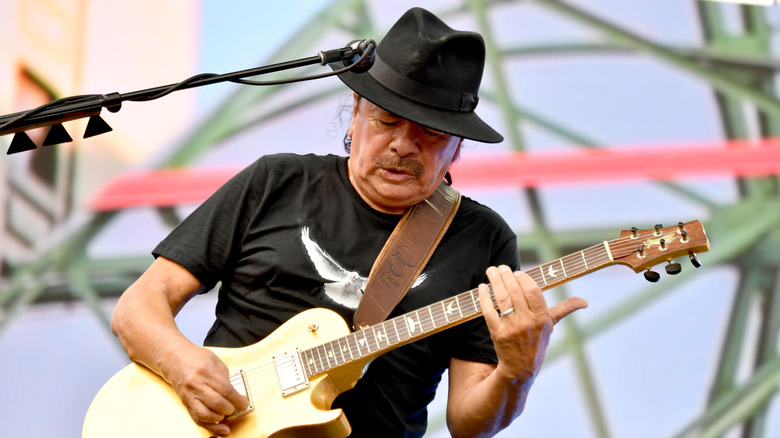
After an illustrious career in the late 1960s and 1970s as a jazzy, experimental Latin rock-jazz fusion band that hit it big with "Evil Ways," "Oye Como Va," and "Black Magic Woman," Santana — guitarist Carlos Santana's ensemble with an evolving lineup — eventually sputtered out. Santana landed the No. 15 hit "Hold On" in 1982, and then disappeared from the Top 40 for a while. The 1990 LP "Spirits Dancing in the Flesh" marked Santana's latest in a string of studio albums to not go gold or platinum, and Columbia Records, Santana's label since 1969, dropped the act.
After the 1992 Polydor album "Milagro" tanked, Carlos Santana didn't record anything at all for years. As the end of the '90s approached, he felt like making music again and he reached out to his old Columbia boss, Clive Davis, who'd since moved to Arista Records. Together they assembled and executed "Supernatural," an album featuring Santana's distinctive guitar and vocals by some of the era's biggest young acts.
The first single, "Smooth," was one of the final songs to gel. Rob Thomas, singer for the band Matchbox 20, sang on the demo, and rather than find a bigger star for the album cut, Santana chose Thomas. "Smooth" spent 12 weeks at No. 1, sold a million copies, won the Record of the Year Grammy Award, and inspired at least some of the 15 million purchases of "Supernatural." Santana then recorded three more star duets albums, including "Shaman," "All That I Am," and "Guitar Heaven."
Roy Orbison - In Dreams
With a booming voice evocative of both country balladeer and operatic tenor, Roy Orbison churned out a string of emotive rock 'n' roll hits between 1960 and 1966. Among Orbison's 22 Top 40 hits from the era: "Only the Lonely (Know How I Feel)," "Crying," "Candy Man," and "Oh, Pretty Woman," a classic rock song from the '60s worth a head-turning amount of money. Orbison thereafter struggled commercially after the '60s — his only Hot 100 entry was the Emmylou Harris duet "That Lovin' You Feelin' Again," which fizzled out at No. 55 in 1980.
The catalyst for a late 1980s Orbison revival was an older hit: "In Dreams" from 1963 was used to soundtrack some dark moments in the 1986 thriller "Blue Velvet." With a nod to that sync, Orbison released a new compilation, "In Dreams: The Greatest Hits," in May 1987, a few months after he was inducted into the Rock and Roll Hall of Fame. In 1988, the musician recorded a new studio LP, "Mystery Girl," but the triumphant comeback was cut short when the life of Roy Orbison came to a sudden end when he died in December 1988 at age 52 from a heart attack. In January 1989, the Mystery Girl" single "You Got It" entered the Hot 100 and would peak at No. 9, Orbison's first Top 10 hit since "Oh, Pretty Woman" reached No. 1 in 1964.
Fleetwood Mac - Silver Springs
Fleetwood Mac started out as a blues band then evolved into an elegant soft rock machine in the mid-1970s with the addition of Lindsey Buckingham and Stevie Nicks. Released in 1977, Fleetwood Mac's "Rumours" became one of the best-selling albums of all time, and the band's LPs sold well into the 1980s while also generating Top 40 singles. In 1987, Buckingham quit Fleetwood Mac, and following a tour in support of 1990's "Behind the Mask" — the band's first studio album since 1974 to not reach the Top 10 — Christine McVie and Nicks announced their intentions to leave, too.
The magic didn't end there, though. With all five members of its "Rumours" era lineup on board, Fleetwood Mac reunited for "The Dance," a 1997 MTV special with a corresponding live LP. A major highlight was "Silver Springs," written and sung by Nicks (and directed toward her bandmate and former partner Buckingham). It was originally intended for "Rumours," but ultimately didn't make the final cut — the tune instead was quietly released as the flip-side of the "Go Your Own Way" 45.
While a few live versions of older Fleetwood Mac songs from "The Dance" hit various lists, "Silver Springs" reached No. 41 on the Hot 100 Airplay chart and No. 5 on the adult contemporary chart. "The Dance" LP topped Billboard's album chart and sold 5 million copies. The refreshed Fleetwood Mac even went back into the studio, and the 2003 album "Say You Will" sold half a million units.
ABBA - Don't Shut Me Down
The Swedish pop-disco foursome ABBA split up in the 1980s, and it seemed as if the 1981 LP "The Visitors" would be its last album. Its members dispersed into various directions — Anni-Frid Lyngstad pursued a solo career, while Benny Andersson and Bjorn Ulvaeus collaborated on the hit stage musical "Chess." ABBA's work, however, never stopped attracting fans. Its greatest hits collection "Gold" — stocked with standards like "Dancing Queen," "S.O.S.," and "Waterloo" — became the second-best-selling LP ever in the U.K. (with more than 5 million copies sold), while it moved 6 million units in the U.S. "Mamma Mia!" — a globally popular stage musical constructed around ABBA songs — first opened in London's West End in 1999, on Broadway in 2001, and inspired a blockbuster 2008 film adaptation and a 2018 sequel.
All that quantifiable love for ABBA finally helped bring back ABBA. In 2021, ABBA closed a discography gap of 40 years with the album "Voyage." The single "Don't Shut Me Down" made the Top 40 of Billboard's Digital Song Sales chart and earned a Grammy nomination for Record of the Year. While ABBA itself didn't reunite for live shows, its members did sanction the creation of ABBA Voyage. Opening in 2022 in a specially built venue, it uses cutting edge technology to present life-like moving images of ABBA as it was in the 1970s performing its old songs.