

Hit Songs Rock Icons Refuse To Play Live
The studio-recorded and widely released versions of some of the most widely known and lucrative rock singles of all time will just have to suffice with fans — because the acts that made those classic tunes absolutely will not play them at their concerts. Rock bands and singers aim to please their audiences. And most of the time, the vast majority of those acts give paying customers what they probably came to a concert to experience: They play the hits. It's absurd for a band to not play the songs that made them rich and famous, but they've got some big reasons — of various degrees of understandability and regular-person relatability — informing the decision to excise those massive hit songs from the performance.
There are numerous instances throughout rock history of bands and solo artists deciding to drop one or more of their classic hits for years or forever. They might cut it right after its chart rise, or after years or decades, because of artists' feelings about their own work. is subject to change. Here then are some hit songs by major rock artists that you're not likely to hear played live anytime soon.
Hit Me With Your Best Shot
For professionally frustrated 1970s songwriter Eddie Schwartz, the answer was therapy. "It was this sort of experimental therapy, and one of the things we did was punch pillows," Schwartz told Nashville Scene. Schwartz left an appointment, and he said the words "hit me with your best shot" just came to him, and years later, he built "Hit Me With Your Best Shot" around those.
"Writing the song was an act of defiance against the music business that seemed to have no place for me," he said. Chrysalis Records signee Pat Benatar overheard a label employee playing Schwartz's demo of the song, and she wanted it for her 1980 album "Crimes of Passion." It peaked at No. 9, Benatar's first-ever top 10 hit, and it became a concert staple for more than 40 years.
But in 2022, Benatar said no more. While acknowledging that "Hit Me With Your Best Shot" was never supposed to be taken literally, she stopped performing it, to the disappointment of fans. "I'm sorry, in deference to the victims of the families of these mass shootings, I'm not singing it," Benatar told USA Today. "You have to draw the line. I can't say those words out loud with a smile on my face, I just can't."
Ramblin' Man
By a wide margin, "Ramblin' Man" is the biggest hit for the iconic Southern rock collective the Allman Brothers Band. It reached No. 2 on the pop chart in 1973 (no other song by the group peaked higher than No. 29), and the album on which it first appeared, "Brothers & Sisters," is one of the group's best-selling studio LPs, moving more than a million copies in the United States. It's quantifiably the Allman Brothers' best-known and most successful single, and so almost without question, fans would expect to hear the song if they attended one of the band's concerts.
However, into the '90s and beyond, "Ramblin' Man" lost its place of prominence. In 1992, late-guitarist Dickey Betts admitted that his band didn't perform it too often anymore because of musical fatigue. "We don't do it much because everybody is so used to it, including the audience," Betts told Ear of Newt. "They've heard it so many times that we'd rather do a song that they don't get a chance to hear very much."
Shiny Happy People
Helping to bring alternative music into the mainstream and taking rock to thoughtful, emotional places, R.E.M. is the '80s band that most deserves a comeback. However, the group actually reached its commercial peak in the first half of the 1990s. Three of its four LPs from that period went quadruple platinum, beginning with the 1991 album "Out of Time," which generated two of R.E.M.'s four Top 10 hits: "Losing My Religion" and "Shiny Happy People."
By the time the latter was issued as a single, R.E.M. had already moved on from the song. According to Setlist.fm, they only publicly performed "Shiny Happy People" twice: once in March 1991 for a Spanish TV show, and a few weeks later on "Saturday Night Live." An overtly and aggressively positive tune, "Shiny Happy People" is so slight as to be meaningless — and thus unworthy of re-creating live on stage — to R.E.M. singer Michael Stipe. "It was bubblegum music made for kids," Stipe told Mojo (via The Independent). "I don't hate it. But I don't want to sing it."
People are People
"People are People" exposed Depeche Mode to a wider audience more than any other song had to the point of its release. The anti-war, lightly industrial synth-pop dance song took the group into the Top Five of the U.K. pop charts for the first time and the Hot 100 in the U.S. for the first time in 1985, setting in motion the group's trajectory as one of the most important rock bands of the 1980s.
The single ultimately sold half a million copies in the States alone, so a lot of people clearly liked "People are People." Not among them: Depeche Mode founding member and the track's composer, Martin Gore. Although it's one of the band's biggest hits of the 1980s, Depeche Mode has barely performed it since the 1980s, simply because of the distaste of Gore, the man who wrote the song. "It's not one of Martin's particular favorites," lead singer David Gahan told Entertainment Weekly. "It's quite literal, very poppy, all major chords — something Martin doesn't like so much these days."
Just the Way You Are
"Just the Way You Are" is vital to the story of Billy Joel, as it was the musician's first Top 10 hit and won Grammy Awards for Song of the Year and Record of the Year in 1979. A sweet and earnest ballad about unconditional love, Joel wrote it for his first wife, Elizabeth Weber, as a birthday gift in the 1970s. After he performed the song — which begins with the line "Don't go changing / to try and please me" just for her for the first time, Weber asked, "Do I get the publishing too?" "In retrospect, I probably should have known right then and there that the relationship was doomed," Joel said in Fred Schruers' "Billy Joel: The Definitive Biography." "I had written 'Just the Way You Are' for someone who had changed."
The nine-year marriage ended in divorce in 1982. Joel later dumped the song about his now former wife from his performance repertoire for many years; by the 2010s, he'd roll out "Just the Way You Are" only on rare occasions. And yet it had already burrowed into the collective consciousness, and that gave Joel pause. "I always worry about people using this as their wedding song," he told USA Today. " I want to say, 'Hey, look what happened to me! You sure you don't want to think about this?'"
Big Me
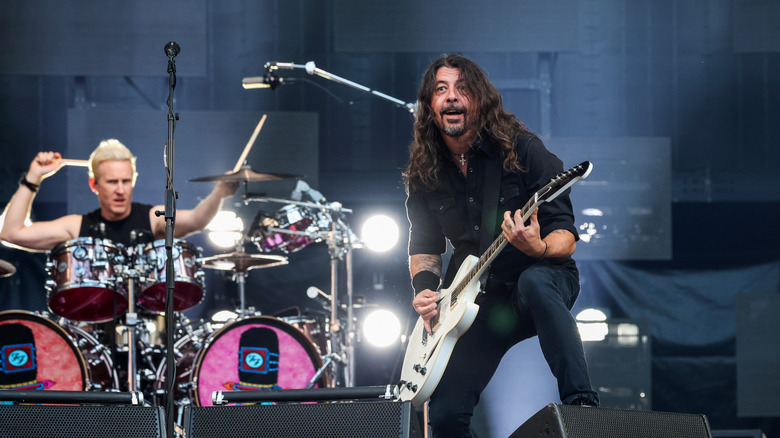
Within a year of Nirvana breaking up upon the 1994 death of Kurt Cobain, drummer Dave Grohl recorded an album under the name Foo Fighters, singing and playing everything but one guitar part. Then he put together a band so he could play his songs live, including the early single "Big Me." A No. 3 alternative rock radio hit, its success was helped along by a humorous music video that parodied the bizarre Mentos commercials of the 1990s.
"Big Me" won Foo Fighters "Best Group Video" at the 1996 MTV Video Music Awards, and during his acceptance speech, Grohl addressed a problem that had developed. "Stop throwing Mentos at us, at our shows. That's what I'm trying to say," he said (via TikTok). "But thank you very much." Around the time of the video's production, guitarist Pat Smear accurately posited that the clip would result in such audience behavior. It got to be such an unruly tradition to hurl Mentos at Foo Fighters that Grohl had to put an end to it. "We did stop playing that song for a while because, honestly, it's like being stoned. Those little things are like pebbles — they hurt," he told the AP in 2006. After purposely not doing "Big Me" live for nearly seven years, the band started playing it again, inspired by tour-mates Weezer's cover.
Stairway to Heaven
It's one of the most ubiquitous and most successful rock songs ever, and more than 50 years since its release, Led Zeppelin fans still can't get enough of "Stairway to Heaven." The epic, multi-part ballad is still and historically one of the most-played tunes on classic rock radio stations while also accruing more than 1.2 billion plays on Spotify. Because Led Zeppelin wouldn't let it be issued as a single in the U.S., for decades, anyone who wanted to hear it had to buy the album "Led Zeppelin IV," and that restriction led to sales of 24 million copies.
For years, singer and lyricist Robert Plant has been eager to shut down "Stairway," wanting to leave it in 1971. "My contribution was to write lyrics and to sing a song about fate and something very British, almost abstract, but coming out of the mind of a 23-year-old guy, you know, and it landed in the era of 23-year-old guys." Plant told AXS TV. Recent performances are scarce. Plant was so unhappy with his take at Led Zeppelin's Live Aid reunion set in 1985 that he planned on skipping it on another reunion show, but ended up singing it. Plant wound up performing "Stairway" at a 2007 Led Zeppelin show and during a 2023 benefit concert, and that's it.
Eat It and Fat
Musical parody artist "Weird Al" Yankovic gained traction in the early 1980s for his spoofs of popular songs, but his career exploded when he took on the era's biggest superstar, Michael Jackson. In 1984, Yankovic's "Eat It," a send-up of Jackson's smash "Thriller" cut "Beat It," went all the way to No. 12 on the pop chart. When Jackson returned in 1987 with an album and single both called "Bad," Yankovic responded with another food-centric parody, "Fat." That track scraped into the Hot 100, peaking at No. 99. "Eat It" and "Fat" became two of Yankovic's most familiar songs.
"Eat It" and "Fat" were concert staples, but just until 2019. Rumors, allegations, and lawsuits relating to Jackson's alleged history of abusing children had been in and out of the news since the early 1990s, but the public was more directly confronted with the matter via the 2019 HBO documentary series "Leaving Neverland," which included interviews with multiple Jackson accusers. The discourse prompted Yankovic to cut both "Eat It" and "Fat" from his tour's set list. "I don't know if that's going to be permanent or not, but we just felt that with what's happened recently with the HBO documentaries, we didn't want anybody to feel uncomfortable," Yankovic told Billboard.
Tears in Heaven
Eric Clapton is loathed by other musicians, but he's still regarded as a talented guitarist and important rock figure, albeit one with fallow periods. After hitting the Top 10 with "I Can't Stand It" in 1981, he didn't land another single in that zone until 1992, when "Tears in Heaven" made it to No. 2. Originally appearing on the soundtrack to the movie "Rush," the sad ballad won the Grammy Awards for Song of the Year, Record of the Year, and Best Pop Vocal Performance, Male, and a version was a highlight of Clapton's "Unplugged" album, the Grammy winner for Album of the Year. Clapton's comeback was sealed, but it came at a tremendous cost. "Tears in Heaven" contains some of the saddest lyrics in all of rock history — Clapton composed it after his 4-year-old son, Conor, died after a fall from an open high-rise window.
Among Clapton's most famous works, "Tears in Heaven" earned a spot in his shows. Then in the early 2000s, Clapton realized he didn't want to perform it, nor "My Father's Eyes," a song about the death of his father, any longer. "I didn't feel the loss anymore, which is so much a part of performing those songs," Clapton told the Associated Press (via NBC's Today) in 2004. "I really have to connect with the feelings that were there when I wrote them. They're kind of gone and I really don't want them to come back, particularly. My life is different now."
Brown Sugar
Raucous, bluesy, and gritty, "Brown Sugar" is a definitive Rolling Stones song. The opening cut on the 1971 album "Sticky Fingers," "Brown Sugar" spent two weeks at No. 1 in 1971. It's a story song as well as a lascivious one, and it's also quite blunt about its potentially disturbing subject matter. It opens with a stanza about kidnapped Africans trafficked into slavery in the American South, where they're physically abused. The chorus implies some kind of predatory sexual activity; the title of the song is a nickname for a young woman of color.
Over the span of five decades, Setlist.fm says that more than 1,100 Rolling Stones concerts featured "Brown Sugar." And then, without announcing its plans, the band quietly cut "Brown Sugar" from its performance list. As of 2026, the last time that the Stones played the song live was during a concert in August 2019. Guitarist Keith Richards suggested that the social and political conversation had changed to the point where "Brown Sugar" was no longer broadly acceptable. "At the moment I don't want to get into conflicts with all of this s***," he told the Los Angeles Times. Mick Jagger confirmed the deletion but stayed obtuse regarding the reasons. "We've played 'Brown Sugar' every night since 1970, so sometimes you think, 'We'll take that one out for now and see how it goes,'" the vocalist said. "We might put it back in."
It's a Long Way to the Top (If You Wanna Rock 'N' Roll)
One part of the formula that made AC/DC one of the world's all-time top-selling rock 'n' roll bands: rock 'n' roll songs about rock 'n' roll. Long before hits like "Rock and Roll Ain't Noise Pollution" and "For Those About to Rock (We Salute You)," AC/DC gave the idea a try with "It's a Long Way to the Top (If You Wanna Rock 'N' Roll)." The lead-off track on the 1975 LP "T.N.T," the song was a Top 10 hit in the band's home country of Australia and belatedly reached the U.K. pop chart five years later.
AC/DC presented "It's a Long Way to the Top (If You Wanna Rock 'N' Roll)" at '70s gigs, primarily in 1975 and 1976. After that, the song emerged once a year in 1977, 1978, and 1979, and was then permanently retired not long after the tragic death of AC/DC's Bon Scott, singer and bagpiper, in early 1980. Replacement singer Brian Johnson didn't want to approach a song so associated with Scott, but technical concerns were a factor. "I think it had a lot to do with the bagpipes," AC/DC bassist Mark Evans told Noise11. There's a bagpipes section of the song, and it proved annoying for the rest of AC/DC to tune their instruments while onstage to match the key of the bagpipes needed for "It's a Long Way to the Top (If You Wanna Rock 'N' Roll)."
The Creedence Clearwater Revival catalog
For the most part, Creedence Clearwater Revival was John Fogerty's band. The frontman wrote the vast majority of the swamp rock band's output in the late 1960s and early 1970s. After CCR disbanded, the singer-songwriter-guitarist embarked on a solo career, but fans who went to his concerts to hear CCR hits would've been sorely disappointed. For more than 10 years, he avoided singing or playing those songs so they wouldn't generate income for his adversary. CCR's music was staunchly controlled by the band's old label, Fantasy Records, and its leader, Saul Zaentz.
An event led Fogerty to soften his approach. Over the 1987 Independence Day weekend, a concert to thank Vietnam War veterans for their service was staged outside Washington, D.C. Organizers asked Fogerty to participate, who carefully considered the weight of the event. "I was thinking about what all this meant because these were my guys," Fogerty, whose Vietnam War-inspired CCR song "Fortunate Son" was a seething anti-war protest song, said in an archival interview he posted on Instagram in 2025. "I wanted to make sure that whatever I did was deferential, had enough honor in it." And so, Fogerty ran through seven Creedence Clearwater Revival chestnuts that night. "I just got over it for one day and did my old songs," he explained.