

Music Icons Whose Best-Known Songs Are Actually Covers
A signature song is a mark of success as a singer: If nothing else, it implies that you've got at least two songs, the signature and a secondary, non-signature song to warm up the crowd. But some performers who have made songs their own weren't the first to record their trademark tune. There's no shame in it: No one would call Whitney Houston, for example, a cover singer, even though her operatic "I Will Always Love You" was born with a Tennessee accent.
Some artists just change a quick pronoun to make the song's subject match the gender they'd rather sing about; others get under the hood and bash around, making the song something very different from the initial version that sparked their interest. Ranging from straightforward new versions to near-total refurbishments, every song on this list had already been recorded when it came to the attention of a skilled performer and made them take notice, thinking, "Hey, I could really do something with this." From the Fugees' masterful version of a '70s classic to the Animals' cover of an old Appalachian folk song, these exemplary tunes from household names have a little more history than you may know.
I Love Rock 'n' Roll — Joan Jett
Joan Jett's 1981 version of "I Love Rock 'n' Roll," recorded with her band the Blackhearts, is one of the tracks you'd use to explain "cool" to space travelers after first contact. The sassy, energetic vocals are classic Jett, powerful on their own but electric if chorused by a hyped-up crowd (or one person alone in their apartment, amping themselves up to deep-clean the oven). The song would be timeless if not for an inadvertent time capsule. The chorus repeats "So put another dime in the jukebox, baby," which at today's jukebox prices will get you 15 seconds of a soundalike version of a real hit, some uncanny-valley jam like "Mambo No. 6" or "40 Ways to Leave Your Lover."
Jett's famous version is a cover twice over. Her first attempt to cover the song in 1979 didn't go anywhere, languishing as a B-side, but Jett apparently believed in the tune enough to try again and give us the song we know today. But it's not originally a Jett joint: She first heard the original of the song, laid down by a British group called the Arrows, on a late-'70's tour of the U.K. with her prior group, the Runaways. The rest of the band didn't like the song, so Jett did it without them.
Me and Bobby McGee — Janis Joplin
You gotta be careful with Janis Joplin.
The untrained quality of Janis Joplin's vocals was key to her success, allowing her to take risks more polished singers might have avoided, as well as connect with her audiences with a shining authenticity that '60s music lovers drank right up. But just because Joplin's unusual vocals weren't polished and standardized by conventional vocal techniques doesn't mean her unique sound is easy to emulate, and many a karaoke hopeful has been stranded during the back half of "Me and Bobby McGee," unable to replicate the charisma of the wordless vocalizing that makes up much of the last part of the track. They can only watch, transfixed, as the audience goes back to their drinks.
Joplin made the song her own, but she didn't make the song. "Me and Bobby McGee" was originally a Kris Kristofferson song (about a woman, inspired by her misheard name, Bobby McKee). The rhythm of the name mingled with Kristofferson's musings about freedom after having watched a Fellini film, and so the song was born. Kristofferson's version is less gleeful than Joplin's ode to memories of transient happy times, made tragic only in retrospect by Joplin's early death. He only heard it after her passing, but Joplin's recording hit Kristofferson so hard he binged the track so he could hear it without crying in public.
House of the Rising Sun — The Animals
It almost feels disingenuous to refer to "House of the Rising Sun" as an Animals song when so many people think of it as a Creedence Clearwater Revival song. Or a gem from Toto's back catalog. Or proof that Dolly Parton can (and will) do whatever she likes. Or an interesting diversion from what you expect from the Supremes. Or an obvious Leadbelly standard. And so on through hundreds of versions: The chilling, sexy-dangerous tune and the ominous lyrical warnings of the destructive power of living for pleasure make performers flock to it. Not quite a murder ballad, but with that same aura of crime and cautionary tale, the tune is also not all that difficult: not quite easy, but if you can sing, you can probably do "House of the Rising Sun."
It's a folk song, originally, which is not quite obvious from modern recordings but evident when you examine it. The first known recording of the song is from 1933, by folk singer Clarence Ashley, but Ashley himself identified it as a folk song long known in Appalachia before he laid down his version. Beyond that, the origins are lost to the communal, casual nature of true folk music. If some specific poor boy's original jaunt down to New Orleans and subsequent ruin initially inspired the song, the specifics are lost to time.
Crazy — Patsy Cline
If you're ever scrolling through a jukebox anywhere in the English-speaking world and it doesn't have Patsy Cline's "Crazy," get out of there. It's a trap at best; at worst, it's a bar that assumes no one will ever need to hear Cline's perfect-down-to-the-breath statement of heartbreak. Sometimes people need to cry in a bar, and "Crazy" is nature's way of making sure that happens. Cline's version of "Crazy," though occasionally covered, is simply one of the finest tracks ever laid down in the history of recording technology. It also wouldn't have happened if Cline's husband, Charlie Dick, hadn't run into Willie Nelson in a bar in Nashville.
Nelson had written and recorded "Crazy" and didn't like his own version (though he's re-recorded and re-released it since). Dick loved the song so much he went right home to wake up his wife and play it for her — spare a thought for poor Patsy, asleep, suddenly being told that she needed to get dressed because Willie Nelson was there and he was going to play her a sad song. Cline went into the studio and tried to sing it like Nelson had, but after a producer convinced her to sing it like Patsy Cline would, they had a hit. It's been making eyes misty and Nelson's bank account beefy ever since.
Respect — Aretha Franklin
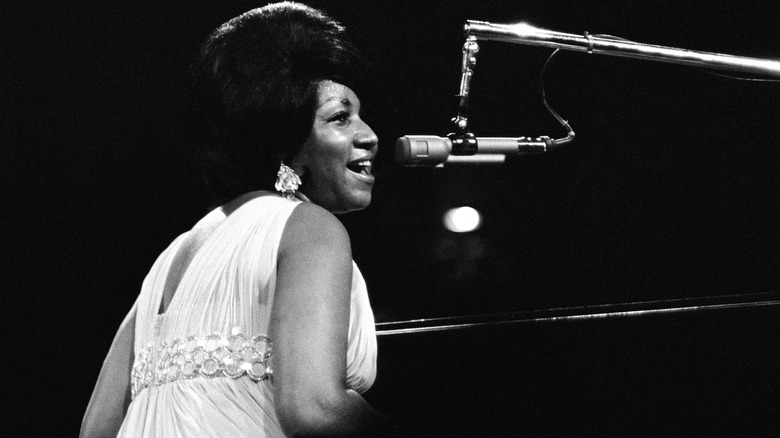
Aretha Franklin's version of "Respect" is, in the truest sense of the word, anthemic. The 1967 track is a triumph in its own right, but it also landed at exactly the right time. Women, Black Americans, queer people, and other groups were challenging American power structures that relegated them to secondary (at best) statuses in society, and the straightforward, unapologetic "Respect" was exactly the song for the moment. Plus, it was cool, sitting right at the crowded intersection of soul and rock and taking up as much space as it needed. "Respect" became Franklin's signature song, an achievement in itself, given the singer's expansive catalog of bangers; she charted five songs in 1967 alone. The song even gave its title to the 2021 Franklin biopic.
But before "Respect" was directed at the flawed society surrounding Aretha Franklin, it had a narrower addressee: a woman treating Otis Redding badly. Redding's version, though excellent, reads much more as a personal heartbreak song, and while it charted, it wasn't the sensation Franklin's version became. Franklin's energy, willingness to experiment, and lyrical tweaks — she added the spelling and the "sock it to me" — turned a good song into a stellar one that would fly up the charts. And while other artists have covered it in the decades since, the song remains unquestionably Aretha's.
Killing Me Softly — The Fugees
The Fugees' cover of "Killing Me Softly" is a master class in covering a song. It's a clear departure from the previous version by Roberta Flack, adding a sample of a sitar lick and hip-hop touches around the edges to make it the Fugees' own, but still centering an excellent, clear female voice and allowing the lyrics, some of the best in the pop music catalog, to contribute to the magic. Both takes hit No. 1 on the Billboard charts, and both deserved to, with each being standout tracks with their own vibe.
Flack's version is more straightforward, a dreamy, very '70s rendition that, while less showy, is more intimate than the Fugees' version, arguably matching the vibe of the lyrics better. But even Flack's recording isn't the original. Flack heard the original version on a flight and loved it, pulling it from the obscurity of in-flight filler. That first version had been performed by Lori Lieberman, with differing accounts of its origin. The credited songwriters, Norman Gimbel and Charles Fox, deny this, but Leiberman's story is that at 19 years of age, she saw a performer whose work so touched her heart that she wrote initial notes for "Killing Me Softly" on a cocktail napkin. That guy was Don McLean, best known for the notoriously lengthy "The Day the Music Died," almost universally known as "Miss American Pie."
Girls Just Want to Have Fun — Cyndi Lauper
Cyndi Lauper pulled off quite a trick with "Girls Just Want to Have Fun." Her signature song is a bright, poppy, and light empowerment anthem: It has a message, but it doesn't fall into the easy trap of being preachy. For many people, the song isn't just the centerpiece of Lauper's recording career, but a shorthand for a certain '80s vibe. Indeed, Lauper and her cohort of playful '80s musicians were a much-needed corrective to the bleak cash-grab greed-is-good economy of the time. But Lauper's essential track, the unofficial soundtrack of putting on makeup to go out for decades, was first recorded by a man.
From Philadelphia. Robert Hazard's version is almost unrecognizable, with impressive guitar work but a weird, gooey vocal delivery that makes the lyrics hard to parse. Lauper, who saw him live, apparently understood enough of what Hazard was warbling to pick out the tune and rejigger the lyrics, making them less about female sexuality and more about female opportunity. Hazard never quite made it big, but his name was on every unit of Lauper's version that ever sold.
I Will Always Love You — Whitney Houston
Very few human beings have ever had a voice as powerful as Whitney Houston's. She could control it exquisitely, singing gently when the song needed it, but when she was ready to belt — stand back. "I Will Always Love You" became one of her best-known songs because it allowed her to showcase her range, less in terms of pitch than in terms of sheer force. Houston could kiss a butterfly on the cheek or she could out-blast an entire brass band, and she does both in her iconic recording of "I Will Always Love You." The track far outperforms that of the movie it was featured in, a forgettable romance called "The Bodyguard." But "I Will Always Love You" had earlier appeared in a very different movie, a sexy musical comedy starring Dolly Parton and Burt Reynolds.
"The Best Little Wh***house in Texas" was an existing stage musical, but for the movie version, Parton pulled out a song she'd written over the breakup of her creative partnership with Porter Wagoner. Parton's softer, more wistful version doesn't feature the Tennessee titan belting, with Parton instead opting for a more intimate and exquisitely tearjerking version.
Dolly loved Houston's version, but no one warned her it would be on the radio. By her own telling, it caught her by surprise the first time while she was driving, and she had to pull over to listen to avoid crashing the car.
Nothing Compares 2 U — Sinéad O'Connor
It's the song that forced the world to learn how to pronounce "Sinéad." Sinéad O'Connor hit the tender hearts of 1990 like a truck full of sledgehammers with "Nothing Compares 2 U," a no-nonsense tearjerker that showed off O'Connor's powerful delivery, exquisite phrasing, and convincing earnestness. The song's success was buoyed by a memorable music video that mostly features O'Connor's face, close in and under her famous and then-controversial cropped hair, singing into the camera. And at a key point, tears roll, but it doesn't knock O'Connor off her stride. You can also see Prince's fingerprints on the track; it's right there in the "2 U."
Prince had been producing a band called the Family, and in a burst of inspiration dashed off the lyrics for "Nothing Compares 2 U" in an hour. The Family's version didn't go anywhere, but it somehow came to O'Connor's attention. Prince apparently hated O'Connor's recording, as he generally did covers of his work. He had recorded his own version shortly after the song was written, but it was never released during his lifetime, only coming out in 2018. Why the famously enigmatic singer did so is unclear, but just maybe he decided that the heartfelt O'Connor could have this one.
Bette Davis Eyes — Kim Carnes
If you've ever seen a Bette Davis film, you'll understand how a song got written about her eyes. Huge and expressive, they inspired plenty of Hollywood directors and casting agents during the star's heyday, and enough people remembered their power that Kim Carnes' "Bette Davis Eyes" could rocket up the charts a generation after the star's peak fame. Carnes delivers the song, which is not about Davis herself but about a captivating woman with movie-star charisma, in a coy rasp that adds to the mystique of the mystery woman. It sounds like we're seeing this person from across the room, through a smoky haze. But Carnes wasn't the first person to sing the story of this femme fatale with the captivating gaze. That honor goes to Jackie DeShannon, who had written the song with Donna Weiss.
The songwriters were fans of Davis and ultimately wrote about the star's key feature, but the version DeShannon recorded is a million miles from Carnes'. DeShannon's take is bouncy and boisterous, more of a saloon gal than an enigma. It's a fun track, but it's not the triumph of mystery and seduction that Carnes' is. Not that DeShannon and Weiss, who won a Grammy for the song after the Carnes version blew up, have anything to be disappointed about.
Hound Dog — Elvis Presley
It's admittedly hard to assign a single most-famous song to Elvis Presley, but "Hound Dog" has to be on anyone's short list. It's got the bouncy vitality that shows the young Elvis at his best, and even today, it's exciting enough that you can imagine a scandalized '50s parent confiscating the vinyl from an overwrought teen. "Hound Dog" wasn't written for Elvis, though, but explicitly for Willie Mae Thornton, who performed blues as Big Mama Thornton.
With a large, imposing voice and, reportedly, an even bigger attitude, Thornton had colossal stage presence. Songwriters Mike Stoller and Jerry Lieber, inspired by Thornton's force-of-nature vibe, wrote "Hound Dog" for Thornton because, in 1952, they couldn't expect much success with the expletive-heavy lyrics they initially imagined. So, "Hound Dog" it was.
Bad blood followed the song. Thornton resented Elvis for, as she saw it, stealing her song, while a lawsuit between Stoller and Leiber on one hand and producer Johnny Otis on the other saw Johnson stripped of his co-writing credit and the associated royalties. Plenty of hound dogs all around, depending on who you ask.