

The 5 Best Duets In Folk Rock History
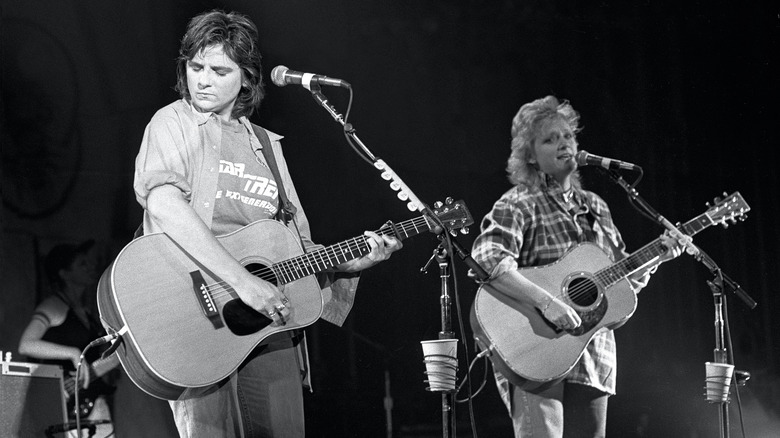
By definition, folk music and its offshoots are vocal-forward arts, and the right combination of voices can turn a simple song into something more resonant and enduring than it could ever be solo. Folk is historically an oral tradition, as it is both literally and metaphorically the voice of the people, and the right interplay of vocals can add a communal dynamic that matches the genre's inherently collective nature. Whether it's a group with multiple vocalists or a collaboration between artists, folk and sister genres like folk rock often thrive when shared, like in duets.
In selecting the best duets in folk rock's history, we picked songs that all share a certain level of critical acclaim, commercial success, and lasting legacy, but that otherwise vary enough to give an idea of the genre's true depth. From the classic folk of Simon & Garfunkel to the unique experimentations of Led Zeppelin, all the way to the borderline alt rock of the Indigo Girls, folk rock has a huge variation in sounds with which to speak for the Average Joe and Jane. To honor one of music's most unembellished and insightful genres, here are five of the best duets in the history of folk rock.
Closer to Fine — Indigo Girls
Younger readers may know the Indigo Girls' signature "Closer to Fine" from its prominent inclusion in the 2023 mega-hit movie "Barbie," but the duo had been defining and redefining socially conscious folk for decades before they were helping movie dolls self-actualize. Self-actualization was always on offer, as the quest for it is the main crux of the meaning of "Closer to Fine." Its story, written by Indigo Girl Emily Saliers, is about the search for an overarching meaning to life and then the ultimate acceptance that no single answer exists. The "crooked line" is the best path.
Many folk duets use their vocal parts to create two separate but complementary perspectives, using differentiated melodies to highlight or contrast each other. The Indigo Girls did that plenty when the songs called for it, such as parts of "Ghost" and "Power of Two," but for a song like "Closer to Fine," which is about a primal, shared urge, they stick mainly to straightforwardly doubling each other in harmony (with the only exception being Amy Ray's background "The less I seek my source" during the chorus). The overall effect of that doubling, along with both Girls jumping up their register, is a refrain that soars, sounding like a revelation shouted from a mountaintop. For many of their listeners, the song was actually a revelation, proving the harmonies on "Closer to Fine" to be the right choice.
The Boxer — Simon & Garfunkel
Simon & Garfunkel were the ultimate duo of their time, and their final studio album, "Bridge over Troubled Water," is all the proof needed. Aside from the title track, which is regarded as one of the best folk tunes ever penned (and of course the merry, catchy "Cecilia," which the band Fun cribbed for their hit "Some Nights"), the album's other standout is "The Boxer," a deeply melancholic ballad about being down on your luck and battling through adversity.
Despite an incredibly intensive recording process that took more than 100 hours and brought in instruments as rare as the bass harmonica (which among other bits is responsible for the deep and ominous booming starting around the 4:20 mark), the end result is a song that is as simple sounding and universally relatable as any true folk classic. The song's two protagonists, the "poor boy" and the "boxer," are one and the same, because they are both Paul Simon, who felt compelled to cry out "in his anger and his shame / 'I am leaving, I am leaving'" upon receiving the group's first negative feedback.
Part of the complicated beauty of "The Boxer" is the gentleness of its sound in contrast with its bleak lyrics. Some of that gentleness is generated by the "lie la lie" refrains, but another big piece is Art Garfunkel's harmonies, which sound almost angelic. Without Garfunkel's tenor, "The Boxer" might have been too dour to hit the way it did.
Girl From the North Country — Bob Dylan and Johnny Cash
Bob Dylan's "Girl From the North Country" is the perfect track to scientifically analyze the effect of a duet, because Dylan first recorded it solo in '63 and re-recorded it as a duet with Johnny Cash in '69. In the original, Dylan's solo voice is as elegiac as ever, and the song feels like a tiny, sad, trembling version of itself — far from a detriment, that smallness gives the song its lasting, wistful charm. But the duet with Cash adds an intangible element that makes the second recording just as poignant and affecting as the first in its own way.
Dylan and Cash's version, one of Cash's best collaborations, is noticeably slower, which makes sense, given Dylan had aged since the original and Cash was always happy to slow things down and let them breathe. Another change is the shift from the original's more continuous fingerpicking to the duet's plodding, relatively staccato chords. Together, the two changes add empty space, which allows the pair's crooning vocals to linger and assume control of the song. Further emphasizing this control is the pair's choice to sing some sections simultaneously but just out of sync, which again forces the listener to lock in on their voices in order to sift between them. Cash's dueting vocals on "Girl From the North Country" take an already stellar song and show us what happens when it's able to really stretch its melodic legs.
The Battle of Evermore — Led Zeppelin
Though Led Zeppelin is a hard rock band through and through, their bucolic lyrics and frequent emphasis on Jimmy Page's acoustic guitar playing tended to veer into the world of folk rock from time to time, a place where they shined (almost) as brightly as ever. Unlike some of their forays, which were only partially stripped down and de-glammed, "The Battle of Evermore" is a pure folk rock piece, comprised solely of acoustic guitar, mandolin, and the dueling voices of Robert Plant and guest vocalist Sandy Denny — Zeppelin's only guest vocalist ever.
Denny's vocal part in "The Battle of Evermore" is more creative than most. The vast majority of her duties seem almost entirely separated from Plant's. She occasionally harmonizes with him, like during the brief choruses, but mainly, she seems to be on her own mission. While Plant acts as the teller of a story about a war between good and evil, Denny, in her mourning wails, seems to be a bard within the story itself. She addresses the inhabitants of Plant's fictional world with warnings like "throw down your plough and hoe / Rest not to lock your homes" and rallying cries like "war is the common cry / Pick up your swords and fly." To put it in the parlance of one of Plant's favorite book series, Plant acts as J. R. R. Tolkien and Denny as his Gandalf, shepherding and inspiring the story's populace to action. That pairing worked the first time, just as it does on "The Battle of Evermore."
Fairytale of New York — The Pogues feat. Kirsty MacColl
The Pogues' 1987 ballad "Fairytale of New York" is a standout example of what folk rock does best: take a slice of ordinary life and crack it open to reveal its profound and permeating core. In this case, the slice is a longtime couple on a Christmas Eve night out in the city (plus another Christmas Eve with one in the drunk tank), and the core is the ocean of history and emotion shared between these random people — simultaneously insignificant and all-important, hyper-specific yet universal.
The story behind "Fairytale of New York" is long and involves years of writing, rewriting, and passing between producers, but the song that emerged is worth it. Its tale unfurls non-chronologically and weaves the miniature victories and defeats of a (drunken) night out into a modern epic (very similar to perhaps the most famous piece of Irish literature, James Joyce's "Ulysses").
The song's emotional climax is its pitch-perfect final verse, which only works because of its two voices: Pogues frontman Shane MacGowan and guest singer Kirsty MacColl. "I could have been someone," sings MacGowan. "Well, so could anyone," answers MacColl, "You took my dreams from me when I first found you." MacGowan reveals, "I kept them with me, babe, I put them with my own / Can't make it all alone, I've built my dreams around you" — lines that just gut you, especially after the darkness that preceded them in earlier verses. MacColl's duet ensures both sides say their piece, which turns the ballad from bitter to bittersweet.