

'60s Drum Solos That Blew Audiences Away
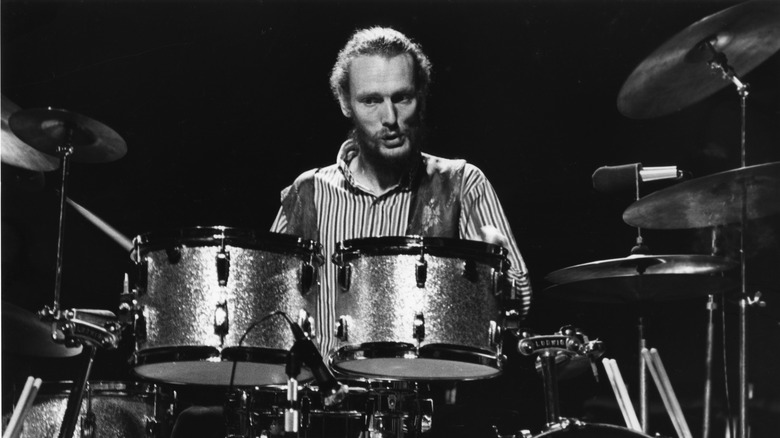
When talking about the many iconic drum solos in the decades-long history of rock music, the 1960s are typically a great place to start, given how quickly rock was evolving, especially in the decade's second half. After all, that was when the likes of Cream's Ginger Baker and Led Zeppelin's John Bonham first broke out as major rockstars. But that's not to say these early purveyors of hard rock were the only ones who created masterful drum solos that blew audiences' minds. That's why we're going to look at five drum solos from 1960s songs that left fans' mouths gaping back in the day, while continuing to do so as modern audiences discover or revisit their music.
In a conventional band setup, the drummer is the quarterback, catcher, and/or point guard of the entire unit. It is typically their job to maintain a steady tempo and lead the way for the rest of the band to do their thing onstage or in the studio. But every once in a while, drummers have a chance to show off with some intricate rolls and fills, with little or no accompaniment to allow them to shine. When executed perfectly, these solos can stand out in the hearts and minds of fans as all-time moments from their favorite drummers, as these have.
Wipe Out — Ron Wilson
There's one key reason why the Surfaris' instrumental track "Wipe Out" is one of those 1963 rock hits that sound even cooler in present times: the drums. From the very first second of the song, Ron Wilson's quick and powerful drum rolls push the song forward, with the repetitive but irresistibly catchy main guitar lick taking over after the intro. But it's during the breaks in between these lead guitar parts where Wilson earned his place in rock history. Listen carefully and notice how each of these brief drum solos (at least in comparison to the others in this list) sound so steady until the final roll, which gets progressively more complex with each repetition. That requires superb control and fluidity, and Wilson had a surplus of each of these key drummer attributes.
It's fair to say that Wilson's drum solos on "Wipe Out" played a vital role in the song's rather unique chart success — it peaked at No. 2 on the Billboard Hot 100 in the summer of 1963 and reentered the charts three years later, reaching No. 16 in October 1966. And, as Classic Bands wrote, the "Wipe Out" solos were the "yardstick for every aspiring young drummer in the early '60s." For many a drummer, that might have remained true decades later, even with the rise of oftentimes heavier sub-genres of rock than the surf rock the Surfaris specialized in.
Toad — Ginger Baker
Cream released only four albums during their two-plus years together, making them one of the best examples of bands that broke up as they were making it big. As such, one can speculate that their drummer, Ginger Baker, would have likely come up with many more mind-blowing solos for Cream, had frequent infighting not led to their premature breakup. Even then, he was able to leave jaws dropping with an extended drum solo in the instrumental track "Toad," fully utilizing the entire kit without sounding the least bit awkward. And while the three-minute-plus version on Cream's 1966 debut album "Fresh Cream" is impressive enough, Baker leveled things up even further in the live version on 1968's "Wheels of Fire" — we're talking a good, uninterrupted 13 minutes out of the song's 16-minute runtime.
Although not as beloved as many of Cream's non-instrumental tracks, "Toad" maintained a presence in pop culture well after its release, notably appearing in multiple scenes in the 1995 Martin Scorsese movie "Casino," including the one leading to Sam "Ace" Rothstein (Robert de Niro) and Nicky Santoro's (Joe Pesci) contentious stand-off in the desert. Baker's solo (the "Fresh Cream" version, to be specific) does such an excellent job setting up the tension between both men, while also offering another example of how Scorsese has a knack of choosing the right classic rock song for the right moment in many of his films.
In-A-Gadda-Da-Vida — Ron Bushy
Surely, one would expect a 17-minute song that is widely considered an early example of heavy metal to include at least one drum solo. Fortunately, that is the case with Iron Butterfly's 1968 track "In-A-Gadda-Da-Vida," and the main drum solo on this one, courtesy of Ron Bushy, stands out from our previous two entries because of how it isn't all about speed, power, and/or volume.
The first solo actually starts out comparatively quietly at around the 6:23 mark, using soft-loud dynamics throughout its nearly three-minute duration. It then ends just as softly as it started, but just when you think Bushy is done showing off on the skins, he launches into another, consistently loud solo slightly past the 13-minute mark. This one isn't as long, and he's largely accompanied by singer-keyboardist Doug Ingle and lead guitarist Erik Brann's psychedelic noodling, but it's just as impressive several decades after the song's release.
While Bushy isn't a household name like most of the other drummers in this list, his solos on "In-A-Gadda-Da-Vida" apparently helped inspire Beatles drummer Ringo Starr's own iconic late-'60s solo on "The End" – which we'll be getting to in a bit. And the song itself has left its mark on pop culture, particularly through its use on "The Simpsons," during a scene where Bart (Nancy Cartwright) swaps the official church hymn with one called "'In the Garden of Eden,' by I. Ron Butterfly." It kind of makes you wonder how the poor church organist tried to replicate Bushy's drum solos on that "rock and/or roll" classic.
Moby Dick — John Bonham
Anyone with little to no knowledge of Led Zeppelin would be forgiven for skipping to the next track on 1969's "Led Zeppelin II" after hearing the first minute of "Moby Dick" — it starts out as a standard blues-rock instrumental with nothing special to set it apart from the rest of the album. But true fans know that John Bonham's nearly three-minute-long drum solo is what makes the song one of the standouts from Led Zeppelin's second album, despite the deliberate absence of Robert Plant's powerful lead vocals. That solo, along with its various live versions, is among the highlights of a career that ended way too early after Bonham's tragic death in 1980.
This is another solo that starts out soft and understated, but it doesn't take long for Bonham to show why he would go on to become one of rock music's greatest drummers ever. The first minute and change sees Bonham using his bare hands to bang on the toms and the congas, before he seamlessly goes back to using his drumsticks for the rest of the solo. All throughout the solo, Bonham's signature triplets can be heard, typically delivered with lightning speed. And most impressively, he doesn't noticeably fall out of the pocket during the solo. Staying within a song's tempo while performing simpler drum solos is hard enough on its own, but doing so while playing a solo as long and complex as the one on "Moby Dick"? That's the mark of a true drumming legend.
The End — Ringo Starr
Even with solos like the one on the aptly named last full track on The Beatles' 1969 album "Abbey Road," Ringo Starr is still considered underrated by many a music fan. But he had a great feel for what to do and what not to do as his band's timekeeper, and what he needed to do on a song like "The End" was to show that he's capable of pulling off pretty nifty solos.
As noted earlier, Starr borrowed a bit from Ron Bushy's tribal-influenced drum solo on Iron Butterfly's "In-A-Gadda-Da-Vida," and while his was much, much shorter, Starr's solo on "The End" was long enough to properly showcase a steady, pounding kick drum punctuated by some creative rolls on the toms and the snare. The solo wraps up just short of 15 seconds, with a simple ending that effortlessly transitions into the extended instrumental break. It may be among the shortest solos on this list, but that's just how many Beatles fans like it — simply put, it's a perfect fit for the song's structure. Ultimately, "The End" may not be the last song all four Beatles recorded together (even if it can feel that way), but it allowed everyone in the band to flex their skills to the fullest in their final months as a group, with Ringo arguably the biggest star of the show thanks to that short but sweet drum solo.