

The 5 Best Bee Gees Songs For Dancing
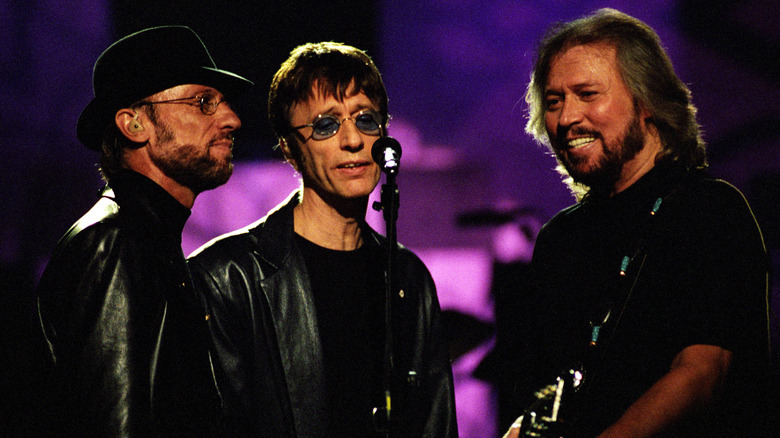
Dance music may sound a lot different today than it did back in the days of disco. But the Bee Gees — the British-born, Australian-raised trio formed by brothers Barry, Robin, and Maurice Gibb — recorded songs that would set any crowd to moving at a club, block party, or wedding, no matter what year it is.
Recognized for their sublime, falsetto-powered harmonies, the group had a knack for writing, arranging, and producing songs that helped define the late '70s disco explosion. But those songs stuck around long after those polyester suits got put in the closet, and today, the Bee Gees can put a pep in your step or some spice in your strut with their songs, turning your most average day into a disco revival. The Gibbs have plenty of nearly perfect songs worth checking out, but if you're looking to put down some moves to their music, these five are the perfect place to start.
Jive Talkin'
In the late '60s, the Bee Gees burst onto the scene with songs like "To Love Somebody," "Massachusetts," and "I Started a Joke," but by the mid-'70s, the trio hardly had a worldwide hit since 1971's U.S. chart-topper "How Can You Mend a Broken Heart?" "Jive Talkin'" changed all of that in 1975, with its funky, cutting-edge sound (dig that synth bass throughout the track!) and a delightfully catchy melody that you've probably sung along with, especially that riff after the chorus. But what really makes the song a dance staple to this day is its snappy rhythm — a happy accident the trio landed on while driving over a Miami bridge to the recording studio.
"Every night, we were going back and forth to Criteria Studios from Biscayne Bay," Barry Gibb explained to Music & Musicians Magazine. "The bridge made a clickety-clackety sound. It stayed in my head, and one night, coming back from the studio, I just started singing this thing over top of the rhythm." Fans couldn't stop moving between the dance floor and the record store, and the song peaked at No. 1 in August 1975.
You Should Be Dancing
The Bee Gees followed "Jive Talkin'" with a dramatic hit that predicted part of their trajectory for the rest of the '70s. The Top 10 "Nights on Broadway" featured a dramatic falsetto backing vocal from Barry Gibb, which would become the centerpiece of "You Should Be Dancing," But it wasn't only those high harmonies that got people moving: it was one of the group's most up-tempo releases yet, punctuated with flourishes like a rapid-fire horn break and a searing guitar lick on the bridge.
"Dancing" got the trio back to No. 1 in America in September 1976. But it took on a second life when it was used in John Travolta's most famous scene in "Saturday Night Fever," against the light-up floor of the 2001 Odyssey club, inspiring countless clubgoers to copy his moves. It was an iconic moment that nearly didn't happen: Travolta fought with the film's director John Badham to retain the close-ups that proved the fancy footwork was all his doing. And he wasn't busting a move to the Gibbs in real time, either. "The Bee Gees weren't even involved in the movie in the beginning," the actor told Vanity Fair in 2007. "I was dancing to Stevie Wonder and Boz Scaggs."
Stayin' Alive
For many, the soundtrack to "Saturday Night Fever" is the definitive disco album. Four of the tracks the Bee Gees penned for the film, including the ballad "How Deep Is Your Love," the upbeat "Night Fever," and "If I Can't Have You" (the latter sung by Yvonne Elliman), went to No. 1 on the American charts.
But there's something about the opening track, "Stayin' Alive," the monster No. 1 hit that opened the movie (scoring John Travolta's now-iconic strut down a Brooklyn street), that inspires a good get-down more than anything else. Maybe it's that CPR-ready beat, created by looping a real drum fill to robotic perfection. Maybe it's those dramatic strings that make your hips shake. Or maybe that "ha, ha, ha, ha" chorus makes your knees bend. Whatever the reason, it's hard to deny that "Stayin' Alive" is one of disco's finest moments.
But for the Gibbs, the song wasn't merely meant for the clubs; they felt the lyrics resonated with audiences in a big way, too. "Everybody struggles against the world, fighting all the ... things that can drag you down," Barry opined in the Bee Gees biography "Tales of the Brothers Gibb." "But when you climb back on top and win bigger than ever before, well, that's something everybody reacts to."
Tragedy
By the end of the 1970s, the Bee Gees were a worldwide musical juggernaut. Their songs were so popular that even their younger brother, Andy Gibb, scored a chart-topping hit with one of them. Interestingly, despite the group's disco-heavy reputation, the Bee Gees' 1979 follow-up to "Saturday Night Fever," "Spirits Having Flown," was better known for its ballads, including the chart-toppers "Too Much Heaven" and "Love You Inside Out." So when the single "Tragedy" featured not only another set of killer falsetto vocals, but an even more pulse-quickening tempo than their previous tracks, it too became a No. 1 hit and offered another reason to get out on the dance floor.
More than most Bee Gees tunes, "Tragedy" took on an incredible life beyond the original recording. The pop group Steps scored a long-running U.K. No. 1 hit with a nostaglic cover version in 1998, and in 2021, it was covered along with several of the trio's songs by the Foo Fighters, who released the recordings under the name the Dee Gees.
One
The disco craze may have ended in dramatic fashion as the '70s came to a close, but the Bee Gees managed to survive by adapting. They wrote countless hits for other acts, including Barbra Streisand, Dionne Warwick, and even Kenny Rogers and Dolly Parton. But the fact remained: after 1979's "Love You Inside Out," their sixth No. 1 hit in America, the group nearly vanished from the pop charts.
The Gibbs weren't done with pop audiences yet, though. In 1989, the group's "One" was released and quickly returned the group back to fashion. Trading in slick disco arrangements for a propulsive, mostly electronic arrangement built around Barry, Robin, and Maurice's unmistakable voices, "One" fit in perfectly with the rest of the radio scene when it reached the Top 10 of the charts in America alongside hits by Cher, Madonna, and Janet Jackson, and proved that the Bee Gees still knew how to create dance-worthy hits.
The unexpected comeback established the Bee Gees' legend for a new generation. Even after the passing of Maurice and Robin Gibb in 2003 and 2012, audiences are still falling in love with (and dancing to) the trio's music — songs that will certainly be stayin' alive for years to come.