

5 Led Zeppelin Songs That Prove 1969 Was The Best Year Of Their Career
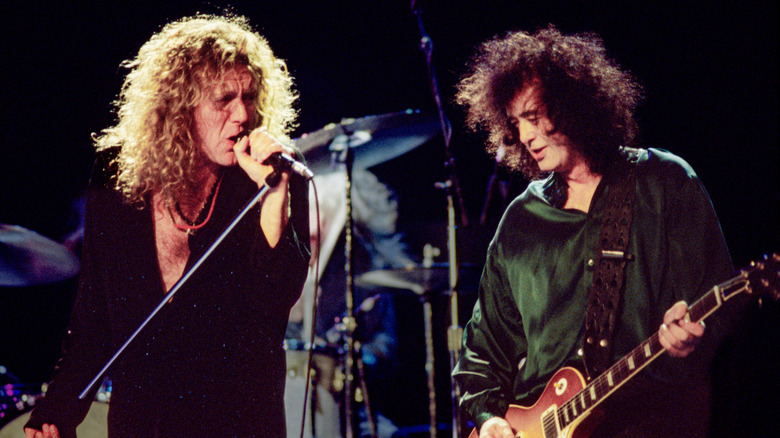
Led Zeppelin were no less than gods that reigned over the world of rock, starting pretty much with their debut and only ending when they were forced to break up in 1980. That makes picking a best year in the band's career especially difficult, and a few strong contenders are in the running. One particularly impressive runner-up is 1971, which saw the release of "Led Zeppelin IV" — one of the greatest rock albums ever and a major reason why '71 was classic rock's best year. Yet Zep had one year even greater, the only one in which they released more than one album: 1969, which saw the release of "Led Zeppelin" and "Led Zeppelin II."
Led Zeppelin was not a band that required two or three albums to find their groove. They knew who they were — a strangely synergetic mix of blues, metal, folk, Tolkien, and mysticism — from the very beginning. The group's first two albums emerged one after another in '69, their debut in January and their sophomore effort in October, and both were already Led Zeppelin at their peak. From among those albums, we've picked five songs that prove '69 was the band's best year. Each showcases the band's ingenuity, complexity, eventual legacy, or some combination of the three. Read on to see why '69 deserves a whole lotta love from Zep fans everywhere.
Ramble On
There aren't many songs in the Led Zeppelin discography as hard to describe simply as "Ramble On," the anchor of side two on "Led Zeppelin II." Of all of their songs, it best demonstrates each member's abilities to each play within their own different styles, while still blending expertly together into something better and new. John Bonham fills the verses with quick, bongo-like drumming that sounds more like a constant patter of rain than actual drums, which pairs with Robert Plant's cozy, autumn-strolling lyrics. Meanwhile, Jimmy Page's guitar in the verses is built from thin open chords that feel like jaunty folk, but again, it pairs well with the bucolic atmosphere.
The real hook in "Ramble On," however, lies in its bass line — a strange, jazzy cycle that shifts speed constantly. The opening notes are given space to breathe, and their big shifts in interval feel like gentle hops from stone to stone on the song's forest path. Most interestingly, the verses' bass line starts slow before essentially doubling speed. By the end of the four-bar cycle, it reaches a quick flurry of sixteenth notes before falling back to the original meandering pace. The pattern adds little bouts of tension and relief, something also accomplished by Plant's vocals, which also come at odd times and irregular speeds. The effect of all these unique parts together is something jazzy, folkish, at times rocking, and more than anything, entirely unique to "Ramble On."
Babe I'm Gonna Leave You
Led Zeppelin opened their first album with "Good Times Bad Times," a groovy but nonetheless straightforward rock number. Its power chords, arpeggiated riffs, and yowling vocals still sound like aspects of contemporaries like Deep Purple or the Stooges. It's not until the album's next song, "Babe I'm Gonna Leave You," that Zep starts to show off how strange and surprising they could truly be. Ironically, it's a cover song that achieves this.
Songwriter Anne Bredon wrote "Babe I'm Gonna Leave You," and Joan Baez popularized it, but Baez's version seems like an entirely different song than Jimmy Page and Robert Plant's. In a lot of ways, it genuinely is. In some places, Plant picks and chooses from among Baez's lyrics and reassembles them. In others, they're entirely new, such as verse four, which builds to his memorable "We gonna go walkin' through the park everyday!" shout.
That shout, like so many of the song's others, signals the start of the hard-rocking, foot-stomping section. It's a far cry from Baez's take, which never varies its gossamer finger-picking once. Led Zeppelin's, on the other hand, starts with similar finger-picking but jumps along with the narrator's emotions up to the heavy rock section and back again. Just like the song's storyteller vacillates between "It feels good to have you back again" and "I'm gonna leave you, go away" inside a single verse, so, too, does the music jump from low to high, soft to loud, in a uniquely Zeppelin way.
Moby Dick
Toward the end of "Led Zeppelin II" and just after "Ramble On" sits "Moby Dick," both the album's oddest experiment and its ending climax (the middle two minutes of the final track "Bring It On Home" don't quite top John Bonham's great white whale). The song is most notable for its middle three-ish minutes, which are all one long drum solo, one that changed rock history. As the years went on and "Moby Dick" was played again and again live, it gradually grew into its own mini set with distinct sections, at times hitting 30 minutes in length. The album version, though only a small fraction of the tune's eventual runtime, is still a monumental piece of drumming and feels especially momentous coming from a band that had debuted less than a year before.
Bonham, along with Jimmy Page, who produced and assembled the track, tells a story with the "Moby Dick" drum solo. It begins sparse and playful, with a series of one-off hits that come at odd times and leave you guessing. After a period of hand-drumming that keeps things from ever getting too pounding or rapid, Bonham begins slowly building up both steam and speed. Eventually, he returns to sticks and mixes in enough of his trademark triplets to turn the solo into a rushing tempest of rhythmically challenging drum lines. By the end, Bonham has proven Led Zeppelin unpredictable, multifaceted, and fierce.
Dazed and Confused
Like "Babe I'm Gonna Leave You," "Dazed and Confused" is also a cover song. The original was written by Jake Holmes and is a strange, surprising, unique track on its own. Yet Led Zeppelin's version takes what is great about the original — namely its haunting, almost sinister energy — and amplifies it into something far larger and more intense. Holmes' original establishes its tension well, but it never quite takes off. It stays at the same level of energy throughout, whereas Zeppelin's starts low and gives itself room to build into giant, soaring peaks.
Paralleling the live evolution of "Moby Dick," "Dazed and Confused" also started relatively innocuously and ended up larger than life. The original is about six-and-a-half minutes of acid rock, alternating between slow sludge and bombastic soloing, but it soon became something else. As the song was played more frequently live, Jimmy Page transformed it into its own guitar solo opera that wove its way through a host of different sections built from different tones and techniques. Perhaps most famously, Page's "Dazed and Confused" solo is where he routinely employed a violin bow to play guitar with. By the end of its life cycle, his "Dazed and Confused" solo ballooned to over 45 minutes in length, making it one of the longest guitar solos in history and proving once again that there was no band bigger and bolder than Zeppelin.
Whole Lotta Love
Among all of Led Zeppelin's hits, it's nearly impossible to single out any as the most iconic or renowned. But when it comes to the purest rock and most classic riff, it's hard to imagine anything beating "Whole Lotta Love," the song that kicks off "Led Zeppelin II" with a bang, a scream, and a moan. The track's central riff is almost impressive in how simple it is: Just two notes alternate twice before a simple E power chord, and that's it. Any simpler and it would be hard to even call it a riff. And yet, it is an undeniably excellent rock riff, one that helped the song become one of Zeppelin's signatures. "When I played the riff for the band ... the excitement was immediate and collective," Jimmy Page told The Wall Street Journal. "We felt the riff was addictive, like a forbidden thing."
Given the constant radio play "Whole Lotta Love" has seen throughout the roughly 60 years since its release, it's fair to say that Page was right about the riff's addictiveness. Of course, that play comes from the radio edit, which omits the trippy kaleidoscope of a breakdown built from Robert Plant's suggestive moans and unique reverse echo track. The album version includes the breakdown in all its impressionistic glory, which helps Zepp-ify the song beyond its otherwise standard structure. The full album version of "Whole Lotta Love" is a song that excels as both a conventional hard rock song and an unconventional sonic exploration, a feat accomplished by a lot of Zeppelin songs, especially in '69.