

He Should Be As Famous As Cat Stevens, But His Potential Was Never Realized
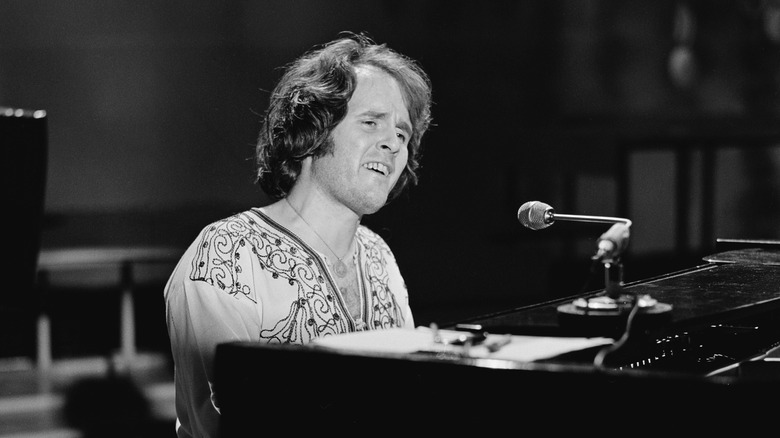
A passionate and captivating vocalist and an immensely talented songwriter, Tim Hardin had all the goods that made Cat Stevens a superstar in the early 1970s, but without the international acclaim and immense material success that came from recording hit albums. Hardin instead became a well-known and highly regarded songwriter among folk and rock musicians — including Stevens — responsible for some gorgeous, popular, and most-covered songs of the '70s.
Raised in Oregon, Hardin served in the U.S. Marines before settling in with the explosive Greenwich Village and Cambridge, Massachusetts, folk scenes of the 1960s. Between 1966 and 1973, Hardin released nine albums, all of which saw mediocre sales, before substance abuse issues led him into obscurity and other personal challenges. After moving back and forth between the U.S. and the U.K. in the '70s, Hardin started work on what could've been a second shot or a comeback LP, but he didn't finish it before he died at age 39 in December 1980.
Nevertheless, while Hardin remained relatively anonymous for most of his adult life and in the decades after his death, his songs moved and entertained millions. Here's how Tim Hardin became a superstar to taste-making and influential musicians, if not one outright.
Tim Hardin enjoyed some brushes with fame
Tim Hardin factored into the life of Bob Dylan, a fellow '60s folkie. Dylan heaped praise on Hardin, reportedly calling him the best songwriter of his generation after hearing the 1966 debut LP "Tim Hardin I." That album was the result of a creatively fruitful time for the musician. The biggest share of his songs that would be frequently and consistently covered were composed between late 1965 and mid-1966.
The "Tim Hardin 2" standout "If I Were a Carpenter" was among them, and when recorded in 1966 by maturing former teen idol Bobby Darin, it was a No. 8 hit. Two years later, Motown's the Four Tops issued their take on "If I Were a Carpenter" and reached the Top 20. Hardin hated both versions of his original, which has since been covered by Johnny Cash and June Carter, Bob Seger, Dolly Parton, and Robert Plant.
In 1969, Hardin's career seemed to pick up some momentum as his music reached bigger audiences. His album, dedicated to his wife and son, "Suite for Susan Moore and Damion: We Are One, One, All in One" charted at No. 129, while his single "Simple Song of Freedom," ironically a cover of a Darin original, reached No. 50 in August 1969, around the time that Hardin played the legendary Woodstock Festival. That gig did him little favors; Hardin's set wasn't included in the Woodstock concert movie or soundtrack album.
Tim Hardin wrote numerous classic songs made famous by other singers
When the 1970s began, Tim Hardin was fading as a performer, but was picking up speed as an in-demand songwriter. In 1971, the biggest year of Cat Stevens' career, Hardin's "Bird on a Wire" LP barely appeared on the album chart, but Rod Stewart covered his "Reason to Believe." An initial lead single outshined by its B-side, it was relegated to the flip-side of "Maggie May," a No. 1 hit.
Hardin also found interest in many of his other compositions. He wrote "Misty Roses," a minor easy-listening hit for Johnny Mathis, as well as "Lady Came from Baltimore," which was a small pop hit for Darin but a huge country hit for Johnny Cash. However, "Black Sheep Boy" from "Tim Hardin 2" may be Hardin's longest-lasting legacy. Rocker Ronnie Hawkins, jazz great Vince Guaraldi, and the Jam front man Paul Weller all took a turn at the devastating song. In 2005, indie rock group Okkervil River included that and several other Hardin takes on an LP of the same name, a concept album about the late singer-songwriter.