

The Greatest Self-Taught Drummers In Rock History
If you're like most rock music lovers, there have almost certainly been moments when you stood in awe watching your favorite band perform, handling their respective instruments as if they were born to play them. Drummers in particular are especially impressive to witness live: steady but lightning-quick hands making almost imperceptible movements, creating pulse-pounding beats with their sticks at a near-superhuman rate. One might imagine that such talent would take years of expensive drum lessons to achieve. Thus, it may come as a surprise that quite a few classic rock drum solos that give music fans chills were performed by drummers who either claimed to have never received any training or have been described as having largely learned how to play the instrument by themselves (aka autodidacts).
It's worth clarifying, though, that no musician — no artist, even — develops in a vacuum, and drummers are no exception. While there are indeed so-called or self-identifying "self-taught" drummers who either never took lessons or only had an informal teacher for a very short period of time, it's safe to say that all of them were influenced by their peers and idols. Admittedly, this may make it seem like the "self-taught" moniker is, at best, a half-truth. With that said, regardless of how strictly you define "self-taught," the following drummers put in the work to learn the drums without having someone to guide their hands throughout most of the process, attesting to the age-old piece of wisdom that geniuses aren't born, they're made (or in this case, self-made).
Dave Grohl
Some fans may think that the tale of how Dave Grohl learned how to play the drums is a fairly well-known story even outside of the fandom, perhaps because of how the Foo Fighters frontman has been open about it in interviews. Speaking to The Guardian in 2021, for example, Grohl mentioned how, in his youth, he would take his pillows, lay them out on the floor to resemble a drum kit setup, and then hit them like they were actual drums and cymbals while pretending to play Bad Brains songs (though that didn't stop Grohl from having a bizarre job before his professional music career took off).
The former Nirvana drummer elaborated on an arguably more interesting anecdote during a 2021 appearance on "The Howard Stern Show." The host asked Grohl to explain what he meant when he said that he used to play the drums on his teeth; Grohl obliged by leaning into his microphone and rapidly clicking his teeth, producing a chattering sequence akin to a drum solo. "When you discover music and you get really into it, it's like an obsession," explained Grohl, "and so you're utilizing any resource to [play music]." The musician even admitted that this practice used to cause Grohl's dentist much consternation. "[My dentist] was like, 'Do you chew on a lot of ice? Your teeth have an unusual amount of deterioration,'" recalled Grohl, adding (likely in jest) that his dentist kicked him out of his appointment after Grohl demonstrated his dental drumming.
Keith Moon
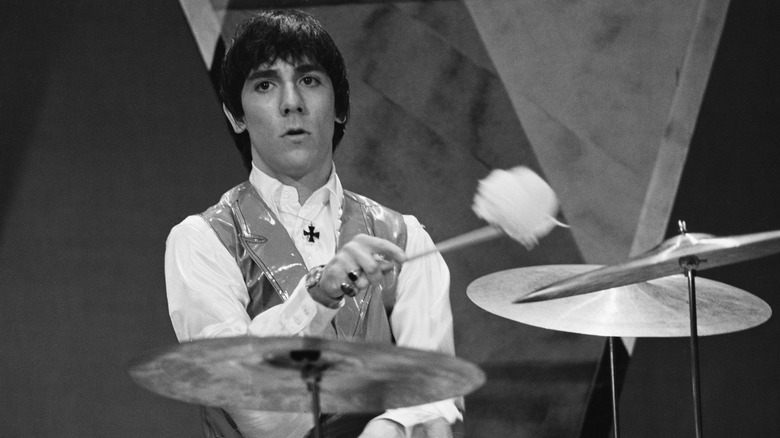
Aside from being regarded as one of rock music's greatest and most influential drummers, Keith Moon is also known as a primarily self-taught musician. At the age of 12, he became part of his local Sea Cadet Corps, albeit as a bugler, not a drummer. Playing the bugle didn't quite work out for him, but the experience helped him discover the drums — and in the process, the man who would eventually become the infamously animated and rambunctious drummer of The Who realized what he wanted to do when he grew up. At the time, he didn't own a drum set, so he honed his skills by visiting nearby music shops after school and making use of the drums there.
Technically, the legendary drummer did take a handful of lessons early on. As the story goes, his one and only teacher was Carlo Little, the peerlessly energetic drummer of Screaming Lord Sutch's Savages. In doing so, Moon gradually developed his own style, taking inspiration from American jazz, rock, and pop. Ultimately proving to be an ill fit for high school, he dropped out, opting to attend vocational school in order to learn a trade so he could earn his own money. Eventually, he made enough fixing up radios to purchase his own drum set. He spent the next couple of years playing with bands, culminating in his 1964 audition for The Who — and the rest, as they say, is history. (Ironically — and as a testament to his skills — even though Moon was said to have hated doing them, he performed one of the best drum solos in rock history.)
Ringo Starr
Long before he joined the Beatles, Ringo Starr spent many of his childhood days being sick. At age 13, he had to be confined in a sanatorium to be treated for tuberculosis. One day, a woman came in and handed Starr and his fellow patients some percussive instruments at random. Upon receiving a drum, Starr knew his world had changed. "I hit the drum and I only wanted from that moment to be a drummer," Starr told People in 2025.
As Starr once reportedly said, "I never studied anything, really. I didn't study the drums. I joined bands and made all the mistakes onstage." Indeed, the man who would eventually complete the Fab Four worked in a factory during his teens, learning how to play on makeshift instruments while gaining experience performing with other young musical acts. When Starr quit his factory job in 1960 to continue his pursuit of music, his family tried to dissuade him, to no avail.
Two years later, Starr, who had honed his talents considerably by then through consistent gigs, crossed paths with John Lennon, George Harrison, and Paul McCartney, who were looking for the right replacement for their drummer, Pete Best. Aside from being a great fit personality-wise, Starr's journey as a self-taught musician developed his drumming skills in ways that were uniquely suited for the Beatles (e.g., his innovative approach to creating specific sounds) and ultimately helped cement the quartet's place in music history.
Ginger Baker
Many would agree that Ginger Baker's 1966 drum solo made the Cream drummer a rock legend. But as it turns out, his childhood peers seemingly knew he was destined for rock 'n' roll superstardom long before the rest of the world knew what the mostly self-taught drummer was capable of.
Baker's gateway to playing music was his love for jazz, which he had become a fan of during his pre-teen years. While he was in school, Baker casually demonstrated a knack for being a percussionist. "I was always banging things," the drummer told Record Collector Magazine in 2007. "When the teacher went out of the class, I'd start banging on the desk, and all the guys would start boogieing." One fateful day, the 15-year-old Baker attended a party where his classmates urged him to try his hand (pun intended) at the drums. His impromptu performance was well received, cementing in Baker's mind that he was meant to play the instrument professionally.
Though Baker never shied away from saying that he learned how to play the drums by himself, he also acknowledged that he received considerable input from other musicians, including jazz drummer Phil Seamen, whom Baker held in very high regard. But Baker didn't just learn to play the drums; he also studied how to read and write music. Interestingly, during the early '90s, Baker opened a drum school, a decision that spun out of him giving his own child drum lessons. But perhaps the most important lesson Baker imparted was a nugget of wisdom he himself learned from jazz drummer Baby Dodds: "A drummer's job is to make the other guys sound good."
John Bonham
Every classic rock fan should already know this history-making drummer. John Bonham, the man whose bombastic, unmistakable drumming style significantly contributed to immortalizing Led Zeppelin in the annals of rock, combined various musical influences in a manner that influenced both his contemporaries and succeeding rock acts. Evidently, his natural affinity for banging, beating, and bashing percussive instruments — makeshift or not — started a young age.
As Mick Bonham, John's younger brother, recounted in his biography, "John Bonham: The Powerhouse behind Led Zeppelin," the future rockstar was drumming on everyday household items for as long as Mick could remember. "I used to play on a bath salt container with wires on the bottom and on a round coffee tin with a loose wire fixed to it to give a snare drum effect," John recalled. "Plus, there were always my Mum's pots and pans." John's parents supported his ambitions from a young age, and by the time he was 15, he had a full drum kit of his own. However, he never received any formal drum training. Not one to let himself be restrained by technique, John prioritized creativity, originality, and feeling over technical correctness, believing that a drummer's individuality only shines through when they zag where everyone else zigs.
Despite his proficiency at the drums, experts familiar with John's work recognize the fact that he hardly ever tried to unnecessarily dominate a song, practicing a degree of percussive restraint that seemed unique for a self-taught drummer. That's not to say, of course, that John Bonham was ever lacking in confidence; he once famously said that the only two rock drummers who mattered were Ginger Baker and himself.