

5 Times The Kinks Turned Musicians Into Legends
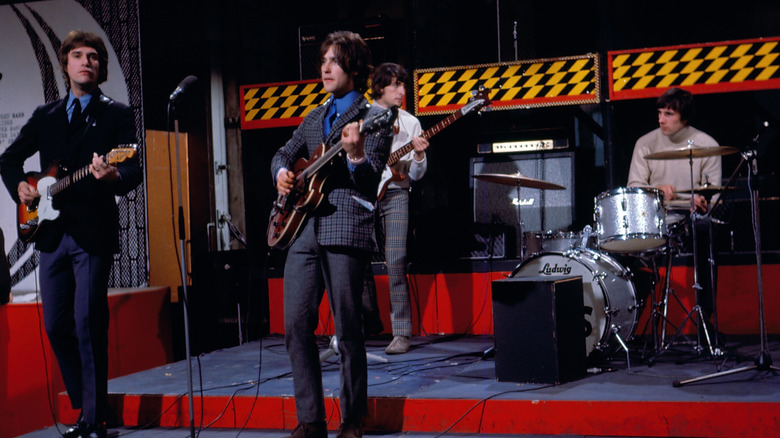
Formed in 1963, the Kinks are remembered as an iconic band of the British Invasion alongside the Animals and the Rolling Stones. The Kinks' proto-punk, riff-inventing hit, "You Really Got Me," changed rock 'n' roll forever, and the 1970 smash hit "Lola" reintroduced them to an American audience. From there, they continued to create and perform into the '80s. The band experienced a generational run, releasing 26 studio albums across a 33-year career before finally disbanding in 1996.
The band was formed by a duo with one of the most explosive sibling rivalries in rock history: brothers Ray and Dave Davies. Ray was the primary songwriter and singer for the group, while Dave played lead guitar and wrote the riffs. The group was rounded out by Peter Quaife on bass and Mick Avory on drums, but through the '70s and onward, Ray and Dave became the only consistent members of the band. This list celebrates the founding members of the Kinks, as well as longtime bassist John Dalton, all of whom became not only rock stars but veritable rock legends.
Dave Davies – You Really Got Me
Legendary is an inadequate a word for the impact Dave Davies had on rock 'n' roll music. Achilles is legendary, Hercules is legendary — Davies is a guitar god. Davies revolutionized the electric guitar when, in a fit of frustration, he sliced the speaker cone of his guitar amp with a razor blade and poked holes in it. The resulting fuzz and distortion, when paired with the power chord-based riff writing of "You Really Got Me" gave the band a uniquely aggressive sound that guitarists have been emulating ever since.
Rock stars like Alice Cooper, David Bowie, Pete Townshend of the Who, and Brian May of Queen, have all praised the riff and sound on "You Really Got Me" for its influence on their music and rock 'n' roll as a whole. The sound was so early and influential, it has even been credited for really inventing punk. "Musicologists have called this the first song built on the power chord, the simplest of all guitar patterns, and so is a progenitor to heavy metal. But because of its simplicity and bratty, irreverent posture, I think "You Really Got Me" is also the world's first punk song," music commentator Mark Foley wrote for KMUW.
In the years since, Davies has contributed to other legendary Kinks projects, such as their 1968 concept album, "Village Green Preservation Society," and their massive commercial hit, " and the Moneygoround, Part One." He released his first solo record, "AFL1-3603," in 1980 and followed with seven other solo albums. In 1995, Davies composed his first and only film soundtrack alongside John Carpenter on the latter's 1995 film, "Village of the Damned." In 1990, Davies was inducted into the Rock & Roll Hall of Fame as a founding member of the Kinks.
Ray Davies – Village Green Preservation Society
While Dave Davies might have brought a raw genius and abrasiveness to the Kink's sound, it was all in conjunction with his brother Ray Davies, the lead songwriter and backbone of the group. As the primary songwriter and vocalist of the Kinks, it was Ray's mind and wit that spearheaded the band's creative direction, manifesting in his magnum opus, "The Village Green Preservation Society." After the rock icon was banned from touring the U.S. for four years, Ray withdrew into the influences of his British homeland, creating a concept album celebrating Britishisms and British music.
In an interview featured in the documentary "Ray Davies: World Through My Window," fellow British rocker David Bowie said, "[Ray] creates a mass memory for us all of, as they say, of an England that possibly did or didn't exist, and I think that's what makes his stuff — it has a real mystical radiance to it." In the same documentary, Elvis Costello also praised Ray: "Those stories are invested with personal meaning and real emotion, and real sense of place and time. It isn't just, like, a fantasy."
Ray eventually let American influences back into his music, most notably and successfully on the album "Lola Versus Powerman," where he heavily employed the resonator guitar and the harmonica. Ray remained with the Kinks until they disbanded in 1996, releasing eight solo albums in the following years. In 1990, Ray was inducted into the Rock & roll Hall of Fame alongside his brother and the other original members of the Kinks.
Peter Quaife – The Ambassador
Peter "Pete" Quaife was a founding member of the Kinks, having been a part of the band as early as 1962, when they originally performed as the Ravens. Although less famous than the Davies brothers, Quaife rode with the band during some of their most iconic eras, playing bass on all of their records from 1964 to 1969. He briefly left the band in June 1966 due to an injury sustained in a car crash, but he returned to the band by November that same year.
Quaife had very little creative input in the band's music, something he resented, but he played an important role as the band's peacekeeper and initial spokesperson. According to his obituary in The Guardian, he was nicknamed "the ambassador" for often helping to settle down the constant bickering between the bandmates. Quaife's favorite period with the Kinks was recording "Village Green," where Quaife felt like he finally had some creative input. "For me, ['Village Green'] represents the only real album made by the Kinks," he said in 1998 (via Rolling Stone). "It's the only one where we all contributed something."
The band's constant fighting is what eventually led Quaife to leave the band in 1969. He was replaced by John Dalton, who had previously filled in for Quaife after his car accident. In 1970, Quaife went on to start his own band, Maple Oak and eventually retired from rock music, working as a cartoonist. His final performance with the Kinks was in 1990 at the Rock & Roll Hall of Fame induction ceremony, where he was inducted as a founding member of the Kinks. Quaife died in June 2010 of kidney failure, but he cemented his legacy as the legendary bassist of the Kink's most prolific periods.
Mick Avory – Kinda Kinks
Mick Avory is the founding drummer for the Kinks, joining the band in 1964 just as they were changing their name from the Ravens to the Kinks. His first recordings appeared on 1965's "Kinda Kinks," though he also played live with the band on their debut album, "Kinks." Prior to joining the Kinks, Avory played around with another group of musicians, who would eventually become the Rolling Stones, but he never performed with them in any capacity.
Avory stayed with the band throughout their entire '60s and '70s runs, eventually leaving in 1984 due to constant feuding with frontman Dave Davies. After leaving the band, Avory spent many years managing the Kink's studio in London, Konk Studios. With former Kinks bassist John Dalton, Avory formed the Kast Off Kinks in 1994, a band consisting of ex-Kinks members who, together, tour old Kinks songs. Avory played on the Kink's most iconic albums, including "Village Green" and "Lola Versus Powerman," and was inducted into the Rock & Roll Hall of Fame as an original member of the Kinks. As of 2026, he continues to tour with the Kast Off Kinks.
John Dalton - Lola
Although John Dalton is not a founding member of the Kinks, he is a legend in his own right as an important figure in the band's history. Dalton first joined the band in June 1966, temporarily filling in for Peter Quaife, who had been injured in a car accident. Arguably, the Kinks released some of their best songs in 1966. Dalton primarily contributed to live performances, but he did record bass for the songs "Little Miss Queen of Darkness" and "Dead End Street" for the band's album, "Face to Face." When Quaife left the group permanently in 1969, Dalton was rehired for the position permanently.
Dalton joined the band at a pivotal period; their ban on performing in the United States had just been lifted, allowing the group to tour the country. In 1970, Dalton wrote and recorded bass for one of the band's most legendary albums, "Lola Versus Powerman," contributing bass for iconic songs like "Lola," "Apeman," and "Strangers." Dalton left the band in 1976 after recording "Sleepwalker," the band's most successful record of the late '70s. Along with Mick Avory, Dalton founded the Kast Off Kinks, but as of 2026, he is no longer an active member. Although he was not inducted into the Rock & Roll Hall of Fame due to not being a founding member, Dalton's contribution to the band's catalogue and his lengthy stay with them makes him an undeniable figure in the Kinks' long history.