

The 5 Best Rock Live Albums Recorded In Japan
Sometimes, you can't really understand a band until you hear them live. Then, they either exceed expectations or disappoint. So it is that band after band has traveled to Nippon — Japan, the Land of the Rising Sun — to test their musical mettle in arenas that have captured some of the best live performances of the 20th and 21st centuries.
As global superstars, the Beatles were the first Western rock band to travel to Japan. In 1966, the Fab Four played at the Nippon Budokan, a 14,000-capacity martial arts venue in Tokyo. With this precedent established, and benchmark for success set, other rock bands over the decades followed suit and immortalized their work in live albums that captured one-of-a-kind moments. Not all such albums have been fantastic, nor have all of them been recorded at the Budokan, though many have — on both counts.
It's tough to choose the best of such Japan-recorded albums, as there's way more of them than the reader might realize. But, we're highlighting albums that improve on the potential of studio recordings, in some way. Maybe there's some energy present in the performance, as bands knew they were being recorded for an album; some variation and ad-libbing in tried-and-true songs that make a setlist truly unique; or even unique song choices. Regardless, all of our albums highlight bands at the top of their game from various arenas of music contained under the rock umbrella. So let's grab a seat and have a listen to the best of the best.
Made in Japan (1972) — Deep Purple
As pioneers of psychedelic, blues-based rock meets heavy rock and proto-metal, Deep Purple's career spans all the way from their 1968 debut, "Shades of Deep Purple," to their 2026 tour and beyond. But out of the band's entire history, their early-career, 1972 live album, "Made in Japan," is one of their best works as well as one of the best live rock albums ever recorded in Japan.
Deep Purple made "Made in Japan" at the direct request of Warner Brothers Records, the band's label in Japan. The entire purpose of the recording was to do what the final recording did: illustrate how electrifying and improvisational the band was in a live setting. This live version of "The Mule" contains one of the longest drum solos in rock history from Ian Paice, while "Space Truckin'" gets expanded from four minutes, 31 seconds to a nearly 20-minute-long jam session. "Space Truckin'" also comes from the band's other 1972 album, "Machine Head," exactly like another song on "Made in Japan": "Smoke on the Water." Even this version of "Smoke on the Water" is longer than the studio version, i.e., not precisely the same version you probably got sick of hearing decades ago.
All in all, "Made in Japan" deserves its spot not only in the heap of best live rock albums recorded in Japan, but best live rock albums, period. This is a time capsule of Deep Purple at their finest.
Tokyo Tapes (1978) — Scorpions
No matter that German rockers Scorpions reached their apex of fame with "Wind of Change" from 1990's "Crazy World," a song so tied to the fall of the Berlin Wall that some folks swear it was written by the CIA — Scorpions had been around way before then. They'd been amassing hits since their 1972 debut, "Lonesome Crow," to the point where their entire discography defines the history of rock 'n' roll. It wasn't too long after their debut that they were successful enough to perform in Japan and record what would become a phenomenal 1978 live album, "Tokyo Tapes."
Scorpions only had five albums under their belt when they recorded "Tokyo Tapes," meaning no '80s hits such as "No One Like You." Their "Tokyo Tapes" setlist also leaves out what's possibly their sickest song and sickest Uli Jon Roth solo, 1977's "The Sails of Charon." But, vocalist Klaus Meine was at the top of his game, every band member was locked in and on point, the production is sharp, and this was Roth's final show with the band, to boot. Unlike a lot of other big Western rock names, Scorpions recorded "Tokyo Tapes" at Nakano Sun Plaza, a much more modest venue of about 2,200 seats. It stands to reason that the smaller setting might have influenced the band's performance and energy in a positive way.
Perhaps most poignantly, Scorpions played "Kojō no Tsuki" ("Moon Over the Ruined Castle") toward the end of their set, a widely loved, early-20th century Japanese folk song about the faded grandeur of a beautiful castle mirroring the impermanence and fragility of human life. This show of respect toward Japan, Scorpions' concert-hosting nation, gives "Tokyo Tapes" a final shove onto our list. The audience reaction alone to Scorpions playing "Kojō no Tsuki" proves the worth of the entire album.
Unleashed in the East (1979) — Judas Priest
Attention, folks: Judas Priest and the high priest of metal, Rob Halford, have entered the building. 1979's "Unleashed in the East" has taken on legendary status in rock and metal circles for capturing the leather-clad gents of Priest at the peak of their early, unrestrained glory. It was recorded across two shows in Tokyo, one in Nakano Sun Plaza and the other in Kosei Nenkin Hall.
Much like "Tokyo Tapes" and Scorpions, "Unleashed in the East" preceded tons of Priest fan favorites from the '80s and '90s, like "Electric Eye," "The Sentinel," and "Painkiller." This transforms the album into a greatest-hits distillation of Priest's '70s catalog, right down to its classic opener, "Exciter," a song that bizarrely flopped in 1978 when it came out but which has become one of Priest's most iconic tracks. Every track in the setlist crackles with immediacy and electricity, is crisply produced, and typifies the hard-rocking attitude that pushed Priest past its peers during the New Wave of British Heavy Metal in the mid-'70s to early '80s. The album also comes equipped with a cover of Joan Baez's "Diamonds and Rust," arguably her best track and a top song from the '70s that captures the meaning of life. The English-language, sideways-written album name on the bottom of the "Unleashed in the East" cover even resembles Japanese katakana.
All this being said, "Unleashed in the East" has gotten some flak over the years because Halford had the flu during the performance and re-recorded some of his parts in the studio. But because we all know how good Halford is when he's not sick, this doesn't really matter to fans or detract from the album's historical significance.
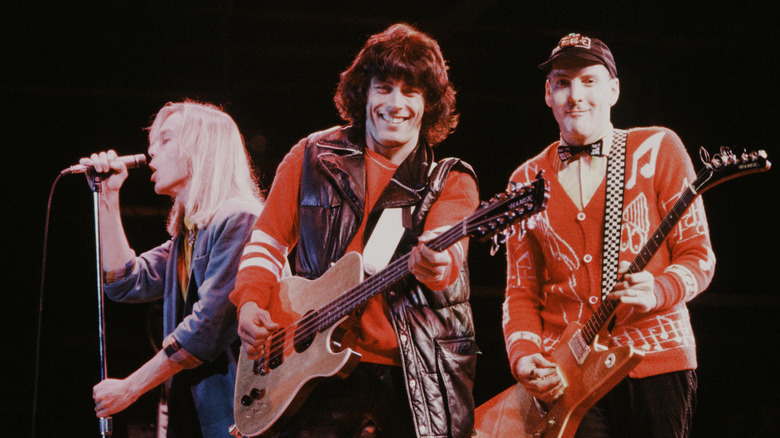
Cheap Trick at Budokan (1979) — Cheap Trick
Cheap Trick were definitely the weirdo outliers of the punk-influenced power pop sphere of the late '70s. But unlike the other bands in this article, they hadn't really proven themselves before they headed to Japan to record their live album. In fact, vocalist Robin Zander said they were hugely in debt and on the verge of breaking up at the time. 1979's "Cheap Trick at Budokan" was an all-or-nothing gamble, one that paid off in large part because it contained a reimagined version of their breakout hit, "I Want You to Want Me."
In short, "Cheap Trick at Budokan" showed that Cheap Trick were a band that worked better live than in the studio — much like a lot of punk or punk-adjacent outfits. Listeners could hear it, too, and we don't just mean all the very audible, shrieking girls in the audience at the Budokan in 1979. Sales-wise, the album blew other Cheap Trick releases out of the water, selling over 3.6 million copies vs. their next-highest-selling album, 1979's "Dream Police" at about 1.4 million copies.
"Cheap Trick at Budokan" contains an excellent, slightly ragged, and more heavily distorted version of "Surrender," a song that defined rock history the year prior in 1978. But, the album's real stand-out track is "I Want You to Want Me," which went to No. 7 on the Billboard Hot 100 and cinched the band's entire career. This version is vastly superior to the band's 1977 original, which sounds like a limp Allman Brothers B-side. Higher-tempoed, crunchy, and dance-worthy, this is the definitive version of the definitive song of one of rock's bedrock outfits leading into the '80s.
Live at Budokan (2004) — Dream Theater
Dream Theater fans need no convincing of the merits of 2004's "Live at Budokan," because they probably wore out their DVD players watching the performance a long time ago. That's because "Live at Budokan" wasn't just a three-CD, 2.5-hour-long colossus of a show when it came out; it was a double DVD. This is Dream Theater, OG titans of prog metal who took the proggy baton from bands like Pink Floyd, at the top of their game in terms of musicianship, composition, and energy. No other studio or live album of theirs ("Live at Budokan" was their fourth of 10) captures the band's virtuosic prowess so well, from the opener, "As I Am," to the epic, 15-minute closer, "In the Name of God."
Much of the exceptionalism of "Live at Budokan" comes from guitar god John Petrucci and keyboard god Jordan Rudess. They play off each other and extend, improvise, and adapt lead lines and solos when possible, but never to the detriment of a song's core passages. Throw in about a quadrillion tempo changes, weird time signatures, and a set that would exhaust most musicians' fingers, and you've got a truly exceptional fragment of rock's broader live history, in Japan or otherwise.
As the name of the album says, "Live at Budokan" was recorded at the Nippon Budokan in Tokyo. The show was ostensibly part of the band's tour in support of 2003's "Train of Thought" but became its own thing. The performance was going to be even longer, but the band had to omit three songs from its setlist, one of which included a prolonged Mike Portnoy drum solo. But no worries, because it's more than good enough as it is.