

5 Songs From The '60s That Nail The Meaning Of Life
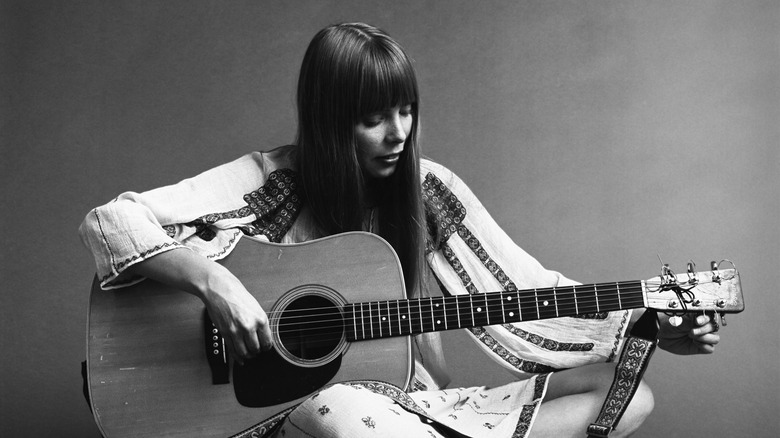
If any decade in recent history seems suited to discussing the meaning of life, it'd be the 1960s. A time of massive cultural upheaval and growth, the '60s were defined by vast countercultural forces surging side-by-side with the Cold War and Space Race, the 1964 Civil Rights Act, the Vietnam War, the assassinations of JFK, RFK, MLK, and Malcolm X, and many other notable historical incidents. This is doubtlessly why so many artists from the era, especially musicians, dedicated themselves to figuring out what life is all about, especially from a sociopolitical angle.
"Figuring out" is the key phrase here, as '60s artists like Bob Dylan and Joni Mitchell were never presumptuous or arrogant enough to come out and say, "This is what it's all about, alright?" That would've been 100% missing the point. Rather, they asked questions and encapsulated moments of life in little vignettes that acted like windows into the universal human. So, we're going to adopt the same approach. We've chosen '60s songs that aren't the only songs from that decade to accurately depict life, but are certainly exemplars of their time.
Much like our list of '70s music that nailed the meaning of life, we wanted our '60s choices to reflect an array of moments and experiences that describe life in its full breadth, from the sublime to the hideous. Whether it's Nina Simone singing about how she wishes to know how it would feel to be free, the Mothers of Invention making fun of plastic people in an age of burgeoning, moronic consumerism, or Leonard Cohen capturing loneliness amidst a crowd, here are our choices.
Bob Dylan — The Times They Are A-Changing
Few choices could be as on-the-nose here, lyrically and as a '60s musical pick, than Bob Dylan's song "The Times They Are A-Changin'" from the 1964 album of the same name. Dylan, who paved the way for folk contemporaries like Joan Baez, Joni Mitchell, and Simon and Garfunkel, wrote this song in his early 20s, right in the midst of all the countercultural tumult of the mid-1960's. It not only typified that time perfectly, but Dylan even debuted the track in concert on November 23, 1963, the day after JFK was assassinated.
But more than being a mere window in the mid-'60s, "The Times They Are A-Changin'" suits any and all feelings of social disquiet, generation after generation, when the zeitgeist shifts moods and the future seems unknown, hopeful, or terrifying: Some people are right there riding the wave, for better or for worse, while others are left wondering what in the world is going on. As the very first verse of "The Times They Are A-Changin'" says, "If your time to you is worth saving/ And you better start swimmin' or you'll sink like a stone/ For the times, they are a-changin'."
Dylan based "The Times They Are A-Changin'" on Irish and Scottish folk songs like the 6/8 time "Come All Ye Bold Highway Men." Such songs' cyclic musical patterns allow the emotion and meaning of "The Times They Are A-Changin'" to build and build, line after stacked line. This writing technique, plus Dylan's unusual and attention-grabbing voice, led his song to such anthemic status that the mangled scrap of paper he used to write its lyrics sold for $422,500 at auction in 2010.
The Mothers of Invention — Plastic People
This song might surprise some readers because it's not meant to flood the soul with lofty, swooning emotions that are, themselves, somehow taken as evidence of truth. Rather, anything from the Mothers of Invention and its lynchpin, the grand wizard of musical comedy, Frank Zappa, nails the meaning of life by making fun of its absurdities. Enter "Plastic People" from 1967's "Absolutely Free."
Few songs embody a sentiment that all of us have felt at one point or another, either walking through a crowd while shopping, hanging out at a party with a drink in hand, or while zipping down the hallway at school as a kid: "People are exhausting." Rope a bit of contextualized sociopolitics into the mix vis-à-vis 1960's America ("I know it's hard to defend an unpopular policy/ Every once in awhile") and a denunciation of commercialized artifice ("She paints her face with plastic goo/ And wrecks her hair with some shampoo") and you've got a magnificent rejection of human fakery that will make you chuckle all the while, like good stand-up.
Plenty of people didn't get Zappa while he was alive, but at least one 1967 British magazine (via ArtsFuse) ranked "Absolutely Free" as favourably as the Beatles' "Sgt. Pepper's Lonely Hearts Club Band," but "much, much freakier and weirder." "Plastic People's" final thesis, though, might just be, "Me see a neon moon above/ I searched for years, I found no love/ I'm sure that love will never be/ A product of plasticity."
Nina Simone — I Wish I Knew How it Would Feel to Be Free
Originally written as an instrumental piece in 1952 by jazz pianist Billy Taylor and released as "I Wish I Knew" on his 1963 album "Right Here, Right Now!," "I Wish I Knew How it Would Feel to Be Free" took off in Nina Simone's more-than-capable pianist's hands come 1967's "Silk & Soul." More than that, Simone gave the song its lyrics and voice, which matched the topic and tenor of the Civil Rights Movement and still speaks to the broader human desire to live a free, independent life: "I wish you could know what it means to be me/ Then you'd see and agree/ That every man should be free." You really can't get more spot-on than that.
As a song, "I Wish I Knew How it Would Feel to Be Free" is fundamentally jazzed-up gospel, with clear church song roots you can hear in Taylor's original. Simone revisited the song over her career and life, keeping the core chord progression and building different accompaniments during live performances that varied quite a bit from her original 1967 version. No doubt the song's very singable spine, plus transparent lyrics, helped elevate Simone to a preeminent status amongst Black activists at the time.
Simone didn't just talk the talk, though. She lived a restless, often-troubled life emblematic of her desire for freedom, right down to advocating a more combative, Malcolm X-aligned method of attaining it. She even evaded the IRS by moving abroad and eventually settling down in France, where she died in 2003. But sometimes, these are the measures necessary to even know how it would feel to be free, let alone be free.
Leonard Cohen — Stories of the Street
"We are so small between the stars, so large against the sky/ And lost among the subway crowds, I try to catch your eye." If that line, alone, didn't make your eyebrows raise and you mutter "Wow" under your breath, then the rest of "Stories of the Street" will.
One of Leonard Cohen's masterful suite of songs off his 1967 debut, "Songs of Leonard Cohen," "Stories of the Street" perfectly portrays the feelings of alienation amidst company that defines much of the human experience. The search for love swept up in the movements of the age, the tension between personal autonomy and external forces, the need to stretch out and find others who feel the same: All of this and more is contained within the impeccably-named "Stories of the Street," because that's where such stories live.
It's not clear exactly what motivated Cohen to write "Stories of the Street," but his March 1961 trip to Cuba might have played a role. Yes, that's one month before the U.S. botched its Bay of Pigs military incursion of Cuba and two years after the Fidel Castro-led Cuban Revolution of 1959, when Cohen's sister Esther had honeymooned in the country. Hence, possibly, the opening lines of "Stories of the Street": "The stories of the street are mine, the Spanish voices laugh/ The Cadillacs go creeping now through the night and the poison gas/ And I lean from my window sill in this old hotel I chose/ Yes, one hand on my suicide, one hand on the rose." Even if this were not the case, Cohen also immortalized his Cuban experience in the poem, "The Last Tourist in Havana Turns His Thoughts Homeward."
Joni Mitchell — I Think I Understand
Joni Mitchell is an unparalleled voice who deserves every bit of praise for her talent and impact, and while we could easily choose any one of a number of her songs, we're going with "I Think I Understand" from 1969's "Clouds."
Taken from Mitchell's second album, which sits squarely in the early, straight-up folk phase of her career, "I Think I Understand" is about precisely what she sings in its chorus: "Oh, I think I understand/ Fear is like a wilderland/ Stepping stones and/or sinking sand." This general principle of transforming hardship into strength — you can either wield fear to get through the wilderland, or let fear consume you – couldn't be more fundamentally human and applicable to a whole host of circumstances across all phases of life.
And now the match-up you never expected and which might blow your mind: "The Lord of the Rings" inspired Mitchell, right down to the very conspicuous and beautiful Tolkien-spun word, "wilderland." As Mitchell explained in 1969, according to her website, LOTR "left a big impression" on her because you can "get your own hope and light and everything from it." She particularly liked the elf queen, Galadriel, who in LOTR gives Frodo Baggins a phial of light to use in dark places on his journey. Tolkien used the word "wilderland" to describe what Frodo and his fellowship would have to endure, which was all it took for Mitchell to get the inspiration for "I Think I Understand." Such a transference of art-to-art, story-to-story, also helps describe the meaning of life.