

5 Songs From 1969 That Define Rock History
By the time the late 1960s rolled around, popular music had already undergone a radical shift from the beginning of the decade. The '60s counterculture was in full swing, anti-war sentiment raged along with the Vietnam War, the Civil Rights Movement had culminated in the Civil Rights Act of 1964, and artists grew increasingly experimental and restless along with the zeitgeist. All of this sociocultural and musical verve culminated in 1969's famed Woodstock music festival, the very year that rock saw some of its defining songs hit the airwaves.
In other words, 1969 presents quite a high bar for songs that define rock's history. In choosing songs for this article, we've got to try and encapsulate not just the spirit of the age, but how that spirit transitioned from one decade to the next. This transition is marked by the fall of era-defining artists like the Beatles, who released "Abbey Road" in 1969 before disbanding in 1970, and the rise of the next generation of rock vis-à-vis the debut albums of bands like Led Zeppelin. At the same time, rock branched further from psychedelia, folk, and blues into sub-genres like art rock, punk rock, and roots rock, all of which need to be represented in our article.
Finally, it's really not possible for a song to "define" an era unless it's gotten major traction with the public. This means we've got to steer away from obscure songs, no matter how good. On the other hand, we also don't want this article to be a mindless selection of greatest hits. So, whether it's the Beatles, Zeppelin, the proto-punk of The Stooges, or the theatricality of David Bowie's Ziggy Stardust persona, here are some songs that defined rock come 1969.
Come Together — The Beatles
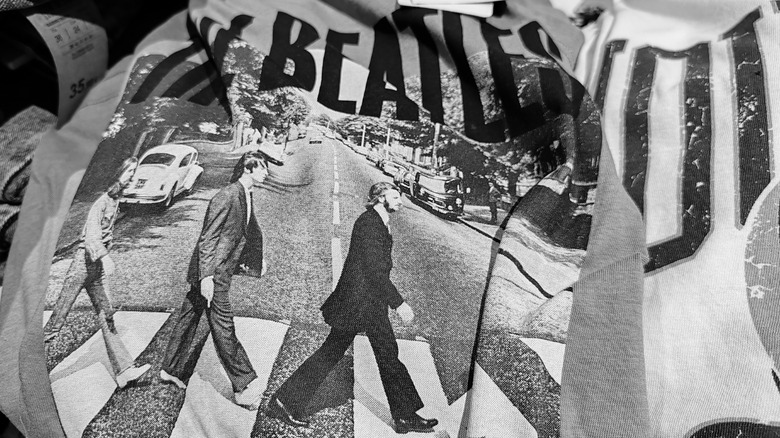
If any band represented the state of rock music circa 1969, it was the Beatles. That year, the Fab Four – arguably the musical vanguard of the entire '60s — released their now iconic "Abbey Road." They'd evolved rapidly over the '60s as much as the '60s influenced them, going from the harmonica and harmonies of "Love Me Do" in 1963 to the weird psychedelia of "Sgt. Pepper's Lonely Hearts Club Band" a mere four years later in 1967. Three years after that, in 1970, the Beatles' relatively brief time in the sun came to an end when they officially disbanded, releasing their final album "Let it Be" as a consolation prize. It's supremely ironic, then, that at the end of an era, one of "Abbey Road's" leading tracks was titled "Come Together."
Musically, "Come Together" is nothing that anyone could have foreseen the clean-cut British boy band of the mid-60s writing in a few years' time. It's groovy, pretty mellow, and characterized by one of the most recognizable basslines in rock history. But like the whole of "Abbey Road," "Come Together" isn't as whacky as some of the Beatles' earlier forays. The song and its album serve as a mini-retrospective and encapsulation of not only the Beatles' musical career and evolution, but the '60s as a whole. Rock, blues, folk, funk, psychedelia, and the echoes of the counterculture: They're all present in "Come Together" and its album.
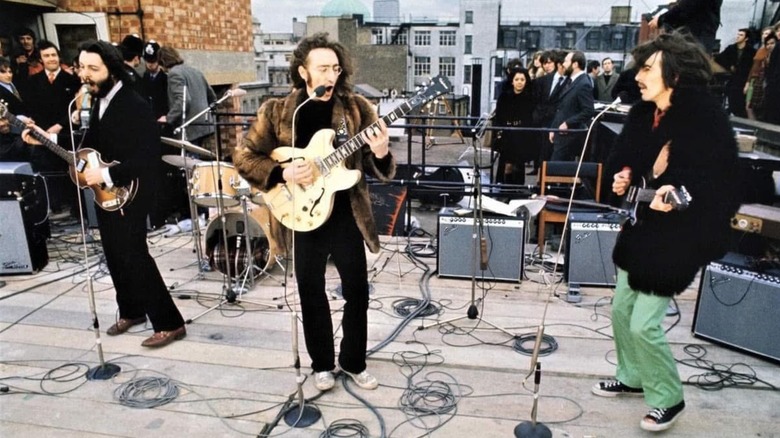
Sadly, the Beatles didn't play "Come Together" on the roof of the Apple building on Saville Row, London, in their legendary, final public performance — a performance partially included in their 1970 documentary, "Let it Be." But they did at least come together one last time to cap the decade.
Whole Lotta Love — Led Zeppelin
If any band represented a passing of rock's musical torch from one decade to the next, it was Led Zeppelin. Coming of age right as the Beatles were heading out, they released their first two studio albums in 1969, "Led Zeppelin" and "Led Zeppelin II." Blues-influenced and rhymically complex, riff-focused but with enough singable hooks, full of verve, swagger, and sex appeal, Zeppelin defined the state of rock to come while also having one foot in its past. And out of all the songs in the band's first two albums, "Whole Lotta Love" from "Led Zeppelin II" defines rock history in 1969.
If Led Zeppelin's self-titled first album was a rock-laced, lower-tempo blues foray (which rubbed critics the wrong way), the band's second album — led by "Whole Lotta Love" — was its cockier, rockier, and somewhat wilder older brother. Not only does "Whole Lotta Love" cut loose and resemble a jam session on the musical side, it openly leans into the Sexual Revolution of its day. Robert Plant's lyrics paint a bluntly horny story, with lines like, "I'm gonna give you every inch of my love," "Baby, baby, I've been yearning / Way, way down inside / Uh, honey, you need it," and, "Shake for me, girl / I wanna be your backdoor man." If that wasn't enough, there's the orgasmic vocal sounds during the song's bridge.
"Whole Lotta Love" also presages the big-hook arena rock of the '80s, with its dual focus on sex and rocking out. Come 1977, Zeppelin themselves set a world record for indoor stadium attendance at the Pontiac Silverdome, with about 76,000 fans present.
I Wanna Be Your Dog — The Stooges
Even as the Beatles were on their way out and Zeppelin was on its way in, rock's undercurrents were roiling. The '60s saw a cadre of young, energetic, raw, what were essentially garage bands hit the music scene, bands later dubbed "proto-punk" for how they laid the groundwork for mid-70s punk rock. The biggest of these bands released their eponymous debut album in 1969, "The Stooges." The album's chief single, "I Wanna Be Your Dog," represents a critical juncture in rock history when some musicians and fans chucked the whole accreted mass of '60s rock standards out the window.
"I Wanna Be Your Dog" is full of fuzzy guitars, repetitive loops, and is patently crude in comparison to much of its musical brethren. Its core, descending chord progression consists of a mere three power chords, one of the simplest types of chords to play that requires only two notes. Its drums, bass, and one keyboard note — smashed over and over are across the song's entire length — are equally basic. But this is part of the music's appeal and purpose. "I Wanna Be Your Dog" defined the reaction to, and split from, any and all '60s rock pretensions.
Plus, "I Wanna Be Your Dog" granted us a new type of rock frontman in the form of Iggy Pop. The original shock rocker, Iggy Pop, was characterized by gonzo stage antics that veered into violent territory, like when he carved an X into his chest with a knife in 1974 after trying to goad an audience member into attacking him. That's punk, alright.
Bad Moon Rising — Creedence Clearwater Revival
Even as the Beatles vanished, rock turned into arena rock, and dudes in garage bands slashed away at power chords, another branch of rock diverged at the end of the '60s to represent what we might call campfire rock, roots rock, folk rock, etc. Enter Creedence Clearwater Revival (CCR), a monstrously successful, four-piece band that exploded out of the gate to land nine top-10 singles across two-and-a-half years. Led by the succinctly genius songwriting of CCR singer and guitarist, John Fogerty, CCR released three full studio albums in 1969 alone. While we could practically choose any big single from those albums to represent this particular footprint of rock history, we're going to go with "Bad Moon Rising" from "Green River."
Imminently singable and approachable, truly a "song" rather than an abstract compositional sojourn, simple but not dumb, "Bad Moon Rising" represents top-tier music from CCR and roots rock on a whole. It's got a straightforward, 1-2, 1-2, boom-cha, boom-cha, drum-driven rhythm, open strumming, and some clean guitar licks, a perfectly structured vocal melody, and that's it. It's also an oddity for the time, as it really doesn't sound like anything else from the late '60s, including Southern Rock outfits like the Allman Brothers.
And indeed, CCR wasn't trying to sound like anyone. Fogerty condensed the band's ethos into the maxim: "be simple and speak powerfully," per Music Radar. With this guiding rock principle in mind, and the self-made label "swamp music," CCR and its bayou-laden, Deep South references outsold the Beatles in 1969. This down-home approach to songwriting is also eminently rock.
Space Oddity — David Bowie
Just in case you thought that 1969 couldn't be any more of an impressive year for rock, it's also the year when David Bowie released "Space Oddity" off his self-titled album. The song's space flight-related topic and its one-of-a-kind opening line, "Ground Control to Major Tom," synced so well with the 1969 Apollo 11 moon landing that the BBC pulled the song from radio because the fictional Major Tom meets a less-than hopeful end. It took four more years for "Space Oddity" to catch on in the U.S. on re-release, the same year that Bowie had already moved on from his Ziggy Stardust persona to Aladdin Sane with the release of 1973's album of the same name.
In other words, "Space Oddity" defined rock history in 1969 on multiple fronts. It was the first big song from one of the most revered artists of the 20th century, David Bowie, and also reflected real-world, momentous events. It might seem obvious, but yes, Stanley Kubrick's legendary 1968 film, "2001: A Space Odyssey," was Bowie's initial inspiration for the song — hence the odyssey/oddity comparison. Also, Bowie wanted to touch on general themes of "alienation and isolation" (via UDiscoverMusic) embodied in his lonely Major Tom character, trapped in space.
"Space Oddity" also fulfills our art rock, or glam rock, segment of rock's history, typified by Bowie and which carried on through the '70s. This branch of rock also formed one of the foundations of '80s "hair bands," as they were called, like Twisted Sister, Poison, Cinderella, etc., and even spilled out into theatrical, non-rock acts all the way to the present, like Lady Gaga.