

'70s Rock Songs Hiding The Darkest Metaphors
There's no shortage of rock songs from the 1970s that have stubbornly remained enmeshed in the fabric of pop culture, several decades after their initial release. Music fans have come to know them well, singing along to lyrics they memorized ages ago whenever one of these familiar classics pops up on a Spotify playlist or in a concert setlist. Interestingly, that level of deep familiarity with a song can often render it somewhat toothless, at least metaphorically speaking. Sure, we know the words by heart, but do we really understand the hidden meaning of the lyrics we're singing?
Occasionally, the symbolism concealed within those beloved rock classics tends toward the grim. For example, when the audience at a Don McLean concert joyfully sings along to "Bye, bye, Miss American Pie," do the concertgoers realize they're actually singing about the plane crash that took the lives of Buddy Holly, Ritchie Valens, and The Big Bopper? In fact, "American Pie" is far from the only song with lyrics and an unforgettable melody that mask some somber themes. That's certainly the case with these '70s rock songs hiding the darkest metaphors imaginable.
Eagles — Hotel California
The Eagles' "Hotel California" has become so recognizable that it immediately invites the listener to join in on the singalong chorus, "Welcome to the Hotel California." The title track on the 1976 "Hotel California" album boasts cryptic lyrics that evoke a feeling of elegant decadence. It feels like the story of someone who's stumbled upon a seemingly glamorous hotel, realizing too late that "you can check in any time you like, but you can never leave."
When examining the hidden meaning of the Eagles' "Hotel California," the lyrics are wide open to interpretation — and those interpretations trend dark. The titular Hotel California has been viewed as a metaphor for various things, from the death of 1960s idealism to a literal trip to hell to the inevitable self-destruction awaiting the greed, hedonism, and excess that characterized a California rock star's life during the 1970s. Some have even insisted the song is a paean to Church of Satan founder Anton LaVey.
For Don Henley, who wrote the song's lyrics alongside Glenn Frey, the metaphors within the song are deliberately murky, with one person's interpretation as valid as another's. "Well, I always say, it's a journey from innocence to experience," Henley said in a 2016 interview with "CBS Mornings." "It's not really about California; it's about America. It's about the dark underbelly of the American dream. It's about excess, it's about narcissism. It's about the music business. It's about a lot of different ... It can have a million interpretations."
Bruce Springsteen — Born to Run
In unpacking the untold truth of Bruce Springsteen, it's clear that "Born to Run" has become his signature song. For fans, it's a joyful ode to the open road — of putting the pedal to the metal in a fast car destined for freedom while singing, "Baby, we were born to run!" And thanks to the song's majestic, bombastic production, "Born to Run" sure sounds like that. A closer perusal, however, reveals a song loaded with metaphors — and dark ones at that.
The lyrics reveal that the narrator and his girl, Wendy, aren't running to something as much as they're running away from their soul-killing present circumstances. There's a sense of desperation in their attempt to leave a town that "rips the bones from your back" as they "sweat it out on the streets," tearing down the highway in "suicide machines" to escape the "death trap ... a suicide rap" while they're still young enough to get out. Escape, though, is not guaranteed. "The highway's jammed with broken heroes," and "there's no place left to hide." Whatever happens, he promises to "live with the sadness."
That darkness comes through more clearly in stripped-down, acoustic performances. There have, however, been other interpretations. In a 2015 essay for The Atlantic, for example, academic Joshua Zeitz put forward his thesis that "Born to Run" was Springsteen's sociopolitical statement on "the tense, political, working-class rejection of an increasingly unequal society."
Bob Dylan — Tangled Up in Blue
Bob Dylan has been loath to explicitly explain the meaning of his songs, but he did offer some rare insight into "Tangled Up in Blue," the acclaimed track from his masterful 1975 "Blood on the Tracks" album. "There's a code in the lyrics and there's no sense of time," he told Rolling Stone in 1978. "There's no respect for it. You've got yesterday, today, and tomorrow all in the same room, and there's very little that you can't imagine not happening."
Of course, that statement is also typical of Dylan, posing more questions than he answered. However, the "blue" in which the song's narrator has become entangled is often interpreted as representing melancholy, and its lyrics represent past vignettes from a romance that crashed and burned. Notably, "Blood on the Tracks" has famously become known as Dylan's "divorce album," written during the final days of his disintegrating marriage to wife Sara.
While that interpretation certainly holds up, the "blue" in "Tangled Up in Blue" may have another meaning altogether. According to Ron Rosenbaum, writing for Slate, the song is actually an homage to Joni Mitchell's acclaimed album "Blue." "Bob Dylan once told me that he'd written 'Tangled up in Blue,' the opening song of the much-celebrated 'Blood on the Tracks,' after spending a weekend immersed in JM's 'Blue' (although I think he may have been talking about the whole album, not just the song)," Rosenbaum wrote.
Pink Floyd — Welcome to the Machine
It's arguable that no Pink Floyd album has been as jam-packed with metaphorical imagery as 1975's "Wish You Were Here." Both the title track and standout song "Shine On You Crazy Diamond" refer to the band's former frontman, Syd Barrett, whose deteriorating mental state was the real reason he left Pink Floyd. Then there's "Have a Cigar," a scathing commentary on money-hungry music executives prioritizing greed over art. Adjacent to that song is "Welcome to the Machine," a grim, atmospheric, and downright spooky track.
The titular machine can be viewed as a metaphor for the music industry, with lyricist Roger Waters equating the production of records with the making of sausages. When a musician is signed by a major label, Waters opines, they become a cog in a vast money-making enterprise that only values them until they can no longer keep churning out hits. As the lyrics illustrate, any dreams an aspiring rock star may have had are ultimately replaced by new ones. "It's all right, we told you what to dream," Waters sings. "You dreamed of a big star ... He loved to drive in his Jaguar."
According to Waters, his metaphor is actually a larger one. "You could say that 'Welcome to the Machine' is only about my experience in the music industry. It's not," he said in an interview posted to Pink Floyd's Facebook. "It's about all our experience in the face of that monstrous grinding thing that chews us up and spits us out."
The Rolling Stones — Brown Sugar
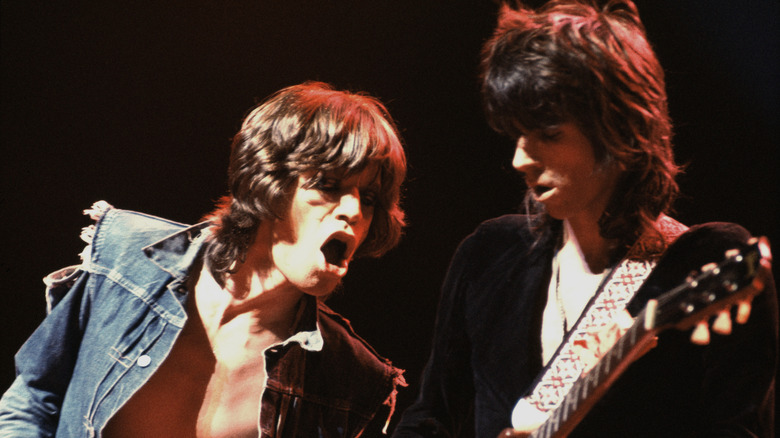
The straight-ahead rocker that kicks off The Rolling Stones' 1971 "Sticky Fingers" album, "Brown Sugar" represents the band at its finest. The song is driven by a jarring, jagged Keith Richards guitar riff, which actually came from Mick Jagger, who wrote the song in its entirety. Of course, even the most cursory examination of the song's lyrics makes it clear that "Brown Sugar" has nothing to do with sugar and can be seen as a metaphor for a Black woman — or, more specifically, a Black female slave in the Antebellum American South. She was "sold in the market down in New Orleans" by a "scarred old slaver," and anyone listening can hear him "whip the women just around midnight."
Another interpretation of "Brown Sugar" is that it's a metaphor for heroin. In 1995, Jagger confirmed that during an interview with Rolling Stone. "That's a double entendre, just thrown in," Jagger said. "God knows what I'm on about on that song," he later added. "It's such a mishmash. All the nasty subjects in one go. ... I would never write that song now."
In any case, over the years, the song's lyrics had become problematic enough that the Stones removed "Brown Sugar" from the band's concert set lists in 2021. At the time, Richards defended the song by offering his own interpretation. "Didn't they understand this was a song about the horrors of slavery?" he told the Los Angeles Times.