

Devo's Version Of (I Can't Get No) Satisfaction Leaves The Rolling Stones' Original In The Dust
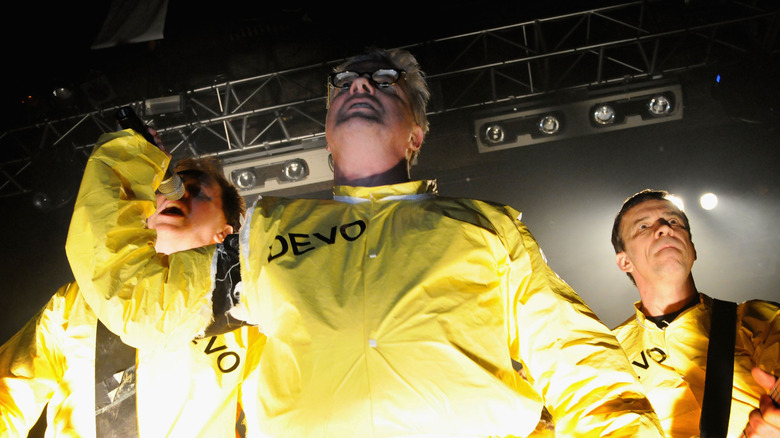
With its unforgettable opening guitar riff, driving backbeat, and moaning vocals, "(I Can't Get No) Satisfaction," released in 1965, put The Rolling Stones on the map. It was the first of the band's singles to top the U.S. Billboard Hot 100 chart. Mick Jagger's verses about alienation, desperation, consumerism, and sex over Keith Richards' distorted guitar announced the band as The Beatles from the rougher part of town. That's legendary, no doubt. But Devo's quirky, 1977 cover of "Satisfaction" — included on the group's first full-length album, "Q: Are We Not Men? A: We Are Devo!" — mines this rich source material, extracts its ore, runs that through a factory, and ends up with a superior product. There's no denying the original has swagger, but it walked — maybe "strutted" is more apt — so that Devo's cut could run.
Sometimes, it takes a cover to expose what makes a song brilliant by casting it in a new light. Consider how Otis Redding's horn-driven rendition from the "Otis Blue/Otis Redding Sings Soul" LP, released the same year as The Rolling Stones' original, is so much sultrier and more anguished. But nobody could have done "(I Can't Get No) Satisfaction" like Devo, especially in the group's more experimental early days. Machine-like, spastic, and sped up, the band's version better encapsulates the song's desperation, alienation, and frustration. With apologies to Jagger and Richards, we think it's a cover so innovative that it eclipses the original.
I can't get no de-evolution
Devo didn't start as a band — it emerged as an expression of a school of thought, a multimedia art project and movement: an "Art Devo." It hinged on the concept of de-evolution: The idea that humanity is evolving in the wrong direction (de-evolving), getting dumber and more violent as industrial and consumer society advances. Devo-the-band aimed to produce what vocalist and keyboardist Mark Mothersbaugh called "simple, bold, somewhat transgressive imagery designed to elicit either a laugh or scorn (or both). ... a conceptual gun to the head" (via Kent State University School of Art).
What makes Devo's version of "(I Can't Get No) Satisfaction" so cool is that it's literally a de-evolution of The Rolling Stones' original. The band's treatment dispenses with the signature opening guitar riff (which Richards claims he wrote in a dream) and replaces it with wailing single-note guitar lines over a spastic, machine-like groove. This minimal, assembly-line feel makes the alienation and desperation in the lyrics more scathing. The lines, "When I'm driving in my car / And a man talks on the radio / He's telling me more and more / About some useless information" cut deeper when delivered with Mothersbaugh's controlled but anguished wail.
Where The Rolling Stones evoke desperation and a kind of defiance with "(I Can't Get No) Satisfaction," Devo's de-evolved version is more dystopic. In the band's new telling, the satisfaction we chase is mass-produced in factories, and our lives seem to be dictated by awful machinery. Sound familiar?
An anticonsumerist anthem from another timeline
Lyrically, "(I Can't Get No) Satisfaction" lashes back at consumer culture, something that gave The Rolling Stones instant credibility as an anti-establishment band. Satisfaction is impossible, "When I'm watching my TV / And a man comes on and tells me / How white my shirts can be." That kind of critique attracted Mark Mothersbaugh to the song, which Devo performed at different speeds since their early days. "I think those are some of the most amazing lyrics that were ever written in rock 'n' roll," he told The New Yorker, "dealing with conspicuous consumption and the stupidity of capitalism and sexual frustration all in one song." Shaped by the same struggle against the establishment, Devo formed as a response to the Kent State shooting of student anti-Vietnam War protesters, which Mothersbaugh and Devo co-lead vocalist/bass player Jerry Casale witnessed.
The Rolling Stones' "(I Can't Get No) Satisfaction" is canonical: An anthem that takes boomers back to high school and part of the soundtrack of their youth rebellion. But in the hands of Devo, it's a frantic rant from an alternate, darker timeline. As much as any of their early songs, it encapsulates the spastic weirdness that made the band special. Sounding ahead — not just of — its time, the cover updates Jagger and Richards' biting original for a dystopian, automated future: One that looks increasingly like the world we see today.