

5 Killer Rock Anthems Born From Snoozy Flop Songs
While a lot of great songs deservedly become hits, so many others completely tank because they were misinterpreted, presented to the public in the wrong way, or simply failed to strike a chord. But underneath that first, underwhelming take or lackluster production, there's the bones of a good song, deep down. Such songs might completely flop in their early forms, reaching only the lower rungs on the Billboard pop chart or missing it entirely. And so, those pieces, labeled failures, disappear into the annals of embarrassing and boring music — they were dull and uninteresting anyway.
Or were they? Because years later, a solo artist or a band with a strong, hard-rocking sensibility may come along and uncover those forgotten flops. Then they reinvent them with the addition of thundering drums, heavy bass, and layers upon layers of guitars. The result: loud, heavy, fist-pumping, head-banging, anthemic classic rock with a palpable edge that's also an unexpected and unlikely cover of a song once considered so bland that audiences actively avoided it. Here are five rock 'n' roll classics that improved on dreary or forgettable originals.
All Along the Watchtower
Bob Dylan is a Nobel Prize-winning voice of the boomer generation, responsible for poetic strokes of genius such as "Tangled up in Blue" and "Knockin' on Heaven's Door." But he emerged from the folk revival of the 1960s — in other words, Dylan has never really been a rocker. "All Along the Watchtower," from his 1967 release "John Wesley Harding," finds the musician at his folkiest. He strums along with himself as he nasally slurs his way through cryptic lyrics about jokers, thieves, and wildcats. It's a challenging song with a winding melody, and it never really takes off. The song was never released as a single in the U.S., and thus it was never a pop hit.
But when preternaturally talented guitar wizard Jimi Hendrix got a load of "All Along the Watchtower," he heard something else. In 1968, the Jimi Hendrix Experience unleashed a fiery, foreboding, and agitating cover of "All Along the Watchtower." Hendrix, already a legend for his instrumental prowess, gives an equally impeccable vocal performance, snarling and soul-baring, as he turns the song into a frenetic, unrelenting psychedelic odyssey that quickens the pulse and sends thoughts racing. Hendrix's version is by and large considered the definitive take on "All Along the Watchtower," associated with the late '60s counterculture movement to the point that it's been used to convey mood and setting in dozens of films and TV shows. It's also the only single the Jimi Hendrix Experience would ever place in the Top 40.
Come on Feel the Noize
After an enticing and forceful drumbeat, the rest of the instruments in Quiet Riot's "C** on Feel the Noize" rush in and instantly build a wall of sound as furious, energetic, ear-splitting rock 'n' roll rages for five minutes. Frontman Kevin DuBrow forcefully bellows and leads sing-alongs while the drums relentlessly pound and the guitars alternately crunch and wail. It's all very heavy metal at its most definitively '80s while remaining melodic and approachable — so much so that "Metal Health," the 1983 album from whence the song came, became the first metal release to ever reach No. 1 on the Billboard Top 200 LP chart.
Such success was a milestone moment in the bizarre history of heavy metal music. Quiet Riot's best-known song and biggest hit is a souped-up, metallic take on a corny glam-rock song from 1973 by the British band Slade, rejected by U.S. listeners upon first release and stalling at No. 98 on the Hot 100. Glam bands liked chugging guitars and danceable drum beats to create a party-like atmosphere befitting their then-outrageous stage shows. The music of glam bands, like Slade, was pop-friendly, but it certainly didn't go all-out rock the way that a group like Quiet Riot did.
I Love Rock 'n' Roll
In the 1970s, the Arrows was an unknown entity in the U.S. and mildly successful in the U.K., landing two songs on the pop chart there in 1974 and 1975. Similar to other kid-marketed bands of the era such as the Hudson Brothers and the Bay City Rollers, the Arrows had a TV variety show, simply titled "Arrows." Band members Alan Merrill and Jake Hooker wrote a song called "I Love Rock 'n' Roll," which their producer didn't care for enough to commercially showcase but still let the Arrows perform on TV. Oddly, the Arrows' version of "I Love Rock 'n' Roll" doesn't rock all that much — the drums are tinny and the guitars understated before leading into an underwhelming and meandering solo.
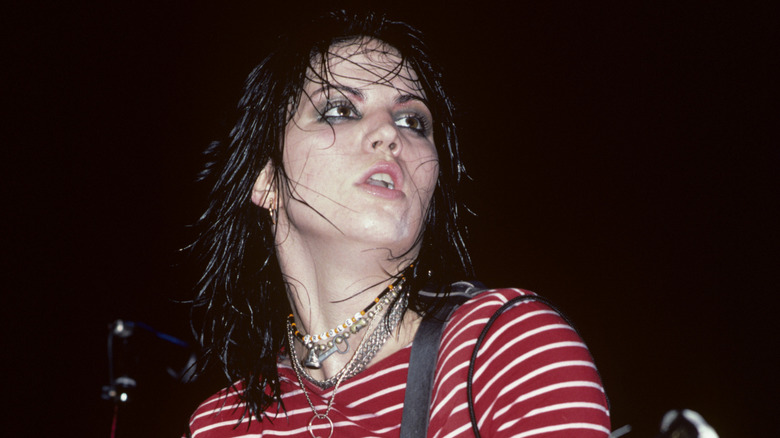
But Joan Jett knew that "I Love Rock 'n' Roll" would be best served as a hard-rock tune in which a capable guitarist or two could absolutely shred alongside a drummer allowed to pound the skins as hard as possible. While Jett was touring the U.K. in the late 1970s with her band the Runaways, she saw the Arrows perform "I Love Rock 'n' Roll" on their show. The Runaways didn't feel like recording a cover, so Jett saved the idea for her solo career, re-recording "I Love Rock 'n' Roll" with her band the Blackhearts. First released as a B-side on a Dutch single release, it became a hit and spent seven weeks at No. 1 in 1982.
Hello Hooray
It's not that Judy Collins' music is bad, but it's almost categorically slow, sleepy, and chilled out. Equal parts folk singer, soft-rock performer, and cabaret act, she's best known for ballads like "Send in the Clowns" and "Hello Hooray." The latter, originated by musician Rolf Kempf and told from the point of view of an extremely nervous musician about to perform a big show, appeared on Collins' 1968 LP "Who Knows Where the Time Goes." Collins' version of "Hello Hooray" never hit the charts, while the "Who Knows Where the Time Goes" album wasn't widely embraced either, peaking at No. 29 on Billboard's LP chart.
And yet "Hello Hooray" became a signature song for Alice Cooper in 1973, when the act was known for its provocative material and horror-laden, gross-out stage show. Producer Bob Ezrin presented "Hello Hooray" to Cooper to get him to cover it for his album "Billion Dollar Babies." Cooper said no, as he considered "Hello Hooray" too folky and out of his wheelhouse, but then Ezrin pointed out that the theme of the song matched Cooper's career moment in which he had to follow up the commercial breakthroughs of "School's Out" and "Elected." Under Ezrin's control, "Hello Hooray" definitely wasn't folk. He added cannon sound effects, echo, and multi tracks of screaming guitar riffs to emphasize Cooper's theatrical vocals. The experiment worked — "Hello Hooray" hit the Top 40.
Got My Mind Set on You
The story of George Harrison includes the musician's difficulty getting the other Beatles to record the songs that he brought to the group, be they ones he wrote himself or ones he wanted to cover. He never did cut "Got My Mind Set on You" with the Beatles, waiting until 1987 to release his take on an obscure and unpopular R&B record by James Ray, written by Rudy Clark, that Harrison discovered in 1963 when he was still a part of the Fab Four. He saw a gem buried in what he found to be a lackluster album, a song called "Got My Mind Set on You."
"If you listen to the song now it's very different from how I've done it. I've updated it and changed the chords, because I preferred it the way I heard it in my head," Harrison told Musician (via "The Billboard Book of Number 1 Hits"). "Clark and Ray's version of it was coming out of the old jazz-swing era, and it has these horrible screechy women's voices singing those backup parts."
Harrison sped up "Got My Mind Set on You" and added some guitar and keyboard riffs, a jaunty saxophone solo, and a propulsive and irresistible drumbeat. His catchy, pop-rock remake went to No. 1 in early 1988. It was major comeback hit for Harrison, who hadn't had a Top 10 hit since 1981.