

5 Flop Songs From The '60s We Can't Help But Love
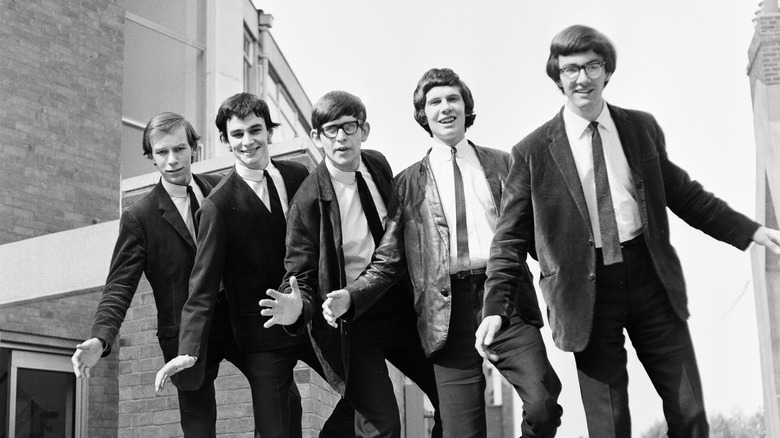
The 1960s gave us some of the biggest musical acts of all time, such as The Beatles, The Rolling Stones, the Beach Boys, Bob Dylan, and Aretha Franklin. But it was also the era in which the dream of being a pop star — or, more specifically, being in a rock band — exploded. This was especially true in the aftermath of Beatlemania, when teenagers across the country decided to try their hand at becoming rock gods, producing a plethora of garage rock bands. Many of these groups were short-lived and released maybe a single or two for a generally local following, before calling it quits or forming other groups.
While these artists, as well as those from other genres like folk and soul, may have only reached a limited listenership before their careers ended, many of their records have since been rediscovered by later generations of listeners and became cult classics. These five songs utterly failed to bother the charts as singles or as key tracks on albums that also failed to chart upon their first release. Nevertheless, we think each is representative of the joyous boundary-pushing that characterized the low-budget recording artists of the 1960s.
Don't Look Back — The Remains
"Don't Look Back" by Boston-based garage rock outfit the Remains has been immortalized thanks to its inclusion on "Nuggets: Original Artyfacts from the First Psychedelic Era, 1965–1968," the influential 1972 compilation that has long been a gateway for those interested in the alternative '60s scene.
With a charismatic performance from frontman Barry Tashian, the song has warm, fuzzy guitar tones throughout, and an unforgettable breakdown reminding listeners to kick against those who attempt to maintain the status quo while the counterculture was in full swing. "Truth is the light/ The light is the way," sings Tashian on a track notable for lacking the sour tone of much of the garage rock of the era.
The track was composed by Tashian's fellow '60s rocker Billy Vera, and despite its intelligent lyricism and attention-grabbing arrangement, it failed to manifest into a hit for the Remains. The band had the honor of supporting The Beatles on their American tour in 1966, the same year that "Don't Look Back" was released, and even played on "The Ed Sullivan Show." But despite the talent on display, the Remains never developed much of a fanbase. Though the band had enough backing to cut a full self-titled studio album, the Remains had already split by the time it hit record stores, and it was destined only to become a cult favorite. The album, on which "Don't Look Back" remains the standout track, was finally rereleased in 2007.
U.F.O. — Jim Sullivan
If you're someone who enjoys digging out dusty old obscure classics that really deserved far more attention than they got, Jim Sullivan's 1969 album "U.F.O." is a must-listen. It's a lost gem that says much about the era in which it was created, and the album's title track is arguably its stand-out.
The song "U.F.O." is lyrically dense and packed with references to Sullivan's obscure obsessions, such as extraterrestrials, with songwriting that marries effectively with The Wrecking Crew's tasteful instrumentation. Strings swell throughout, giving the song a rich melancholy that complements the sense of awe arising from the subject matter, while Sullivan's warm vocal grounds the song in folk and country, despite the weirdness underpinning it.
Sullivan released one more album in 1972, but his career failed to take off. In March 1975, he left his family in Los Angeles to seek his fortune in Nashville, Tennessee. However, he never got there. His car was discovered in Santa Rosa, New Mexico, his guitar in the passenger seat. He was never seen again, and much of the mystique that has built up around "U.F.O." relates to how prescient many of his lyrics seem to be of Sullivan's strange, unsolved disappearance ... or abduction?
One Potato, Two Potato — The Elite
The Elite was a well-regarded local band in the mid-1960s in Texas' famously fecund Fort Worth garage rock scene, but its following remained local. "One Potato, Two Potato" is perhaps the most enjoyable of the Elite's singles, a song that spans both sides of the 7-inch record. Combined, the performance lasts just over three and a half minutes, and the band's youthful energy fills it with effervescent passages that switch between playground chats, nonsensical vocals lifted from the Trashmen's "Surfin' Bird," cacophonous drum fills, smooth-surf rock guitar passages, and climactic grunts and screams from the band members.
The Elite fell apart after just a few years together, with its members joining other bands. But as lead singer Rodger Brownlee told the Star Telegram back in 2004: "The level of notoriety we had in the Elite was never matched ... we agreed that we never had the same feeling of exuberance or excitement with any of the other bands we were in. It was like losing your true love. It was a period of time that would only happen once" (via Malcolm Mayhew). Indeed, "One Potato, Two Potato" demonstrates just how much fun it must have been.
Egyptian Shumba — The Tammys
Girl groups of the early 1960s were typically smooth, composed, and classy. The Tammys, however, was something else entirely, and while the band's music may not have made the national charts, the best of its singles, "Egyptian Shumba," has emerged as an eccentric cult classic over the years.
The Pennsylvania group, made up of sisters Gretchen, Cathy, and Linda, was championed by fellow pop star Lou Christie, who helped them cut three singles. While the others are standard girl group fare, "Egyptian Shumba" is notable for the sisters' frenetic adolescent vocal style, which includes chorus passages in which the girls simply scream as if they were in a schoolyard.
Their vocals are accompanied by a mock-Middle Eastern instrumentation, and the contrast utterly undermines the apparent attempt at exoticism. The song is simply bags of fun, and danceable too, but put it on at a party and the screams are sure to divide the room.
Care of Cell 44 — The Zombies
Listening to it today, it seems unbelievable that The Zombies' "Care of Cell 44" failed to chart in the band's native U.K. in 1967, or in the U.S. on its later release in 1968. The song just oozes that '60s sound, and, like the band's big hit "Time of the Season," has the power to transport you back to that era from its opening bars.
An uplifting pop number that nevertheless deals with the unusual topic of writing to a loved one in prison, "Care of Cell 44" has been compared to the work of The Beach Boys' Brian Wilson and The Beatles' Paul McCartney, both obvious influences on The Zombies' songwriter Rod Argent. The song has an ambitious arrangement, with multiple bridges and purely a cappella harmonies that burst again and again with rousing hooks featuring full instrumentation. Argent's voice is as pure, warm, and melodic, while Chris White's exceptional bass performance gives the track an irresistible groove.
"Care of Cell 44" is a hit that never was, but it gained popularity the following year after the success of "Time of the Season," which revived the fortunes of the band just as The Zombies were about to call it a day.
My Pal Foot Foot – The Shaggs
Often considered a song so bad that it's actually good, the Shaggs' "My Pal Foot Foot" is a weird slice of outsider music that tells the story of someone looking for a missing friend — the Foot Foot of the title. The song was performed by three young sisters with little prior musical knowledge, who, in one of the strangest origin tales in music, were forced to practice to become a rock band by their father, who had been foretold by his mother, a supposed psychic, that he would have three famous musical daughters.
Technically, that is true. However, the Shaggs failed to make any commercial breakthrough in 1969 — the sisters' playing style is distinctly non-standard and often off-tempo, as heard on "My Pal Foot Foot". But the band's music has gained a cult following over the years, with prominent fans including Kurt Cobain and Frank Zappa, the latter of whom once claimed that the Shaggs' naive music was better than the Beatles. Indeed, the Shaggs may have unwittingly found itself at the forefront of the musical avant-garde. For listeners with a taste for seeking out the stranger corners of the music of the late 1960s, "My Pal Foot Foot" has grown to be an essential release.
Oscillations – Silver Apples
The blending of electronics and rock music didn't come easily in the 1960s — indeed, it only became common practice many years later. But back in the day, the American experimental band Silver Apples was laying the groundwork for later developments with incredibly forward-thinking — and commercially non-viable — tracks such as 1968's "Oscillations."
The work of New York musicians Simeon Coxe III and Danny Taylor, Silver Apples as a musical project benefited from cheap accessibility to cast-off electronic equipment used by the U.S. military during World War II. One of these devices was an oscillator, originally used to jam Axis communication devices with strange frequencies, but which could, in the right hands, be used to make unusual music.
"Oscillations" contains much that is derived from the psychedelic rock of the era, but is mindbogglingly prescient in its use of electronics in rock compositions. A total flop at the time, it is now widely regarded as a pioneering electronic record.
Complication – Monks
Monks was a band of American GIs stationed in Germany who set about making some of the weirdest music of the 1960s. Formed originally as a straightforward covers band, its members began shaving the tops of their heads and donning monk attire, while the music they played grew increasingly acerbic, turning them into proto-punk pioneers. "Complication" was both released as a single and a track on Monks' 1966 debut album "Black Monk Time," and highlights why this obscure band has come to develop a strong cult following down the years, especially among prominent alternative artists such as Iggy Pop and Mark E. Smith.
As with much of the work the band produced in the few short years it was together, "Complication" combines a bevy of different drum patterns with grinding bass, guitars and keys, high-pitched, croaky vocals, and an unpredictable arrangement that meant it was destined never to be a huge pop hit. But give it a listen today, and it sounds fresh and riotous, although it is obviously shot through with playful humor. As the liner notes to "Black Monk Time" explained back in 1966: "Listen, as Roger beats, Gary plucks, Dave pummels. And Eddie dreams hell's bass part. And Larry fingers the keys of the day after tomorrow. The monks believe in nothing. The monks believe that everything is possible" (per the Monks Official Website).
If Not This Time – Fifty Foot Hose
Many of the cult records of the late 1960s failed to find an audience at the time due to being just too ahead of their time, though this often meant an appreciative following later on. San Franciscan psychedelic band Fifty Foot Hose's debut album "Cauldron" is one such example. A strange combination of psychedelic rock, electronics, and avant-garde composition, the album's standout track, "If Not This Time," sounds both of its era and exceptionally ambitious. The track is replete with electronic elements and studio trickery, such as singer Nancy Blossom's double-tracked vocals, pushing the exploratory track into trippier waters than other era-defining music by contemporaries such as Jefferson Airplane.
The array of electronic textures that fizz and squelch throughout the track was the work of founder member Cork Marcheschi, who fashioned his own electronic instrument from assorted objects that included theremins, ex-military radio parts, and fuzz boxes. However, as "If Not This Time" shows, Fifty Foot Hose used such innovations tastefully; though challenging, the track is soothing rather than abrasive, and while not especially catchy as a pop track, it is atmospheric enough to fit alongside the bigger hits of psychedelia.
Making Time – The Creation
British freakbeat combo the Creation has been compared to the Velvet Underground for being a band that, at the time, didn't gain the commercial success it deserved, but which has been cited by generations of musicians as an important touchstone of the 1960s. The stomping track "Making Time" shows the band at the height of its powers, and begs the question now why the Creation couldn't get to the next level.
As well as having a driving rhythm and an infectious guitar part reminiscent of early Kinks hits, the track is notable for being one of the first known examples of a guitar being played with a violin bow, with the Creation guitarist Eddie Phillips beating the Yardbirds' Jimmy Page to the innovative technique. It is a raw but melodic track that seems to anticipate some of the biggest bands of the next three decades, such as Oasis.
"Making Time" was the band's first single under the name the Creation — its core members had previously performed and released music together as the Mark Four — and while it had minor chart success in Britain, it failed to chart in the U.S.
Defecting Grey – The Pretty Things
The Pretty Things was a long-running British rock outfit that went through several iterations down the years, eventually earning a modicum of success in the U.S. in the late 1970s. But arguably the band's best music came out in 1967, when it was at its most experimental and psychedelic. "Defecting Grey" was released as a standalone single alongside that year's "S.F. Sorrow" LP, a conceptual work about the life of the title character that may have influenced The Who's rock opera "Tommy."
The song alternates between waltz-y verses and driving hard-rock passages, interspersed with back-tracked guitar solos that recall experimental Beatles tracks such as "Strawberry Fields Forever." The track feels incredibly evocative of that time, but sadly for the band there was little audience for it when released as a single, and "S.F. Sorrow" also failed commercially. To fans, it seems incomprehensible that "Defecting Grey" isn't held among the classics of the era, but to those in the know, it remains a much-loved hidden gem by an underappreciated band.
Children of the Sun – The Misunderstood
Few bands of the 1960s managed to make a sound as heavy as the Misunderstood, whose 1969 single "Children of the Sun" features the kind of raw aggression that rock bands of all generations crave to replicate. The California band was discovered by the legendary British DJ John Peel in 1966, who convinced its members to relocate to the U.K., where he believed The Misunderstood might find a more enthusiastic audience.
It wasn't to be: Though the Misunderstood gained a certain degree of critical adulation, the band lost label support after lead singer Rick Brown was drafted into the Vietnam War, and it had split by the time "Children of the Sun" was released. It's a shame, because the track easily fits alongside the best of the psychedelic blues-rock that emerged in the wake of the British Invasion, with chunky bass tones, vocals that grab the listener by the throat, and a tremolo-drenched guitar wig-out for a finale that gives a hint of what the Misunderstood must have been like as a live act.
There's a Break in the Road – Betty Harris
"There's a Break in the Road," which failed to chart upon its release in 1969, was New Orleans soul vocalist Betty Harris' final single before retiring from the music industry in 1970. For this reason alone, it's a bittersweet listen. Fans are blessed to have a great catalogue of Harris singles from the 1960s, of which "There's a Break in the Road" is just one. But the track shows that the singer, who had made a name for herself as a tasteful interpreter of the soul songs of her longtime collaborator Allen Toussaint, had the rawness and verve to become a funk icon if she had remained in the business over the next decade.
Over spiky guitars and an irresistible bass groove supplied by Leo Nocentelli and bassist George Porter Jr. of The Meters, respectively, as well as an expansive drum part from jazz drummer James Black, Harris crackles with power and defiance as she rails against a former lover who has mistreated her. The vocalist may have been channeling her frustration against the music industry itself, which treated her much like the man in the song, and it makes for a spellbinding performance on a funky track that could still fill a dancefloor today.