

This Wonky No. 1 Song From 1958 Will Ruin Your Week (And Every Christmas)
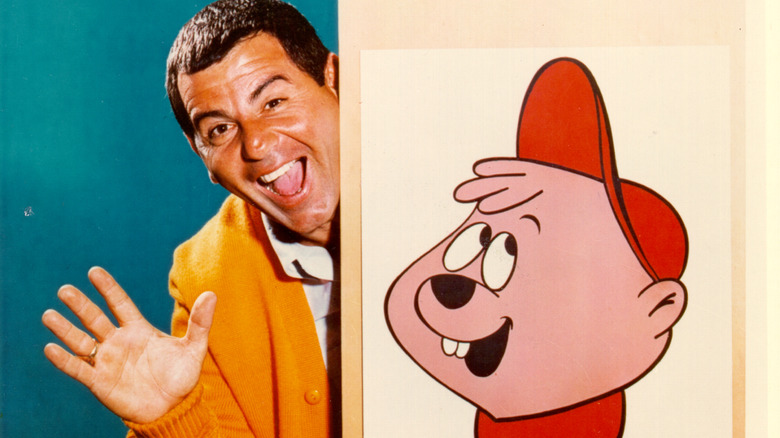
Of all the hit singles from the 1950s that are so painfully dated, repellent, and prohibitively odd that we can't help but wonder how they ever actually went to No. 1, none are more so than the 1958 chart-topper "The Chipmunk Song." Technically, it's a Christmas song, but we think it's a terrible, indefensible tune no matter the season.
"The Chipmunks with David Seville" is the credited act, but those two halves are one and the same. "The Chipmunks" were a fictional trio of rodent brothers rendered as illustrations, created by Ross Bagdasarian, who wrote and produced the record (and appears as a frustrated audio engineer) under the stage name David Seville. The song itself consists of pitch-shifted voices expressing vague platitudes about Christmas as well as the want for a hula hoop, a major fad toy of the '50s, and it sold 2.5 million copies in three weeks and spent four weeks at No. 1. "The Chipmunk Song" also won three Grammy Awards, making it one of the worst pieces of music to ever sell that well and get that much industry acclaim. Here's a look back on the inexplicable phenomenon of "The Chipmunk Song," the most unlistenable and altogether worst No. 1 hit that should've been left in 1958.
The Chipmunk Song is musically weak and annoying
As David Seville, Ross Bagdasarian had already topped the charts earlier in 1958 with "Witch Doctor," where he perfected the technique he'd use to create the voices ascribed to the Chipmunks. He recorded at an extra-slow speed, then played it at a normal tempo, creating high-pitched voices. Inspired by an encounter with a stubborn chipmunk, Bagdasarian thought about how his son, Adam, started inquiring about Christmas in the fall, and built the song from there. While trying to create one of the best fictional bands of all time, he decided that there should be three Chipmunks, and he named them Alvin, Simon, and Theodore after three employees at his label, Liberty Records.
Apparently not wanting to add too much to the novelty of animals that spoke in extremely irritating voices so high that they're tough to understand, Bagdasarian didn't put much effort into the rest of "The Chipmunk Song," sometimes subtitled "Christmas Don't Be Late." There's little accompaniment beyond a single guitar playing the same five notes over and over, and the singers don't bother to modulate their voices with a similarly repetitive melody, which doesn't move up and down the musical scale very much.
The dynamic between the Chipmunks and their handler was always off-putting
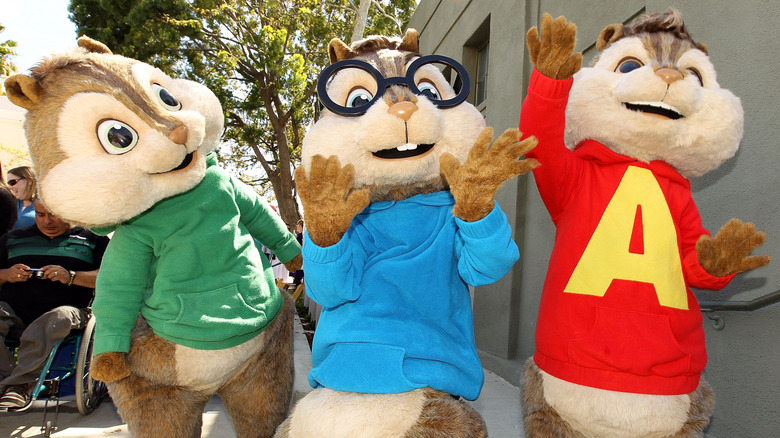
The only time that "The Chipmunk Song" is at least a little clever is in its meta presentation. Listeners get to hear not just the song but also the recording process, albeit a scripted and staged one. And that's where things get uncomfortable. Between verses, Bagdasarian (as Seville) speaks up from the booth to offer his notes — praise for Simon and Theodore and nothing but disdain for Alvin, the troublemaker of the group. He repeatedly bellows at what is essentially a child for not paying close enough attention and for being "a little flat," ominously ordering him to "watch it." Then, when all the Chipmunks commit the apparently unforgivable sin of wanting to sing their fun Christmas song again, he gets really ticked off.
Cartoon characters change over time, and the Chipmunks trio certainly did. "The Chipmunk Song" was the first strike in a franchise that would lead to more Top 40 singles, millions in record sales, a 1980s Saturday morning cartoon show, and a series of blockbuster movies in the 21st century. More often than that, the humor was derived from the tension between the innocently mischievous children and the quick-to-anger David Seville. And it all came from a strange, unfunny, and just plain bad lark of a '50s hit.