

Nursing Home Hits That'll Put Smiles On Seniors' Faces
The music you remember from your youth sorts you into a generation as surely as any other cultural reference or phase of life. Musical cultures, and the emotions tied up in our memories of them, allow songs to "sound" millennial, Gen-Xish, or boomery ... or even representative of older generations, back when people bought vinyl records not because they were deliberately making a point but because that's all there was! We're talking about a time even before recording songs off the radio onto a cassette.
For timing, we've chosen songs here that someone around 80 years old might remember from their teenage years or early adulthood, moving a few years back in time from the '70s music most boomers claim as the soundtrack of their youth. We've gathered four energetic bops and one slower, slightly sadder song with an interesting place in music history: the very first No. 1 track on the Billboard Hot 100 and the oldest track present on our list, having been released in 1958. We've also tried to dig past the most obvious hits to bring you songs you might not have had the pleasure of meeting.
Vyoch Tyoch Tyoch – The Barry Sisters
In the late 1930s, traditionally not considered an optimistic period for Jewish culture, one bright spot was an emerging hybrid genre called Yiddish swing. Sung in Yiddish and marrying klezmer influences with big-band energy, the genre was an American phenomenon that allowed Yiddish speakers to participate more readily in the modern, vibrant musical culture of the interwar United States. Two of the most glamorous ambassadors for the style were the Barry Sisters (who wisely abandoned their earlier stage name of the Bagelman Sisters), who carried the torch into the postwar 1950s and '60s. Of their recordings, one of the most charming is the flirtatious "Vyoch Tyoch Tyoch," released as a single in 1964.
You don't need to know Yiddish to love this song, and listening to it with no command of the language shows you just what masters of delivery the Barry Sisters were. Their performance of their parents' native tongue isn't even slowed down by its gutturals and consonant clusters, with the singers delivering coquettish call-and-responses, playful choruses, and a come-hither last line that probably had a number of non-Jews thinking about language lessons. (Though in fairness, the actual phrase "vyoch tyoch tyoch" only sounds like Yiddish: it's meant to reflect the sound of a heart fluttering at a cutie's approach.)
Da Doo Ron Ron – The Crystals
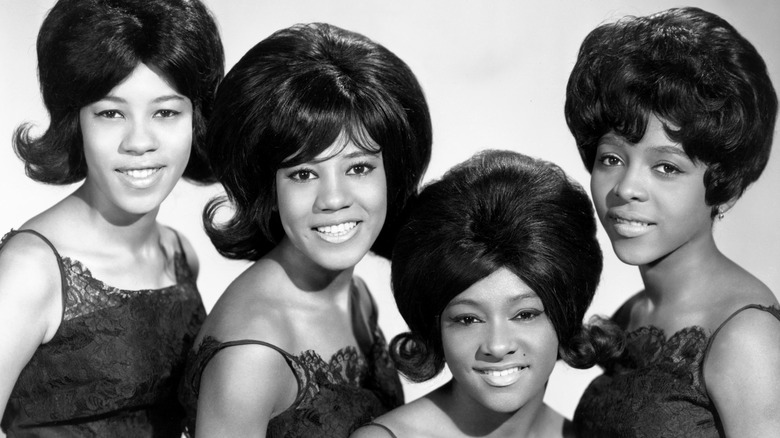
Under the wing of Phil Spector, a bad person but undeniably a production genius, the Crystals notched several hits during the girl-group boom of the 1960s. Their biggest smash was "Then He Kissed Me," but an even bigger charmer is 1963's "Da Doo Ron Ron (He Walked Me Home)," a high-energy song marking an early use of Spector's "Wall of Sound" technique of cramming a whole bunch of musicians in an echoey room and somehow getting gold out of it.
The phrase "da doo ron ron" is, of course, gibberish, a placeholder phrase to map out the rhythm that was deemed good enough to keep. The rest of the lyrics aren't much better, being repetitive teenybop silliness about a boy named Bill (sometimes changed to a girl named Jill in male-voiced cover versions). What elevated "Da Doo Ron Ron" among its many peer tracks is its sheer bubbly energy and its absolute gleefulness in being lightweight and silly. The Crystals are having fun, and so can you. An added treat for music fans: Allegedly, none other than Cher herself was one of the backing singers on the track.
Lovesick Blues – Patsy Cline
Patsy Cline's best-remembered songs are heartbreakers, such as the bereft "Crazy," the wistful "I Fall to Pieces," and the restless "Walkin' After Midnight." But before the studios tried to tame Cline and her transcendent voice into a schmaltz machine, she cut some tracks that showed a wilder, rawer sound, with growls, yelps, and yodels. A great example of Cline's early work is "Lovesick Blues," released as a single in 1960, which shows her range not in simple terms of octaves and notes, but in what the human throat and lungs can do. If the voice is an instrument, Cline was doing the outside-the-box equivalent of beating out a drum solo on the side of a piano.
It's easy to imagine recordings like "Lovesick Blues" being hard to market, but they show a richer, more interesting side of mid-century American music and one of the best American female voices of the period. Cline's successors agree: Dolly Parton, Loretta Lynn, and Tammy Wynette recorded a track of themselves singing along to Cline's "Lovesick Blues" and released it on their joint album "Honky Tonk Angels."
You Never Can Tell – Chuck Berry
The protagonists of Chuck Berry's 1964 "You Never Can Tell" have more luck than they could have reasonably expected. Married as teenagers, they furnish an apartment, the "monsieur" finds work, and they make enough to buy a car and go to New Orleans on vacation. (This is, presumably, how far you could stretch a dollar in those pre-avocado toast days.)
"You Never Can Tell" never dropped all the way off the radio, helped by its inclusion in the film "Pulp Fiction" and occasional covers that never seriously threatened Berry's as the definitive version. This is partly because of Berry's command of his own lyrics — he knows both what he wants to say and how he wants to say it, and his tone puts him squarely on the side of the "old folks" watching and commenting from the sidelines. Phrases like "The Coolerator was crammed/ With TV dinners and ginger ale" do more to show us how these people live than a paragraph of prose about a neighborhood, and especially would have in 1964: They stopped making Coolerator fridges in 1954, so the kids are making do with an old klunker. Plus, it's all delivered in that perfect voice, a little gravelly but always agile.
Poor Little Fool – Ricky Nelson
The very, very first Billboard Hot 100 No. 1 was "Poor Little Fool" by Ricky Nelson, a TV star crossing over into music to act as a multi-front teen heartthrob. Already famous from starring on the popular radio show-turned-sitcom "The Adventures of Ozzie and Harriet" with his real-life parents and brother, Nelson was a good-enough guitarist and singer whose blue eyes and pouty lips caught the attention of American girls — and the executives who wanted to sell them things. Buoyed by the rising star of rock as well as Nelson's looks, "Poor Little Fool" was the most-listened-to song in the country on one fateful day in 1958, when Billboard rolled out its new weekly ranking of the most popular songs in the United States.
If "Poor Little Fool" isn't Nelson's best work, arguably immortalized only by luck, it's certainly not a shameful plonker. Nelson's voice is clear, young, and confident, and the shoo-wop background singers match him in an almost-mocking Greek chorus. (They've seen teenage heartbreak before.) Additionally, the song feels perfectly of its time. It sounds how you expect a 1958 hit to sound: soulful, buttoned-up, and designed for teenagers to practice breakups to. Motown was coming to muss up Nelson's hair and get America on the dance floor ... but it wasn't quite there yet.