

Paul Simon Held The No. 1 Spot On Valentine's Day 50 Years Ago With A Totally Ironic Hit
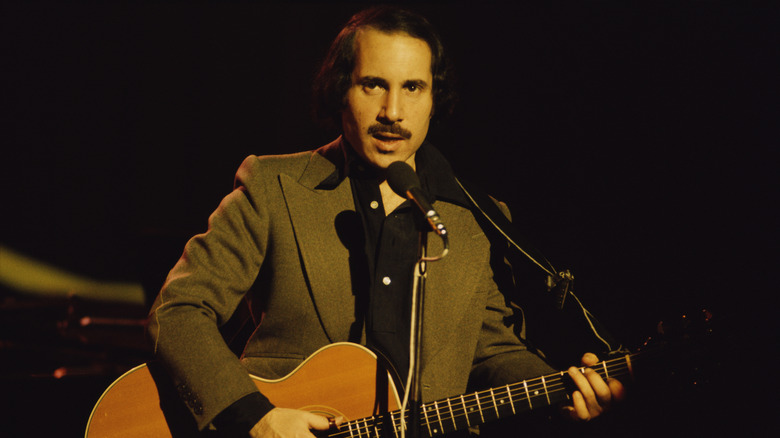
By the mid-1970s, Paul Simon had established himself as a solo artist beyond the boundaries of the success he experienced as half of folk duo Simon & Garfunkel. While he would go on to explore world music (highly successfully with 1986's "Graceland," less so with 1990's "Rhythm of the Saints"), at that time, he was planted firmly in the singer-songwriter lane. That was the milieu in which he would achieve his greatest chart success as a solo artist, landing his first — and still only — No. 1 hit with "50 Ways to Leave Your Lover," his tongue-in-cheek 1975 ode to breakups.
Spending three weeks at the top spot on Billboard's Hot 100 in February 1976, "50 Ways to Leave Your Lover" remained on the chart for an impressive 17 weeks, but — somewhat ironically — still sat at its pinnacle on February 14. So how did what is arguably the most popular anti-love pop song spring to the top of the charts, and on Valentine's Day, a day historically devoted to love in all its many splendored forms?
50 Ways to Leave Your Lover is a breakup song that mourns a failed relationship
A single from Paul Simon's 1975 album "Still Crazy After All These Years," "50 Ways to Leave Your Lover" details various ways one can end a romantic relationship. In the lyrics, an unnamed woman offers the narrator advice on how to extricate himself from a pesky relationship, insisting, "There must be fifty ways/ To leave your lover." Several of these are outlined in the chorus, when Simon sings, "You just slip out the back, Jack/ Make a new plan, Stan/ You don't need to be coy, Roy/Just get yourself free/ Hop on the bus, Gus/ You don't need to discuss much/ Just drop off the key, Lee/ And get yourself free."
With those five suggestions, Simon offered an array of methods one could simply end a relationship, although slipping out the back or hopping on a bus may seem cowardly to some. And, despite the song's title, Simon never does reveal the other 45 ways of leaving a lover.
Of course, the irony remains that the song hit No. 1 on February 7, 1976, and remained there through Valentine's Day. One potential reason is that "50 Ways to Leave Your Lover" can be interpreted as straddling the borderline of being both a great breakup song and a great love song — albeit one that pre-emptively mourns the loss of a romance that's become stifling.
Paul Simon has never revealed the subject of 50 Ways to Leave Your Lover
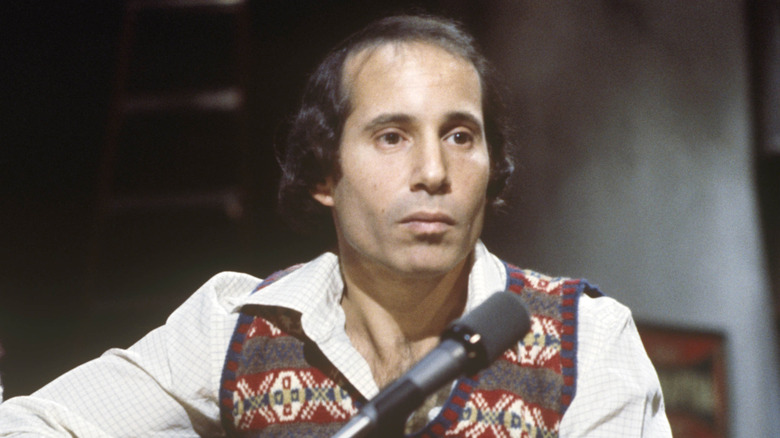
"50 Ways to Leave Your Lover" is clearly about a relationship gone so bad that it not only needs an exit, but also to be freed from. That has led many to wonder who Simon's "50 Ways to Leave Your Lover" is really about. The timing places the song within the timeframe of his marriage to Peggy Harper, whom he wed in 1969 and divorced in 1975. Interestingly, though, Simon has insisted that the song isn't about Harper — yet he's also never revealed who actually inspired it.
However, Simon has confirmed that the beginning of the song came to him one day out of the blue. "The opening words just popped into my mind," he told author Timothy White for his book, "Rock Lives." "'The problem is all inside your head, she said to me ...' That was the first thing I thought of. So I just started building on that line."
The singalong chorus, however, has an entirely different origin story. "The chorus, the words of that, I was teaching my son Harper, who was just, you know, young at the time, I was teaching him about rhymes ... so that was what that was about," Simon said when appearing on "The Howard Stern Show". Despite being the only composition from his solo career to reach No. 1, Simon was somewhat dismissive of "50 Ways" when he told White, "It's basically a nonsense song."