

11 Strange Stories You Forgot Were In The Bible
There are numerous examples of stories in the Bible that have become so iconic, even those who are not of the faith or have not read the book in its entirety are familiar with them. Ask the average person to imagine the creation of the world, for instance, and there's a decent chance they'll visualize Adam and Eve. David and Goliath have become a metaphor for overcoming seemingly insurmountable odds. And the narrative of the birth of Jesus Christ has become so widespread, companies all over the world design their business strategies and product schedules around the date we collectively agreed to recognize.
But for every Samson and Delilah or Sodom and Gomorrah, there's a less popular passage or chapter within the pages of the thousands-year-old tome intended to immortalize an event or impart a lesson. And while such stories are presented as actual historical accounts, it's hard to deny that many of them contain elements that can go toe-to-toe with with the best novels, TV shows, or movies in terms of pushing the limits of one's suspension of disbelief.
From a big-bellied monarch accidentally guaranteeing the success of his own assassination to a starving messianic figure losing his temper enough to end a tree with words, these are some of the strangest stories that you may have forgotten — or perhaps, didn't know — were in the Bible.
King Nebuchadnezzar lived like an animal for seven years (Daniel 4:1-36)
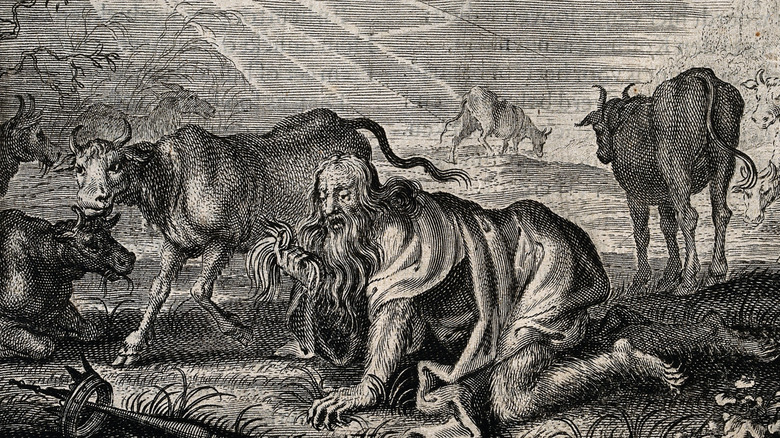
The peculiar tale of King Nebuchadnezzar's seven-year stint of living among wild animals began when, during his years of prosperity, he had a terrible nightmare full of incomprehensible visions. The perturbed ruler called upon the best and brightest of his kingdom, but not a single mystic was able to help him understand his horrific dream. Enter Daniel, a man who possessed the ability to interpret dreams (aka the most qualified person for this oddly specific task).
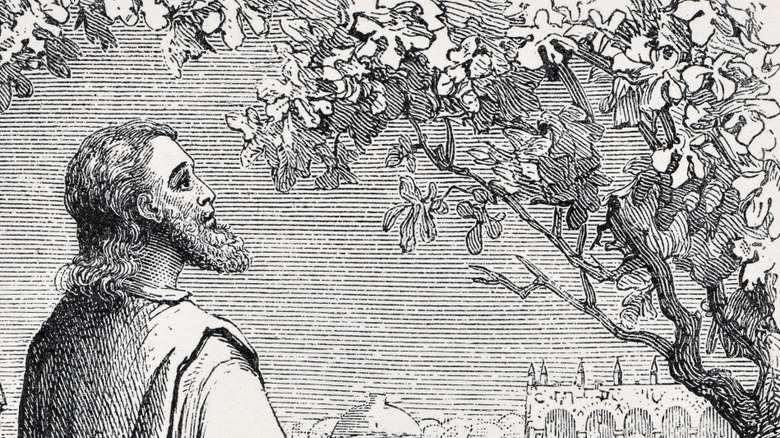
When Nebuchadnezzar told Daniel about what he saw (including a large tree and an angel with confusing instructions) the interpreter reassured the king that he had nothing to fear, before telling him that it was actually a stern reminder from God to be a nicer king overall — or else, he'll be humbled for seven years, driven out of his kingdom and forced to walk on all fours and eat grass.
One would think that such a colorful warning would have been enough to change Nebuchadnezzar; unfortunately, it wasn't. Exactly a year passed, and when the king gave himself a verbal pat on the back for singlehandedly building his empire, God's warning kicked in immediately: Nebuchadnezzar lost his sanity and all sense of self-grooming, and only became himself again seven years later.
(Interestingly, while "Nebuchadnezzar" can be a mouthful to pronounce, it's not even the longest name in the Bible.)
The floating hand writing on the wall (Daniel 5:1-31)
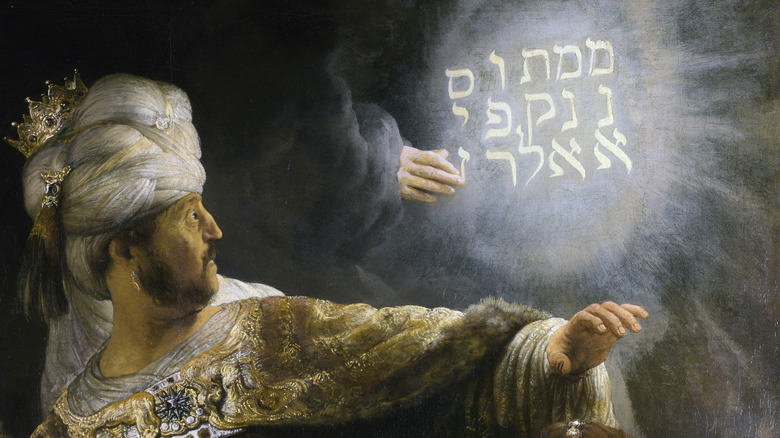
Picture this: You're the ruler of a great empire, and you've decided to throw the best party ever. So you pull out all the stops — you've sent invitations to all your aristocrat friends and their families, prepared the finest food and drink, and even brought out the "good" plates and goblets from your extensive collection of dinnerware — to make sure that you all have an unforgettable night. Then, unexpectedly, your gold-and-silver gala becomes a celebration to remember ... because out of nowhere, a cluster of disembodied human digits shows up and writes an unintelligible message on your wall. That's exactly what happened to Belshazzar, king of Neo-Babylon, when he held a lavish banquet for 1,000 nobles in his kingdom — and served wine to his guests in the gold and silver goblets that his ancestor, Nebuchadnezzar, pilfered from a temple in Jerusalem.
After the floating fingers finished scribbling, the shocked ruler had a reasonable reaction: He called in every expert to help him decipher the code, even offering extravagant rewards to anyone who could successfully complete the task. Ultimately, the responsibility fell upon the shoulders of Daniel, who had earned a reputation for interpreting dreams. Refusing the rewards, Daniel decoded the message for Belshazzar: His rule would end then and there, and his kingdom would be divided. Daniel still got the rewards, but the outcome didn't change — Belshazzar's life ended that same night.
God froze the sun in the sky for a day (Joshua 10:1-15)

When you're leading a massive group of people who have known nothing but years of endless wandering and constant fighting, you would probably understand how useful it would be for the sun to stay still and light your path for as long as you need to keep moving. And if, like the Israelite leader Joshua, it were actually an option for you, you'd probably take it.
Under Joshua's leadership, the Israelite tribes moved across the region of Canaan, gradually taking one important city after another. When he and his men successfully conquered the town of Ai, the neighboring town of Gibeon struck a peace deal with them, with their mighty warriors turning into woodcutters and water carriers for the Israelites. This development deeply worried the king of Jerusalem, Adoni-Zedek, prompting him to enlist the aid of four other kings and launch an offensive upon Gibeon.
The Gibeonites begged Joshua to help them fight off the five armies; in response, the military commander brought in a very big gun. As Joshua's men clashed with Adoni-Zedek and his allies, God pelted the invading soldiers with hailstones, causing even more casualties than Joshua's men. But Joshua took things a step further, asking God to hold the sun in place for a full day so that they'd have enough time to capture the retreating armies. God granted his wish, enabling Joshua to capture the kings and slay them, after which they pushed further into Canaan.
The tragic tale of Judah, Er, Onan, and Tamar (Genesis 38:1-30)
Judah was one of Jacob's 12 sons, and he didn't exactly have a reputation for being a good person. After all, it was his idea to sell their brother Joseph, whom they were all jealous of (as Joseph was their dad's favorite). Eventually, Judah left his brothers to build a life of his own.
Judah had three children: Er, Onan, and Shelah. Unfortunately, for unspecified reasons, Er seemed to have an unkind streak similar to his father's; this was enough for God to determine that Er had to die. When Judah's eldest perished, God ordered Onan to sleep with Er's widow, Tamar, so that he could continue the bloodline. Onan wasn't wild about this idea, though, so he went to great lengths so as not to get Tamar pregnant. God didn't like this, which meant Onan had to join his brother in death.
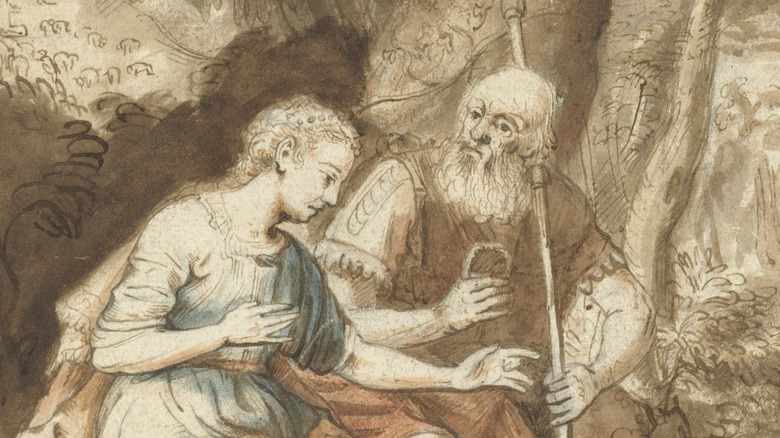
Struck with grief and wanting to spare his remaining son from the same fate, Judah sent Tamar away to live with her father. Many years later, Judah and Tamar had a chance encounter, as the former was on his way to some sheep shearers. Tamar disguised herself and Judah mistook her for a prostitute; they ended up sleeping together. Three months later, Judah learned the terrible truth: his daughter-in-law was pregnant, and he was the father. She ended up giving birth to twins; meanwhile, Judah was understandably horrified by his actions, and refrained from further intimacy with her.
Jesus told Peter to go fishing for coin (Matthew 17:24-27) and killed a fruitless tree with words (Matthew 21:18-22)
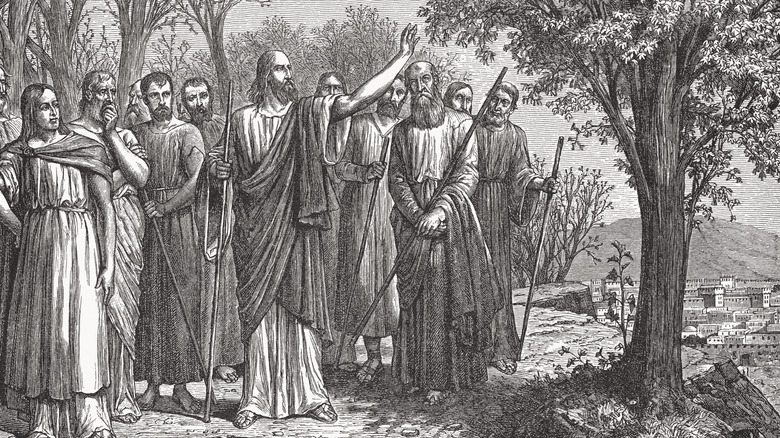
When people think of every miracle Jesus Christ performed in the Bible, turning water into wine, multiplying bread and fish, and getting up from death by crucifixion would probably be their top three.
But Jesus' bag of divine tricks wasn't just limited to grand gestures: The carpenter's son also engaged in a fair bit of trolling. It's no secret that there was no love lost between Jesus and the authority figures during his time. So when he and his disciples arrived at a fishing village called Capernaum, the temple officials immediately got down to business and badgered them to pay temple taxes. After making a reasonable argument to Peter about who should and shouldn't be paying such taxes, Jesus — presumably with a shrug and an eyeroll — told his apostle to catch a fish, open its mouth, take the coin he would find inside it, and use it to pay their taxes, just so everyone could be happy.
Jesus may have had a sharp sense of humor, but it seems you wouldn't like him when he's hangry. During an early-morning walk, Jesus came across a fig tree and wanted to pick some breakfast off of its branches. When he found that it had nothing to offer but leaves, he quite plainly told it to "never bear fruit again" — after which it immediately withered, to the shock of his followers.
The king whose belly fat became his undoing (Judges 3:12-25)
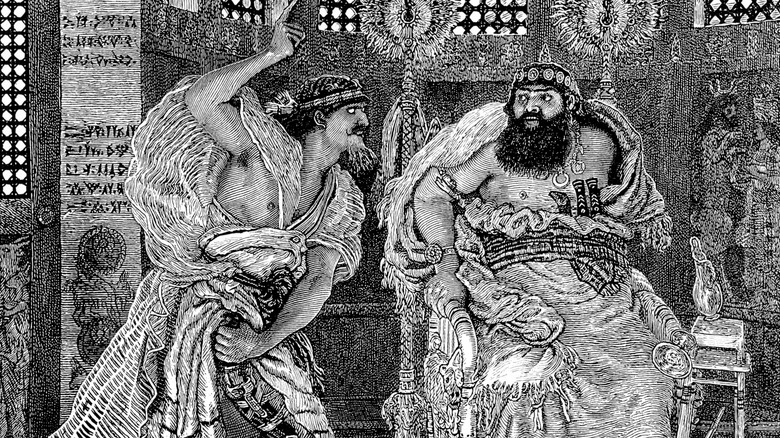
In the Old Testament, the Israelites had a complicated relationship with God, occasionally landing on his bad side. On one such instance, Israel fell into the hands of Eglon, king of Moab, for nearly two decades. There was exactly one other thing that was noteworthy about Eglon: He was, as the text described, "a very fat man."
When the Israelites decided that they'd had enough of Eglon's rule, they patched things up with God. His solution to their problem came in the form of Ehud, a southpaw who was skilled with the sword. Pretending to be an emissary, Ehud approached Eglon with a tribute, after which he told the king that he had a secret message to deliver. When they were left alone, Ehud pulled out the 18-inch sword that he was hiding under his robe and stuck it right into the king's abdomen.
The outcome was, well, gruesome. The rolls of fat on Eglon's stomach were said to be so large, they basically sucked the blade — and even the handle — into his belly, basically ensuring his demise. So violently effective was this assassination attempt that the contents of the dying king's bowels were pushed out of his body. By the time his servants barged in and realized what had happened, it was too late. In the chaos, Ehud made a stealthy exit; unsurprisingly, he didn't bother retrieving his sword.
A young man dozed off during Paul's public lecture -- and died (Acts 20:9-12)
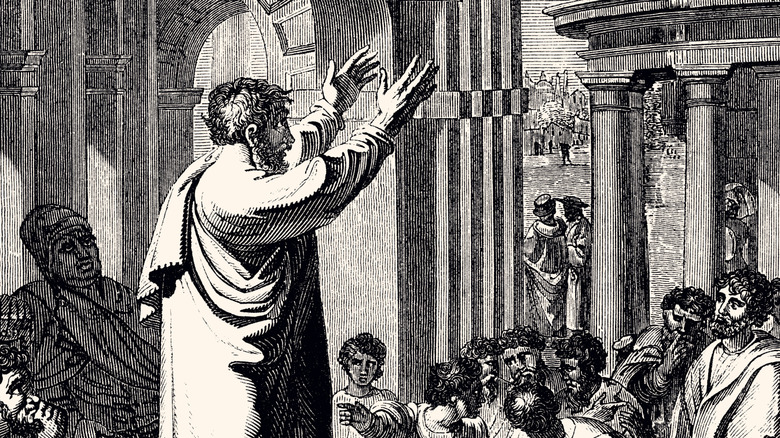
If you're familiar with the surprising history of Paul the Apostle, you may be aware of the fact that, as a traveling missionary, he played a critical role in spreading Christianity to different parts of the world. Being an evangelist also meant that Christianity's persecutor-turned-propagator gained a considerable amount of public speaking experience while fulfilling his duties. That said, as any orator would tell you, it's inevitable that even the best at the craft would encounter one or two sleepyheads in the audience. And in the case of a young man named Eutychus, dozing off literally meant that Paul's words bored him to death. At least, temporarily.
During Paul's third evangelical mission, he stayed in an Asian district called Troas for seven days. At one of his lectures there, Eutychus couldn't stop himself from falling asleep as Paul droned on. Unfortunately, the youth was sitting by a window on the third story of the venue; as he drifted off, he tragically fell out of the window to his death. Paul stopped his lecture momentarily and rushed to Eutychus, picking him up and bringing him back to life... after which the apostle went back inside, had a quick snack, and resumed his talk until morning broke. As Eutychus undoubtedly learned that day, not even a fatal fall was enough to save him from what he must have felt was a thoroughly boring talk.
Jephthah's tragically foolish vow (Judges 11:29-40)
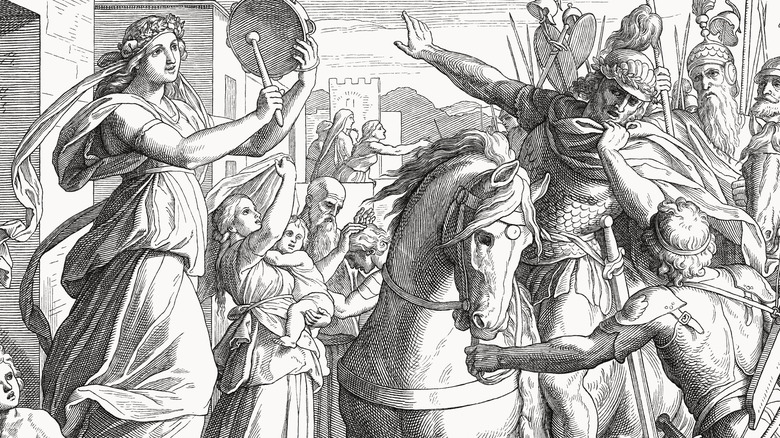
The Old Testament has no shortage of stories in which key figures make deals with God for certain outcomes, especially when they're out picking fights with strong opponents. One of the weirder examples of this is the deal struck between God and a Gileadite named Jephthah, one of the region's battle-hardened fighters.
Fighting on behalf of the Israelites, Jephthah made a promise: In exchange for a decisive victory against their enemies, the Ammonites, he would burn and sacrifice the first thing that comes out of his door after he triumphantly returns home. It is unclear exactly why he made such a vow, but nevertheless, God delivered. Jephthah plowed through 20 towns with relative ease. But as soon as the weary warrior reached his residence, he instantly realized that he was in trouble: Joyfully greeting him by the door with tambourine in hand was none other than his daughter and only child (whose name was not revealed).
Accepting that he could not go back on his foolish promise, Jephthah could only weep. Oddly enough, his daughter was surprisingly chill about the whole ordeal, even taking it upon herself to comfort her father and requesting only that she be given some time to be comforted by her friends. She left for the hills and, as promised, returned to her father after two months. The text says that he followed his vow, which meant he burned his daughter as a sacrifice to God (no doubt, with much regret).
Balaam's talking donkey (Numbers 22:21-35)
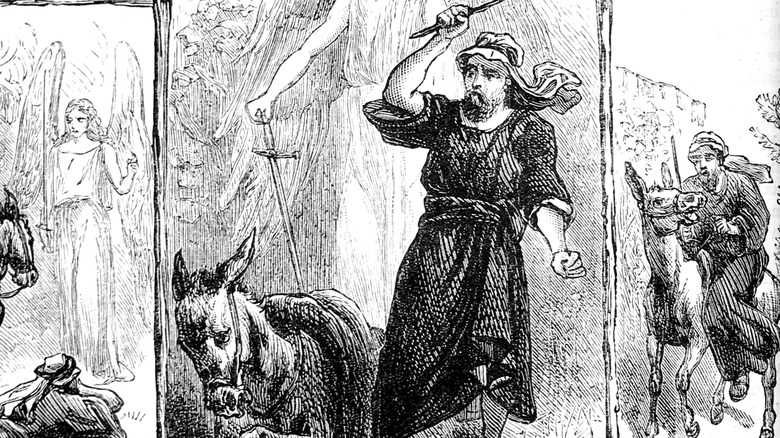
It would be wrong to make a list of strange Bible stories without including the astonishing story of Balaam's talking donkey. Initially contacted by King Balak of Moab to place a curse upon the Israelites, a man named Balaam, who reportedly possessed powers of divination, refused the ruler's request after consulting God about it. In response, the king offered Balaam a significant monetary reward for the task; when Balaam raised the matter with God again, God told him to meet with Balak, but with strict instructions not to be swayed.
The next day, Balaam got on his donkey and set off to Moab. While it's not explicitly stated why (perhaps because God sensed the soothsayer wanted the money he'd been offered), God was quite upset with Balaam. Thrice, he sent an angel with a sword to stand in the middle of the road and prevent Balaam from moving forward; and thrice, Balaam's donkey saw the messenger and stopped walking, so that they wouldn't be killed. The bewildered Balaam couldn't see the angel, so he beat his donkey in every instance.
Right after the third smacking, God gave the donkey the ability to talk. It asked Balaam why he kept hurting it; the angry diviner said it was because the donkey kept embarrassing him. But when God let Balaam see the angel, he immediately realized his mistake, bringing him to his knees and making him one of the few people in history to lose a fight with a talking donkey.
Never make fun of Elisha's bald head (2 Kings 2:23-25)
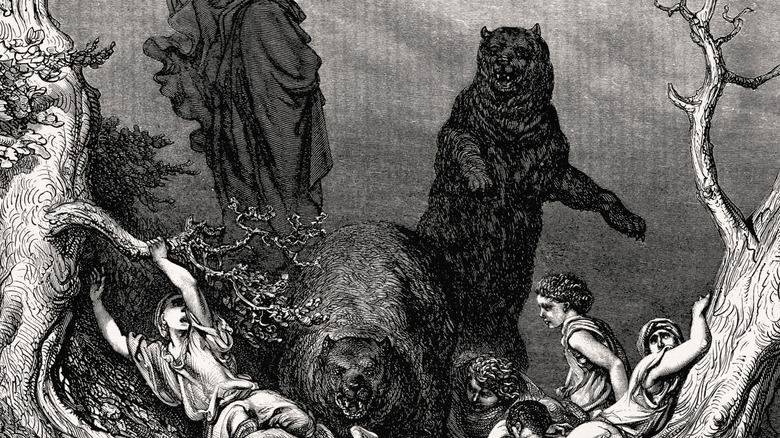
If this story is any indication, Elisha, the protege of the prophet Elijah, is one of the famous Bible figures you wouldn't want to meet in real life. Elisha performed a few impressive miracles during his lifetime, including parting the Jordan River with his staff, bringing a dead boy back to life, and permanently purifying a spring that supplied an entire city with water. But perhaps his most well-known feat was that one time his bullies met their demise at the hands of not one, but two angry bears.
Making his way to Bethel, Elisha encountered a group of boys who made the terrible decision of mocking him for his lack of hair. Calling him "baldy" and ordering him to scram, Elisha simply stared them down while saying a prayer to God. Enter Elisha's ursine familiars, who seemingly popped up out of nowhere and straight-up slew 42 of his mockers. After this unexpected display of carnage, Elisha nonchalantly went on his way. While we admit that it's certainly not nice when bullies gang up on someone and make fun of their physical characteristics, reacting by having a pair of bears cut a bloody swath through them seems a tad excessive.
The mind-blowing angel visions of Ezekiel (Ezekiel 1:1-28; 10:9-19)
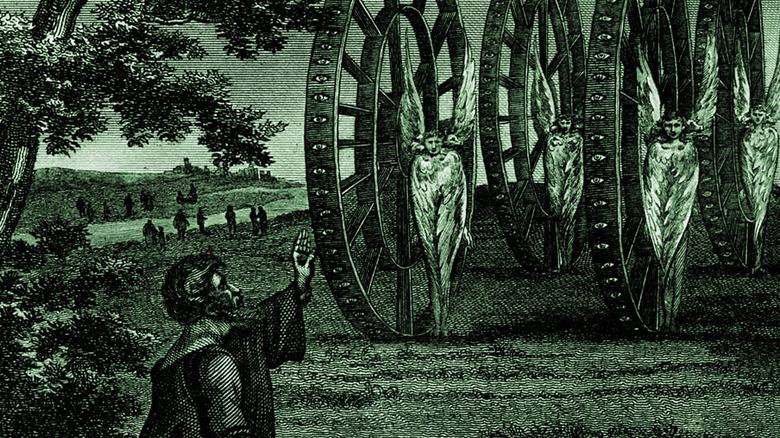
Pop culture has greatly shaped the way we visualize angels: good-looking humanoid figures with wings, in flowy white robes. High-ranking ones like the Archangel Michael may even be carrying weapons or sporting armor. But this is what angels really looked like in the Bible — at least, based on how the prophet Ezekiel saw them in his visions.
His first vision came when he was 30 years old, during his exile near the Kebar River. He noted seeing a gigantic cloud illuminated by lightning, bearing fire that resembled glowing metal. Inside this irregular weather disturbance were four humanoids, each with four faces (a human being, an ox, an eagle, and a lion), four wings, and hands attached to each wing. Each of these anatomically astounding individuals had a sparking topaz wheel that moved or stood still with them.
On a different occasion, Ezekiel had another vision of angels, albeit with very slight anatomical differences. Each of the cherubim, as they were called, had "whirling wheels" (a wheel intersecting another wheel) mimicking their movement, as well as the ability to fly. Oh, and they also had way too many eyes in places where they wouldn't normally be, such as their wings, hands, and backs. While it's hard to speculate exactly what Ezekiel's wheels could really have been, some have raised the possibility that he may have been describing extraterrestrial ships — making it, hypothetically, one of the world's earliest known UFO sightings.