

5 Old Rock Tunes We'll Be Blasting On Repeat 'Til The Day We Die
One of the miracles of rock music is that some tunes simply refuse to date. Many decades after they were first composed and recorded — often using equipment and techniques so basic that they would astound us today — some cuts still reverberate with the raw energy that makes rock great.
To prove it, here are five lesser-known rock tracks that have been around for more than 60 years, yet still have huge replay value to listeners today. They date from rock's formative years, when the genre was still emerging from its roots in blues and R&B, before the advent of hard rock, stadium rock, and the innumerable sub-genres that followed.
Nevertheless, all of these tunes rock as hard today as when they were first released. For this list, we've selected comparatively lesser-known classics: either hidden gems by famous artists that have been overshadowed by bigger hits, or tracks from musicians whose fame has faded, but which will nevertheless get you hitting the repeat button. Enjoy.
The Johnny Burnette Trio – The Train Kept A-Rollin'
"The Train Kept A-Rollin'" comes out of the gates with driving drums, bass, and distorted guitar played through an intentionally damaged amplifier, which barely lets up for nearly two-and-a-half minutes. Meanwhile, front man Johnny Burnette delivers one of the rock 'n' roll era's most enduring vocal takes, changing through the gears to offer a dynamic, barking vocal performance that demands you get up and dance. The track was originally composed as a jump blues track by Tiny Bradshaw in 1951, but Burnette's 1956 version turned it on its head, putting the guitar at the center of the song and making it really rock. Hard.
"The Train Kept A-Rollin'" emerged again a decade later with a new arrangement by the Yardbirds, and became established as a popular cover song by hard rock acts. But even the Yardbirds' famous take can't quite measure up to the Burnette version, whose relentless chug and ragged charm make it a rockabilly classic that remains hugely entertaining to modern ears.
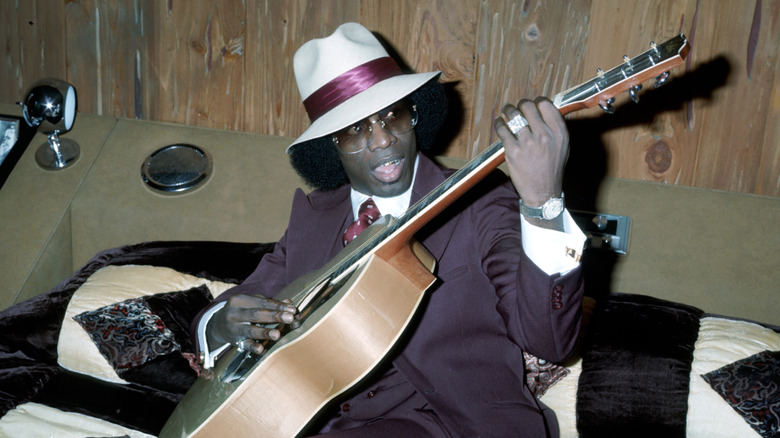
Johnny 'Guitar' Watson – Space Guitar
The 1950s were the golden age of boundary-pushing rock instrumentals, when the latest guitar innovations could hold listeners spellbound as they listened time and again, just to get to grips with these strange new sounds. And for those few who purchased Johnny "Guitar" Watson's mind-bending "Space Guitar" back in 1954, there could have been little else like it.
The instrumental goes through several distinct passages, each demonstrating Watson's blistering technique long before the concept of shredding was part of rock vocabulary. His performance is soaked in feedback and reverb, effects that only became central to rock during the psychedelic era more than a decade later. It's an incredible track which, as its title implies, was like something from the future landing in the mid-'50s. That Watson is an excellent player as well as an innovator makes the track more than a historical curio — it rewards repeated listening for guitar lovers, with Watson's abilities never less than enthralling.
Watson found renewed fame in the 1970s with era-defining funk tracks such as "Superman Lover" and "A Real Mother For Ya." But "Space Guitar" shows that his prodigious talent went far back, and that he was an unheralded precursor to other guitar innovators like Chuck Berry and Jimi Hendrix.
Vince Taylor and His Playboys – Brand New Cadillac
British-born rocker Vince Taylor has been written off by some as little more than an Elvis Presley impersonator. But while Taylor didn't have the vocal polish of The King, his ragged delivery influenced generations of later artists, including punk rockers The Clash, which covered "Brand New Cadillac" for the album "London Calling" in 1979.
The 1959 original is certainly worthy of your time. Taylor's "Brand New Cadillac" gradually builds around an infectious, danceable four-note guitar riff, becoming increasingly unhinged as it proceeds. Taylor gives the performance of his life, hamming up the pleas of the jilted lover to great effect. The track features some great stabs of guitar at the end of each verse, as well as an addictive guitar solo that is thankfully played twice during its tight two-and-a-half-minute runtime. By the time the outro of the track comes along, you'll be ready to hear the whole thing over again.
Dale Hawkins – Susie Q
Dale Hawkins' "Susie Q" is a Southern swamp rock classic that reached beyond its blues roots and exerted a huge influence on later artists like Tony Joe White and Creedence Clearwater Revival, which popularized it in the decades that followed. The track employs stripped-back percussion and an infectious groove over the intro and verses to swaggering effect, which gives way to multiple hard guitar passages accompanied by nothing more than yelps from Hawkins.
Its strange alchemy is undeniable, and though it clocks in at little more than two minutes, it's utterly addictive listening. Hawkins was all about rhythm as a performer — he famously rejected the idea of singing lower-tempo country and western – and "Susie Q" is driven along by slap-bass and Hawkins' masterful lyrical arrangement, which, while simple and derived from the blues, effectively builds the tension before the band lets those guitars wail.
Dick Dale and His Del-Tones – Misirlou
Known to many modern listeners as the opening music to Quentin Tarantino's "Pulp Fiction," Dick Dale's masterly "Misirlou" is one of the heaviest songs you'll encounter from the pre-hard rock period.
Dale was a California guitar legend who amassed a huge following on the West Coast thanks to his intricate picking techniques performed with heavy gauge strings, as well as his bombastic stage shows. In the early 1960s he released a string of great singles, including "Misirlou" in 1962 and the classic album "Surfer's Choice," which created the template for surf rock and made him a nationwide star.
Dale had Lebanese ancestry, and despite "Misirlou" being foundational to surf rock, it's based on a traditional Mediterranean folk melody, but played at a furious pace that transformed it into one of the wildest guitar riffs of the decade (the version on "Surfer's Choice," titled "Misirlou Twist," contains extra instrumentation that more clearly reveals the song's roots). Much of Dale's discography holds up, but "Misirlou" is his masterpiece — a showcase for the incredibly heavy tones he could coax from his gear long before the widespread use of effect pedals.