

5 Shoegaze Songs From The '90s To Soundtrack Your Dreams
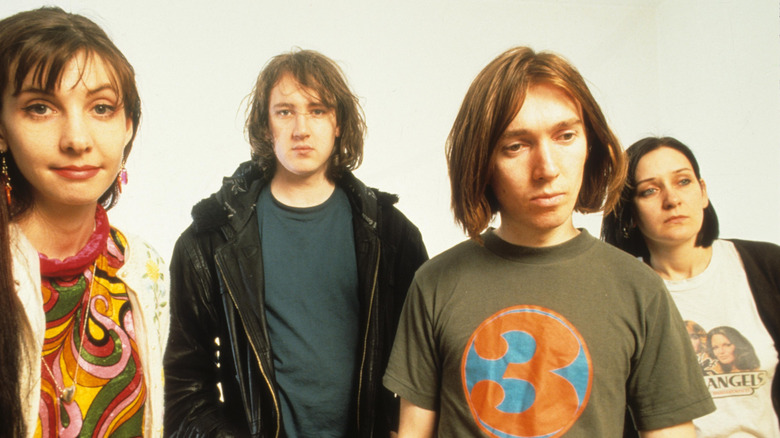
One of the strangest and most singular genres to branch out from the tree of rock in the '80s, shoegaze reached its peak in the early '90s, bringing a whole new world of dreaminess to the sonic landscape. Building off the meditative explorations of dream pop bands like Cocteau Twins and the avant-garde experimentations of new wave acts like Siouxsie and the Banshees, shoegaze pushed rock into a new, cerebral territory, turning songs into soundscapes and riffs into walls of textured guitar.
The end result of all this evolution is a genre characterized by its etherealness. With its trademark effect-laden guitars and muted vocals, shoegaze is one of the most dreamlike subgenres out there. Even its performers, stereotypically playing with their eyes at their feet and singing about probing their innermost feelings, seem almost in a dream, if not directly channeling one. To reach that Lynchian place of surrealism and introspection, here are five shoegaze songs from the '90s to soundtrack your dreams.
Lush - Nothing Natural
Found on the band's debut full-length album "Spooky," Lush's "Nothing Natural" is a perfect introduction into the dreamlike world of shoegaze. The song starts in media res, with the genre's trademark wall of sound in full effect from the first second. Thanks to Lush's co-leads Miki Berenyi and Emma Anderson pulling double duty on both guitars and vocals, and combined with an expected amount of ethereal guitar effects, the sound is, all wordplay aside, lush.
The lyrics and music video for "Nothing Natural" are just as exemplary of the genre as its sound. Lines like "The seasons shining in your hair / And it was more than I could bear" are fragile and poetic, and showcase the introspection typical of many of their contemporaries. Likewise, the music video is sparse, intimate, almost appearing unenthusiastic — hallmarks with which any fan of the '90s shoegaze aesthetic will be familiar. For most of the video, Berenyi and Anderson merely gaze longingly into the camera while lights flash around them, revealing an almost empty set painted to look like open sky. To call it dreamlike would be an understatement.
Slowdive - When The Sun Hits
In any discussion of all-time great shoegazers, Reading rockers Slowdive are bound to come up. Likewise, their album "Souvlaki," a rare sophomore effort that trumps the debut, is bound to come up in the conversation of best shoegaze albums. Every track on the album is a worthwhile inclusion, but "When The Sun Hits" is when "Souvlaki" is at its biggest, most anthemic, and most definitively shoegaze.
Neil Halstead's vocals are low and plain spoken, the bass is rhythmic and pumping, and the group's trio of guitarists are all working overtime to create waves and troughs of steady, cresting noise. It is truly the perfect song to underscore dreams, which makes sense, given the band's frequent labeling as dream pop.
Interestingly, "Souvlaki" was initially a critical flop, panned by critics in the band's home country of the U.K., whose taste had perhaps shifted toward the emerging Britpop scene. In later years, the album has been retroactively given rave reviews, similar to the story of Weezer's "Pinkerton," another sophomore album whose scathing initial reviews belie its eventual near-universal acclaim.
My Bloody Valentine - Sometimes
Often considered shoegaze's crowning achievement, Irish-English rockers My Bloody Valentine are at their best in their 1991 album "Loveless." The album has been praised extensively, topped many best-of lists in the genre, and remains an enduring influence for artists across genres, even years after the band eventually disappeared.
Famously, "Loveless" was, depending on who asked, either a labor of love or absolute nightmare to create, requiring multiple studios, over a dozen engineers, multiple labels, and hundreds of thousands of pounds in costs. The toll it took to produce was worth it, however, considering its legacy as both a radical reinvention in the field of rock guitar and as the archetypal shoegaze record.
"Sometimes" is one of the album's ballads, but it feels only marginally different from its more upbeat tracks. More than anything, it showcases one of the genre's most defining characteristics: mixing the vocals a bit lower than the uber-distorted guitar in order to keep the entire track congruent as a single wall of dreamlike noise.
Ride - Leave Them All Behind
Ride is a quintessential part of shoegaze's formation in England in the late '80s and to this day, their albums are considered some of shoegaze's all-time best. In a rare agreement between commercial success and critical success for the genre, one of Ride's best albums, "Going Blank Again," actually reached No. 5 on the UK albums chart in 1992, making it a rare commercial window into the genre for many neophytes.
Fortunately, "Going Blank Again" kicks in immediately, with the eight-plus minute magnum opus, "Leave Them All Behind." Few songs over the eight minute mark are released as singles, let alone lead singles for a high profile album, but "Leave Them All Behind" was, and with good reason. The guitar, bass, and drums are tour de forces throughout its considerable length, but in true shoegaze fashion, none overpower the other and instead create one sonic painting. If there is a standout, it's the blistering guitar work of vocalist/guitarist Andy Bell, who fans may also recognize as the longtime bass player for Oasis.
Catherine Wheel - Black Metallic
Catherine Wheel are every bit as important to the evolution of shoegaze as any other band on this list, but are otherwise quite distinct from their peers. Far from the scene's musical hub in London, Catherine Wheel's version of shoegaze was free to become moodier and often harder, perhaps unsurprising given that the band's frontman Rob Dickinson is a first cousin of legendary Iron Maiden frontman Bruce Dickinson. That extra edge translated into more riff-heavy guitar at times, and potentially, their unusual mainstream success in the U.S.
Unlike their contemporaries, whose success remained largely confined to the U.K., Catherine Wheel actually found decent success stateside, led mainly by "Black Metallic." The video is atmospheric and ghostly, pairing well with Dickinson's haunting, lingering vocals and the expansive, reverb-heavy instrumental sections. At four-and-a-half minutes, the already meaty single version of "Black Metallic" is actually edited from the album version. In that seven-minute-plus epic, the song reveals its true nature as a shoegaze anthem with lengthy textural guitar sections that make an excellent soundtrack to dream to.