

These Band Members Saw Their Careers Go Downhill After Their Lead Singer Abandoned Them To Go Solo
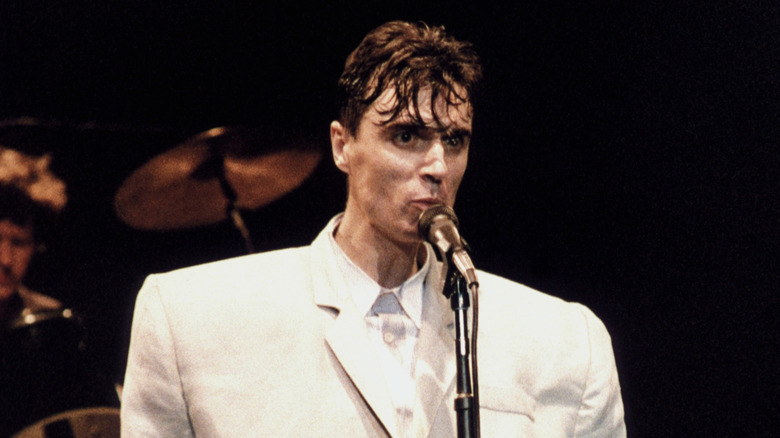
The odds of becoming successful in the world of music are astronomically low. For every group that hits the big time, there are thousands of unknown acts slogging away in small clubs that will never experience the dizzying heights of rock stardom. Those that do make it to the top often have a mysterious musical alchemy in which the whole is greater than the sum of its parts. Within that equation, though, it's impossible to ignore the importance of a band's frontman or frontwoman in its eventual success. This is far more than just the ability to hold a note but a combination of a distinctive voice, a winning personality, and charisma to spare.
Yet despite the undeniably challenging chances of success, many of those who do achieve it have demonstrated a disturbing tendency to part ways with the singer who's been at the forefront of all that success. Whether this comes from artistic differences, personality conflicts, or a singer's belief that the grass will be greener as a solo act, these splits are far from an isolated phenomenon. When it happens, it hasn't always gone well for the band members who've been left behind. Read on and it will be clear that these band members saw their careers go downhill after their lead singer abandoned them to go solo.
Black Sabbath
Black Sabbath was founded in the working-class British town of Birmingham in the late 1960s. Bassist Geezer Butler, drummer Bill Ward, guitarist Tony Iommi, and singer John "Ozzy" Osbourne paved the way for what would become heavy metal by grafting horror-movie elements onto guitar-driven hard rock. As Sabbath grew increasingly popular during the 1970s, Osbourne's outrageous antics and legendary intake of drugs and alcohol made him unreliable and difficult to work with. In 1979, the rest of the band had enough and fired him.
In the short term, that decision proved beneficial to both the singer and his former bandmates. Osbourne's debut album as a solo artist, "Blizzard of Oz," became a monster hit, while Sabbath hired a new frontman, Ronnie James Dio, and unveiled "Heaven and Hell," a critical and commercial success that sold more than 1 million copies. However, differences with the rest of the band contributed to the real reason Dio left Black Sabbath in 1982. During the rest of the decade, a seemingly endless string of singers fronted the band during a tumultuous period that saw Sabbath crater commercially — while Osbourne cranked out one hit after another as a solo artist.
Osbourne reunited with the original Black Sabbath lineup for a 2013 album, "13," with that reunion culminating in one final tour. In the summer of 2025, Osbourne, experiencing various health problems, reunited with the others for a one-off Sabbath show. Weeks later, the legendary frontman was dead at 76.
Van Halen
When relations between Van Halen singer David Lee Roth and guitarist Eddie Van Halen crumbled, Roth exited the band to embark on a solo career that proved to be far less successful than his work with Van Halen had been. Yet the band rose like the proverbial phoenix with the addition of guitarist-frontman Sammy Hagar, which, if not quite as successful as the Roth-fronted iteration, delivered four consecutive No. 1, multiplatinum albums. But history was bound to repeat, and eventually relations between Hagar and brothers Eddie and Alex Van Halen grew fraught. While opinions vary as to whether Hagar quit or was fired, his exit coincided with Roth briefly reuniting with the band — until that went south. At that point, Van Halen replaced him with a new singer, former Extreme frontman Gary Cherone.
The band recorded just one album with Cherone, 1998's "Van Halen III." This iteration was decidedly not embraced by fans, and "III" holds the distinction of being the first Van Halen album to sell less than 1 million copies. Cherone was ousted in 1999, and the group then went on hiatus until Hagar returned in 2003. That reunion proved to be short-lived, and Hagar exited for good in 2005 under rancorous circumstances. Van Halen eventually reunited with Roth, but the group never recaptured the heights of its glory days. Years after his cancer diagnosis, Eddie Van Halen sadly died in October 2020, closing the band's book forever.
Judas Priest
Part of the heavy metal wave unleashed by the success of Black Sabbath, the fellow Birmingham band Judas Priest slogged its way through the 1970s until breaking through with the 1979 album "Hell Bent for Leather." Playing fast and loud, frontman Rob Halford's vocal style — a type of operatic shrieking — came to define heavy metal itself. Further success came with subsequent albums, particularly 1982's "Screaming for Vengeance," which became the group's biggest seller and brought Judas Priest its only single to enter the Billboard Hot 100, "You've Got Another Thing Coming."
The band's success with metalheads remained strong for the next decade — until Halford decided to exit the band in 1992, looking to spread his wings and embark on other projects beyond the boundaries of Judas Priest ("[M]y mid-life crisis, I call it," Halford quipped to The Guardian). As Halford pursued various solo efforts with limited success, he was replaced in Judas Priest by singer Tim "Ripper" Owens, who'd previously fronted a Judas Priest cover band. Owens recorded two albums with the group, 1997's "Jugulator" and 2001's "Demolition," representing a low point for the band by selling well under 100,000 copies combined. With Judas Priest on the ropes and Halford's solo career having failed to live up to expectations, the frontman rejoined Judas Priest in 2003 after an 11-year absence. He has fronted the act ever since and joined the ranks of musicians who left their bands only to come crawling back.
Mötley Crüe
In the group's late-1980s heyday, Mötley Crüe ruled rock's hair-metal subgenre. Consisting of bassist Nikki Sixx, guitarist Mick Mars, drummer Tommy Lee, and singer Vince Neil, the band chalked up a string of hits ranging from "Dr. Feelgood" to "Girls, Girls, Girls." Behind the scenes, however, the act began to fray when Neil balked at the desire to pursue a more blues-based direction. "I'm not a blues singer and Mötley is a rock band — not a blues band," the singer told the Los Angeles Times. "I think it's a stupid idea that will alienate the fans."
Neil and the band parted ways. He signed a record deal with another label and released his debut album. Meanwhile, Mötley Crüe began sourcing his replacement, ultimately settling on former Scream frontman John Corabi. There was much bad blood between Neil and the group — he hadn't talked to the guys since the split, telling the Times, "I don't really care if I talk to them again."
As the '90s progressed and grunge emerged as the dominant musical force, both Mötley Crüe and Neil found themselves no longer in fashion as their respective fortunes dipped. Desperate to reclaim their past glory, the band fired Corabi in 1996, and Neil returned to the fold, with the reformed group mounting a successful reunion tour. Corabi wound up taking a break from the music biz, becoming a long-haul trucker.
The Police
In 1977, drummer Stewart Copeland joined forces with guitarist Andy Summers and bassist/vocalist Gordon Sumner (dubbing himself "Sting") as The Police. Propelled by a punk energy and superb musicianship (plus a healthy dollop of reggae), by the early 1980s, The Police was one of the hottest bands in the world. Behind the scenes, however, tensions simmered. Sting didn't just sing the group's hits — he also wrote them. This irked Summers and Copeland, who wanted to include their own compositions on the band's albums, placing Sting in the awkward position of informing them their songs simply weren't as good as his. Meanwhile, Sting was finding the three-piece format limiting, and he yearned to expand his musical purview as a solo act. That was ultimately the real reason The Police broke up in the mid-1980s, at the peak of the group's popularity.
While Sting did indeed go on to enjoy a monumentally successful solo career, Copeland experienced his own (albeit lesser) degree of success composing music for movies, while Andy Summers pursued his passion for experimental music. The band's enduring popularity was evident when the band came back together in 2007 for a massively popular reunion tour, grossing a staggering $362 million. It would be easy to assume that Summers and Copeland would be too busy counting the millions they raked in from that reunion tour to keep holding a grudge. In 2025, however, they sued Sting over alleged unpaid royalties.
Wham!
The history of British pop duo Wham! is a brief one. Comprised of George Michael and Andrew Ridgeley, the group's second album — 1984's "Make It Big" — exploded in the U.S., yielding hit singles "Wake Me Up Before You Go-Go" and "Careless Whisper." When Michael exited the partnership in 1986, feeling that Wham! had simply run its course, he became even bigger as a solo artist, racking up a string of No. 1 singles.
Ridgeley, on the other hand, went in a completely different direction, moving to Monaco to pursue what was an ultimately failed career in Formula 3 racing. When that dream evaporated, he relocated to Los Angeles to give acting a shot — which went about as well as racing. In 1990, he released his debut solo album, "Son of Albert." Sales were so poor as to guarantee it would be his only solo album.
As Ridgeley told Big Issue, he was well aware that he couldn't come close to matching Michael in terms of either talent or ambition, although they remained friends after breaking up Wham! "At that point I had no real idea what I would do next," Ridgeley admitted. "I didn't have any real ambitions to do anything else in music."
Talking Heads
Drummer Chris Frantz and bassist Tina Weymouth first met singer-guitarist-songwriter David Byrne as students at the Rhode Island School of Design in 1971. The band they formed in 1975, Talking Heads, became a sensation that sold millions of albums — until Byrne abruptly quit in 1991, blindsiding Frantz and Weymouth (by then a married couple) and keyboardist Jerry Harrison. "But we were shocked to find out about [Byrne's departure] via the Los Angeles Times," Frantz told the Los Angeles Times of Byrne breaking the news of Talking Heads' split in a newspaper interview. "As far as we're concerned, the band never really broke up. David just decided to leave."
As Byrne became increasingly focused on his solo efforts. Frantz and Weymouth had already achieved some modest success with their side project, the Tom Tom Club. But while Byrne went on to enjoy a respectable solo career and his bandmates continued with their own musical endeavors, none of them ever matched the success of Talking Heads. Looking back at the band's breakup more than four decades later, Weymouth admitted she wished she'd had the opportunity to accomplish more with the band. "I thought we had a lot in us and we were so young to be retired at age 32," she said during a 2023 Q&A with the other band members, as reported by People. Speaking to the outlet that same year, Byrne addressed the real reason he left Talking Heads — to focus on his solo work — admitting he had "regrets on how that was handled."
Roxy Music
Riding the coattails of the British glam rock wave of the early 1970s, Roxy Music hit the charts in 1975 with the hit "Love Is the Drug." The band's biggest success, however, was its 1982 album "Avalon," which sold in excess of 2 million albums (more than all their previous studio albums combined). At that pinnacle, frontman Bryan Ferry decided to disband Roxy Music in 1983. He embarked on a solo career, while the other band members explored their own musical pursuits. While Ferry's 1985 solo album, "Boys and Girls," sold just over 1 million copies, his subsequent releases never came close to that level of success. In 2001, Ferry and the rest of Roxy Music reunited for a tour. Speaking with The Guardian at the time, band member Andy Mackay denied the reunion tour was "all about money," with guitarist Phil Manzanera noting, "It's not about a midlife crisis — we're too old for that. This is about fun, about doing what we do, which is play music."
The success of that tour kept the group together for another decade, although it never recorded a follow-up to "Avalon." In 2011, the band split up again but occasionally reunited from time to time. As Manzanera told Rolling Stone in 2014, the initial split resulted from a mutual desire to move on. "Musicians like to do new things," he said. "It's unfortunate for the fans, really, because they would like you to play the same old stuff forever and ever."
Alice Cooper
With wild theatrics and hard-hitting rock, Alice Cooper (born Vincent Furnier) pioneered the shock-rock genre. However, it's easy to forget that Alice Cooper was originally the name of the band, not its frontman. Furnier legally changed his name to Alice Cooper when he embarked on a solo career after Alice Cooper (the band) split up following the release of 1973's "Muscle of Love."
Interviewed by Rock Candy, Cooper (the singer, not the band) admitted that relations between him and the other members had become strained, with all seemingly headed in different directions: "I've always known it couldn't have lasted between us back then. ... We were dysfunctional. ... I never truly felt the band divorced. Rather we separated, and everyone went off down their own track."
Suffice it to say, Cooper skyrocketed to superstardom at the release of what was, technically, his first solo album, 1975's "Welcome to My Nightmare." The rest of the band did not and never came close to the level of success enjoyed by their former frontman. In 2025 — more than a half-century after the split — Cooper reunited with his original band for a new album, "The Revenge of Alice Cooper." Working with his former bandmates all those years later, he told Rock Candy, "felt just like coming home."
The Velvet Underground
In examining the untold truth of The Velvet Underground, it's been said that the band hardly sold any records, but everyone who bought one went on to form a band. The original quartet — comprised of guitarist/frontman Lou Reed, lead guitarist Sterling Morrison, bassist John Cale, and drummer Maureen Tucker — was the antithesis of the late-1960s hippie movement, delivering gritty, edgy, distortion-driven rock touching on taboo topics ranging from heavy narcotics to sadomasochism. German chanteuse Nico partnered with the band for its debut album, but she departed after that.
When Cale exited the band amid personality conflicts with Reed, he was replaced on bass by Doug Yule, who brought a pop sensibility to the band. Just before the release of "Loaded" — the first album to feature Yule — Reed exited for a solo career. Yule then fronted the band, but Morrison abruptly quit the group mid-tour in 1971, and Tucker followed a few months later. Yule soldiered on with a band featuring no original members that sounded nothing like the Velvet Underground, until eventually packing it in after recording the little-remembered "Squeeze" album.
Cale went on to a modestly successful solo career, while Tucker raised her children and wound up working at a Wal-Mart in Georgia. Morrison spent some time working on tugboats before earning his doctorate in medieval studies, eventually becoming a college professor. In 1993, the band reunited for what should have been a lucrative tour — until falling to pieces due to ongoing conflicts within the group.
The Clash
When you consider that The Clash erupted from the British punk explosion, it speaks volumes that the band made its live debut opening for the Sex Pistols. Consisting of Paul Simonon on bass, Topper Headon on drums, and guitarists Mick Jones and Joe Strummer both handling vocals, The Clash enjoyed years of commercial and critical success during the early '80s with hits such as "Train in Vain (Stand by Me)," "Rock the Casbah," and "Should I Stay or Should I Go?" But that brief burst of success proved to be short-lived. Interpersonal issues within the band led the others to fire Jones in 1983, after what he'd intended to be a brief holiday stretched to nine months AWOL from the band. With touring and recording obligations looming, The Clash held auditions to find a replacement, and guitarist Nick Sheppard landed the gig. The result was the 1985 album "Cut the Crap," a disaster so terrible that Strummer disowned it. The band split up shortly after that — this is the real reason The Clash disbanded.
Meanwhile, Jones had been immersing himself in the burgeoning hip-hop scene, and his first post-Clash project, Big Audio Dynamite, was a moderate hit that proved wildly influential in setting the template for melding rap elements with rock. Jones continued to experience success as a solo artist, while Strummer later confessed he'd regretted sacking him. Sadly, Jones and Strummer had recently reconciled when the latter died in 2002 from an undiagnosed heart condition, closing the final chapter in the tragic real-life story of Joe Strummer.