

The 5 Best Classic Rock Songs That Tell Complete Stories
Many singer-songwriters draw on their own lives to weave stories, which is great for stans but not so much for everyone else. If you're not up to date with every conspiracy theory about Taylor Swift's love life, you may not get why the 10-minute version of "All Too Well" hits so hard. Happily over the years, the classic rock genre has treated us to music that invites us all in on a story — whether it's been inspired by real events or sprung from their imaginations, we get all the drama, from start to finish.
We've highlighted just a few that are among our favorites. Among them is a '70s song that shouldn't have been a hit, with lyrics that were changed to honor the memories of those involved. There's also a big-hair, full-throated rock ballad whose story made millions — including the singer — say "eiuw," and a seminal track from a classic rock band whose members still can't put their finger on exactly what their musical yarn is about. Pull up a chair and listen up: It's story time.
The Wreck of the Edmund Fitzgerald — Gordon Lightfoot
Singer-songwriter Gordon Lightfoot faced many ups and downs, but he couldn't have known the impact a 1975 Newsweek article would have on his life and career. He read about the sinking of the S.S. Edmund Fitzgerald on Lake Superior in a violent storm, killing all 29 people aboard. Inspired by the tragedy, he began writing, and within around a week, he had penned "The Wreck of the Edmund Fitzgerald," adding it to the tracklist of his 1976 album "Summertime Dream."
Over seven verses, Lightfoot detailed how the ship, with its veteran crew and cargo of iron ore, got caught in a late-November storm, immortalizing their demise in verse four: "The captain wired in he had water comin' in / And the good ship and crew was in peril / And later that night when his lights went outta sight / Came the wreck of the Edmund Fitzgerald." Released as a single in 1976, and despite being a radio-unfriendly 6-plus-minute-long track, it topped the Canadian chart almost a year after the sinking. In the United States, it rose to No. 2 on the Billboard chart, eventually reaching No. 1 for Rock Digital Song Sales in 2025.
Although "The Wreck of the Edmund Fitzgerald" was one of several hits throughout his career, Lightfoot never really let the story go. He changed the lyrics as new information about the sinking emerged, such as a reference to the hatchway, which could cast the crew responsible for it in a poor light and upset surviving relatives. "The new line takes the onus off the deckhands," he told MLive in 2013.
All I Wanna Do Is Make Love to You — Heart
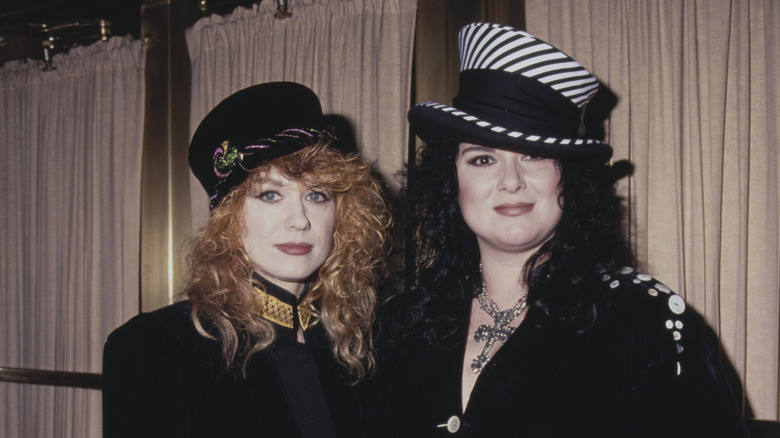
We highlighted Stevie Nicks' quote about needing a big attitude, but when the rock band Heart released the 1990 single "All I Wanna Do Is Make Love To You," frontwomen Nancy and Ann Wilson needed more than big hair to weather the storm it churned up. The song recounted an encounter between a woman and the hitchhiker she picked up on a rainy night. So far so saucy, we all thought — until we got to the final verse, where the mother of all bombshells was dropped.
"You can imagine his surprise," Ann sings. "When he saw his own eyes / I said, 'Please, please understand / I'm in love with another man / And what he couldn't give me, oh, whoa / Was the one little thing that you can.'" One Facebook commenter summed up many people's shocked attitudes: "I was 15 when this track came out. I remember my mum saying, 'Terrible song ... turning the act of adultery into a ballad.'" Although it was a monster hit globally, it was banned in Ireland.
Turned out, the controversial song wasn't even a Heart composition. Mutt Lange wrote the original for Don Henley, and when he declined, Dobie Gray released a version in 1979. Nancy said that when she and Ann heard it, they loved the hook but did a gender switcheroo with the lyrics to make the protagonist a woman. Ironically, Ann's no fan of the song either. She told Dan Rather on AXS TV in 2025: "You're a hitchhiker. I don't know you. So, let's get in the car and exchange fluids and now get out. I mean, that's hideous."
A Boy Named Sue — Johnny Cash
There may be some dispute about the person at the center of this Shel Silverstein-penned number — some say it's Tennessee Judge Sue Kerr Hicks, while others claim it was inspired by male writer Jean Shepherd. But there's no denying "A Boy Named Sue" was one of Johnny Cash's most beloved songs. It tells the story of a man who, after being saddled with a woman's name by his absentee father, fights his way through life while seeking revenge on his parent, before the surprising final twist.
In the hands of lesser artists, the song would have probably sunk without trace, but thanks to Cash, it has become as legendary as the man who sang it. Silverman jotted the lyrics down for Cash after singing it at a 1969 party, and June Carter suggested Cash sing "A Boy Named Sue" at his forthcoming gig at San Quentin (which came after Cash's concert at Folsom Prison). Although he read the lines from the music stand in front of him — according to his autobiography, "Man in Black," Cash had barely rehearsed it — the audience went wild for the unconventional song, largely thanks to his rambunctious performance.
Although very much a product of its time, "A Boy Named Sue" does speak to anyone who — for whatever reason — stands out from the crowd. Lots of ink has been spilled about what the song has to say about fatherhood, masculinity, and the best ways to overcome life's challenges. We just think it's a great story.
Roland the Headless Thompson Gunner — Warren Zevon
It's hard to imagine anyone other than the peerless Warren Zevon coming up with the poetic yet brutal tale "Roland the Headless Thompson Gunner," a song about a murdered Norwegian mercenary who comes back from the dead to exact revenge on his killer. He co-wrote it in 1974 ("over many jars") with Spanish bar owner David Lindell, who he described as a "piratical ex-merc" in the liner notes to "I'll Sleep When I'm Dead: An Anthology" (via American Songwriter).
Inspired by Lindell's military exploits, the song is peppered with locations and conflicts, and while they're not 100% accurate, "Roland the Headless Thompson Gunner" pulls no punches about the brutality of war. We hear it particularly in the second verse: "Through sixty-six and seven / They fought the Congo war / With their fingers on their triggers / Knee-deep in gore." It's also in the fourth verse's description of his murderer's death: "He didn't say a word / But he blew Van Owen's body / From there to Johannesburg."
The epic song is featured in Zevon's 1978 album "Excitable Boy," and while it didn't match the success of "Werewolves of London," the dark story is beloved among his fans. Among them is Zevon's good friend David Letterman. In October 2002, Zevon made what would be his last public appearance, closing the latter's late-night show with a rendition of "Roland The Headless Thompson Gunner." Zevon died of cancer almost a year later.
Hotel California — the Eagles
The haunting tale of what happens to a man seeking rest at a hotel after driving a "dark desert highway" and then potentially being trapped there forever is the subject of as much discussion as it is adoration. "Hotel California" is the title track from the band's 1976 album (and home to the Eagles' most underrated song ever), which Henley has previously called the Eagles' "creative peak" (via Louder). The song came together against the backdrop of the United States' 200th anniversary celebrations and was — at least in part — inspired by Neil Simon's play "California Suite."
Alongside evocative lyrics such as "Her mind is Tiffany-twisted / She got the Mercedes Benz / She got a lot of pretty, pretty boys / That she calls friends / How they dance in the courtyard," the song also includes an astonishing guitar duel between Don Felder and Joe Walsh that's every bit as gripping as the story. When it was complete, the band refused to cut the song's near 7-minute run time, despite the label's insistence: "We all said no way," producer Bill Szymczyk told Classic Rock, and music history was made.
In 2016, Don Henley tried to explain for the umpteenth time what "Hotel California" was all about. "I always say, it's a journey from innocence to experience," he told Gayle King on "CBS Mornings," adding, "It's not really about California; it's about America. It's about the dark underbelly of the American dream. It's about excess, it's about narcissism. It's about the music business. It's about a lot of different ... It can have a million interpretations."