

5 Songs By The Kinks That Prove 1966 Was The Best Year Of Their Career
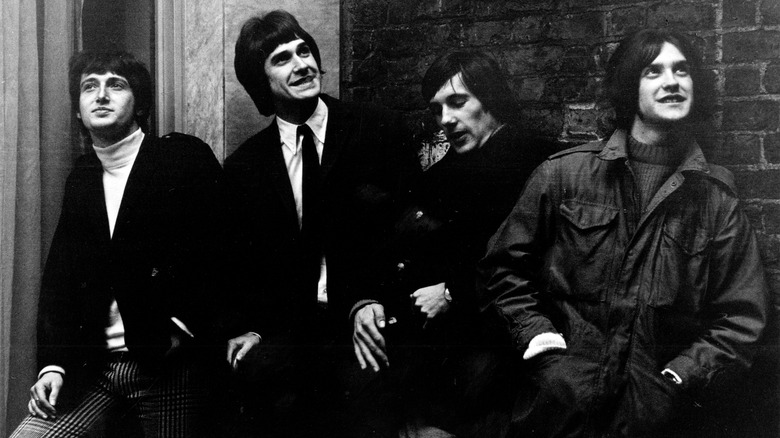
When looking at the Kinks' chart history, 1964 and 1965 produced the biggest hits — and the most memorable ones. After all, songs like "You Really Got Me" — a track with such a lasting cultural impact that Van Halen successfully covered it in the late '70s — and "Tired of Waiting for You" remain well-known to this day. However, 1966 produced the best mix of commercial success and creative excellence for the Kinks, thus making it the peak year for the band led by the notoriously quarrelsome brothers Ray and Dave Davies.
At this point in their career, the Kinks were a year away from the creative heights of "Waterloo Sunset," and two years away from releasing the critically-acclaimed album "The Kinks Are the Village Green Preservation Society." But neither project appeared on the Billboard charts, and this marked a period where the band had almost fully moved away from the infectious hooks and heavy guitars that helped make them British Invasion mainstays in 1964 and 1965. 1966, however, was the perfect bridge between both eras, and the five Kinks songs listed below from that year offer just that — a good, accessible blend of hard-hitting yet catchy rock 'n' roll and unorthodox musical experimentation.
Till the End of the Day
Technically, this can be considered a 1965 track, as it was released as a single in November of that year. But being that it spent its entire run on the Billboard Hot 100 in the spring of 1966, we're counting it in that year, too, and naming it as the first track that made 1966 so great for the Kinks and their fans. (That, despite a four-year U.S. touring ban that started the year prior.)
The song has the ingredients that made "You Really Got Me" and "All Day and All of the Night" huge hits earlier in the Kinks' career, starting with a loud, aggressively strummed guitar-only intro. Lyrically, "Till the End of the Day" is just as simple, and therein lies its charm — it's a song about how good it feels to be with your significant other, living life as young people with few responsibilities in the world. It's an uplifting message that many boomers certainly identified with back in the day, and it's one that's relatable even to younger generations.
Despite the high-impact intro, positive lyrics, and great guitar work from Dave Davies (his solo on this song is also worth mentioning), "Till the End of the Day" missed the U.S. Top 40, only making it to No. 50 in May 1966. It may be a '60s flop song of sorts, but it's one that truly deserves a lot of love.
Dedicated Follower of Fashion
One common observation about the Kinks late-'60s output is how unmistakably and quirkily British their songs were during this period. With that in mind, "Dedicated Follower of Fashion" can be thought of a gateway tune to that era, and one that wouldn't be too out of place in the Kinks' 1967 to '69 discography. And despite the presence of another loud power-chord intro, it's also an early example of the band stepping out of the box to integrate new influences into their established mix of hard rock, pop, and R&B — in this case, it's old-timey British music hall tunes.
Out of all the songs listed here, "Dedicated Follower of Fashion" is arguably the catchiest, as it tells the quirky tale of a trendy young man who is, as the song's title suggests, up to date with what's hot and what's not in British fashion, and isn't shy to show off his flashy wardrobe at the hottest clubs in town. Haven't we all known someone like that, regardless of where they're from or which fashion trends they're following?
The song is, for all intents and purposes, a humorous mockery of such overly fashion-conscious individuals, though the humor and references ("Carnabetian army," anyone?) may have been a bit too British for U.S. listeners, as it barely scraped the Top 40 with a Billboard peak position of No. 36 in June 1966. (It did much better back home, peaking at No. 4 on the U.K. charts that April.)
Sunny Afternoon
Aside from being the biggest commercial success by far out of all the songs in this list (No. 14 in the U.S., No. 1 in the U.K.), "Sunny Afternoon" stands out as the most major departure thus far from the Kinks' usual subject matter. While it continues the band's then-current pattern of focusing on British themes and integrating music-hall influences into their sound, it's notable for its choice of target — U.K. Prime Minister Harold Wilson and his progressive income tax scheme. It can also be interpreted as a dig at the haughty products of old money, given the protagonist's whiney tone and the fact that his drunken actions led to his girlfriend leaving him. Through that, frontman Ray Davies expertly skewers both sides of the income tax issue — the greedy taxman and the pompous formerly-rich guy who just lost his fortune.
In addition to its pure lyrical genius, "Sunny Afternoon" also excels as a dark (if witty) song with a deceptively easy-going melody. Pay little attention to the lyrics and you may easily mistake it as the ideal song to do as the protagonist does — enjoy an ice-cold beer on a hot summer afternoon. But as mentioned, it's far more than that. It's biting social commentary served up in the form of a memorable descending main chord pattern and a whimsical melody and arrangement — a juxtaposition that works perfectly on this song.
I'm Not Like Everybody Else
As the B-side of "Sunny Afternoon," "I'm Not Like Everybody Else" takes us back to more familiar Kinks territory, at least for fans of their earlier material. But while it does have a more traditional rock arrangement that hews closer to the Kinks' 1964 and 1965 recordings, it's not like anything else (pun definitely intended) the band recorded in that general style.
In a nutshell, "I'm Not Like Everybody Else" is an ode to nonconformity, the ultimate anthem for any outsider and misfit who's been looked down on by the friends and family of the person they love. The song's protagonist knows that he's different and it's implied that not everyone likes him, but he's not going to change who he is for anybody, or apologize for choosing to do things his way. That's a kind of righteous defiance you didn't hear too much of in 1966, and it certainly helps that the lyrics are backed up by a moody, minor chord-heavy garage-rock arrangement, with Ray Davies singing each word as if he means it.
We'd go as far as to say "I'm Not Like Everybody Else" is a classic rock nugget that deserved to go all the way to No. 1 on the pop charts. But unlike the other 1966 Kinks tracks in here, it's the only one that failed to chart either in the U.S. or in the U.K.
Dead End Street
And now, we wrap up with a return to the social commentary and music hall vibes with "Dead End Street," both of which are turned up to 11 compared to what the Kinks offered on "Dedicated Follower of Fashion" and "Sunny Afternoon." Much like the latter song, there's a similar contrast between the music and lyrics that works so well — jaunty and happy-sounding melody paired with lines about unpleasant situations. But unlike "Sunny Afternoon," there's no wry humor to be had here; lyrics such as "What are we living for?" and "I'm gonna die on dead end street" are as bleak as it gets for 1966. It's a stark look at being broke and jobless with no hope of emigrating to build a better life, largely due to the impending end of the U.K.'s assisted passage scheme.
Aside from serving as a spiritual predecessor of sorts to the even more pessimistic (and musically similar) "London Calling" by the Clash, "Dead End Street" sees the Kinks getting adventurous with their arrangements, with a strong trad jazz influence and a trombonist adding to the instrumentation. It's also unique for its use of two bass parts, with one holding down the rhythm and the other played like a traditional guitar. Sadly, neither that nor the sharp commentary in the lyrics helped the song gain traction with American audiences, as "Dead End Street" was, once again, a much bigger hit in the U.K. charts, where it peaked at No. 5 toward the end of 1966.