

The 5 Best Guitar Solos That Sound Hard But Are Easy To Play
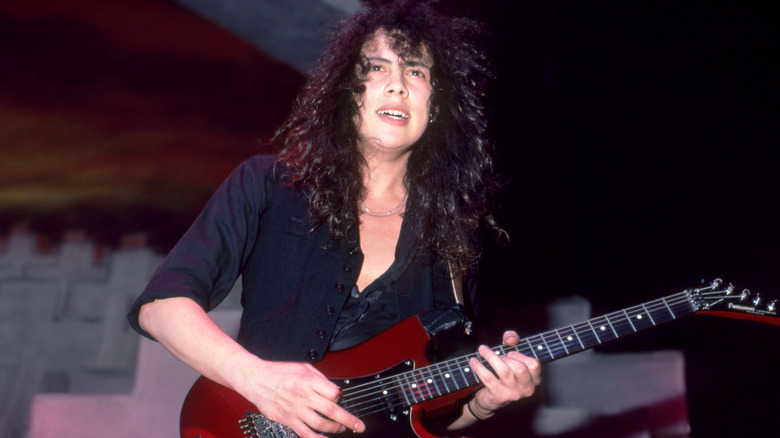
That's right, people, it's time to shred. Far from being an inaccessible feature of guitar-based music of all stripes, and decades before you try any ridiculous lead lines belonging to some of the greatest self-taught guitarists in rock history, there are easy solos. As soon as you've got some basics under your belt, you can give them a shot — even the ones that sound tough.
But first, when we say, "easy solo," we mean easy for a solo, as lead lines almost always require more control over your hands than strumming out very easy beginner songs like Bob Dylan's "Knockin' on Heaven's Door." Don't expect to play our recommendations if you just bought your first guitar last Tuesday. Even a solo like the famously simple solo from "Smells Like Teen Spirit" requires practice, though that solo is just as easy as it sounds. We've got to find a sweet spot of techniques between beginner-enough (you can play basic scales, slides, bends, hammer-ons/pull-offs, etc.) and non-intermediate (sweeps, difficult alternate picking, etc.), just as we've got to find a sweet spot between complex-sounding and not too difficult-sounding. Also, bear in mind that what sounds difficult to non-musicians is often different than what's actually difficult.
Now that all the provisos are out of the way, let's open the floor: here are some recognizable solos you could nail sooner rather than later.
Comfortably Numb - Pink Floyd (David Gilmour)
Yes, even you can play a killer guitar solo that's been imprinted on classic rock fans for life. David Gilmour's "Comfortably Numb" guitar solos from Pink Floyd's 1979 "The Wall" — there are two — sound tough because of Gilmour's exquisite feel, tiny articulations, and timing that boils down to mere tenths of a second. That part of Gilmour's work will take years of practice to capture, but the raw notes of "Comfortably Numb" aren't too tough. They come in clusters of very small intervals (minimal hand stretching) balanced out by basic bends, vibrato, and hammer-ons/pull-offs. There's nothing exceedingly fast nor exceedingly technical, which also helps grant the solos their very vocal quality — a quality that lends them their emotional power.
Gilmour, a guitarist so legendary that his Black Strat became the most expensive guitar ever sold at auction, stitched together his "Comfortably Numb" solos from various takes. Taking a technician's approach, Gilmour simply says that he pored through his takes to find the best bits and put them all together. It's interesting that such a practical, workmanlike approach produced solos so overflowing with feeling that are easy enough to play. But that's sometimes the secret to the best music: keeping things intentional and structured while also letting them feel spontaneous and energized.
When practicing Gilmour's "Comfortably Numb" solos, you should do the same as usual: focus on accuracy at a low tempo, then build to full tempo (the song already has a very low tempo of 63 BPM in 4/4 time). There are only a couple arpeggiated phrases that'll feel fast at that point, but by then you'll be up to speed — literally.
Purple Haze - The Jimi Hendrix Experience (Jimi Hendrix)
Much like David Gilmour's "Comfortably Numb" solo, Jimi Hendrix's solo from 1967's "Purple Haze," released in the best year of his career, is a victory of taste over flash. And just like Gilmour, the solo's individual notes won't be tough to hit, though mastering Hendrix's confidence, accents, articulations, etc., will prove a monolithic task. That's as it should be, because Hendrix is Hendrix and you are you.
Nonetheless, beginners ought to be able to nail the nuts and bolts of this surprisingly simple, short solo. You've got very few notes, some bends, some pretty quick slides, and some standard hammer-ons/pull-offs. You've also got some potential alternate picking (back-and-forth up/down plucks), though you could downpick the entire thing. The only tricky bit is getting your pinky to comply over the stretch from the 12th to 16th frets for one little part, which beginners will quickly learn also requires you to shift your wrist and elbow positions (unless your guitar is at your throat). Better get used to that, though, if you want to keep progressing and trying more difficult stuff.
Bear in mind that any guitar tabs you find for Hendrix's "Purple Haze" solo are going to look different to what you hear in live performances, because Hendrix improvised this solo in full or in part when he played it at concerts. Also, Hendrix was left-handed but played a right-handed guitar, which might confuse beginners looking up video tutorials (Hendrix's guitar will look mirrored, not flipped like in a tutorial).
Fade to Black - Metallica (Kirk Hammett)
Say what? A beginner can play a solo from the world's biggest metal band? Indeed. Though newcomers could possibly tackle solos from "Nothing Else Matters" and "Master of Puppets," we're going to recommend Kirk Hammett's opening solo on "Fade to Black" from 1984's classic thrash-era "Ride the Lightning." You can breathe easy because there's no high-speed shredding here, just a melodic solo played over a relatively slow passage.
Don't get confused when "Fade to Black" starts, because the opening acoustic guitar belongs to James Hetfield. Hammett's solo starts about fifteen seconds in and lasts until almost the minute marker, like a companion guitar interlocked with Hetfield's main chord progression. A beginner's task is made much easier because even though "Fade to Black" clocks in at 120 BPM, the opening feels firmly half-time, at about 60 BPM. This makes every part of Hammett's solo easily accessible except for a quick sequence at about 33 seconds in — you'll just have to practice this more. Even the final, ascending, 8th-note arpeggio is so slow that it sounds like a practice exercise. Plus, because this solo is long, you'll have a chance to practice memorizing longer passages and/or reading notation/tabs for sustained periods of time.
This solo is so simple, in fact, and Hammett has played it so much, that he's allegedly grown sick to death of it. He's admitted to trying to improvise during live shows, but only up to a point, because he doesn't want to bungle his part in front of tens of thousands of people. But no worries, because you can always play the solo yourself.
Paranoid - Black Sabbath (Tony Iommi)
No worries, you don't have to lose a couple of fingertips in a factory accident to play like Black Sabbath's Tony Iommi. You didn't know that's where his particular playing style and way of phrasing, which spawned the entirety of heavy music as we now know it, came about? Well, now you know it. And you can also know the guitar solo from "Paranoid" off Sabbath's 1970 album of the same name, an album that spawned pretty much every major Sabbath hit casual fans know, like "Iron Man" and "War Pigs," the latter of which earns boomers some bragging rights over other generations.
Iommi's solo from "Paranoid" proves that you don't need to go overboard to get a solo's point across or to make it memorable. Iommi's solo covers pretty much every basic a beginner needs: a familiar pentatonic box shape, simple bends, hammer-ons/pull-offs, all framed around repeated notes. Because it's at a higher tempo than other solos on this list, it might trick a beginner's ear into thinking it's harder than it is. But, as soon as you practice at a lower tempo and get used to some of the trickier transitions between strings, you'll find that "Paranoid" is a bedrock educational song for improving overall skill.
As is sometimes the case, Iommi and the rest of Sabbath felt very differently about "Paranoid" than the public. The band considered it a too-short throwaway song without any real depth. We don't know if that impacted Iommi's composition of the song's solo, but if it's easier to play as a result, then cheers.
Hotel California - Eagles (Joe Walsh & Don Felder)
We know that no one wants to hear the Eagles' "Hotel California" again, because it still plays once every 11 minutes on radio stations across the U.S. But we can't omit its solo in good conscience. This most iconic of dual-guitar solos from the Eagles' 1976 album of the same name features both Don Felder and Joe Walsh. From about 4:18 and continuing to the end of the song, the solo starts with Felder, switches to Walsh, then sees both guitarists fuse their parts. With practice, an advancing beginner can learn the whole thing, both parts included, though you obviously can't play both at the same time (though you can record yourself).
Like "Paranoid," this solo is made easier because it's built on a pentatonic scale, which naturally forms box shapes across the fretboard. The tempo is slow, the notes very deliberate and paced, and even certain parts that might make fans go "whoa!" — the harmonized dual-guitar bit, the strike-while-you-release-the-string-bend around 5:20 — are simpler than you think. The most challenging part comes from playing it all in a very smooth and legato, even heady, manner that perfectly fits the song's hidden meaning about drug abuse, the delusions of fame, the end of the American Dream — take your pick.
As for the solo itself, it grew from Felder and Walsh playing together and building their parts off each other. No matter that it was a very in-the-moment, spontaneous creation, the note placement remains extremely deliberate. This is a great song to use to learn not to rush.