

The 8 Best Motown Songwriters Of All Time
When Berry Gordy founded the Tamla and Motown labels in his native Detroit in 1959 and merged them a year later into the Motown Record Corporation, he launched one of the most seismic shifts in pop music history. One of the most significant Black-owned businesses in the world, Motown billed itself as "The Sound of Young America": a home for R&B acts to enjoy the commercial success that had eluded them for years. Driven by a stellar cast of songwriters, Motown artists scored 27 No. 1 hits on the Billboard Hot 100 between 1961 and 1970 — more than the Beatles in that same period — and continued making hits into the '90s.
What truly set Motown apart was its unique business practices. Gordy was a songwriter as well as a record exec, and knew the value of having great songs for his acts to sing. So Motown had its own publishing arm (Jobete, named using the first two letters of Gordy's three children), and employed songwriters in much the same way as he signed other talent. By holding writers to the same exacting standards as he did artists — Motown Quality Control meetings are the stuff of legend — Gordy created an environment where some of the most enduring songs in the world were born. Many of the label's top acts were great writers, too, and penned hits not only for themselves but others.
Motown's greatest songwriters wrote tunes that still get boomers moving, and we remember their names as fondly as the songs they composed.
Smokey Robinson
As the lead singer of the Miracles, Smokey Robinson's gorgeous voice powered many of Motown's early hits. Their 1960 single "Shop Around" was the company's first national Top 10 hit, and the first to sell a million copies. As the decade progressed, the group scored favorites like "You've Really Got a Hold on Me," "Mickey's Monkey," "Ooo Baby Baby," and "I Second That Emotion." All of them were co-written by Robinson — whose nickname is the subject of varying accounts — but his songbook was too prolific to keep just for himself.
Writing your own hits at Motown was a rarity at the time, but Smokey also co-wrote hits for the Temptations ("The Way You Do the Things You Do," "My Girl," "Get Ready"), Mary Wells ("My Guy," "Two Lovers"), Marvin Gaye ("I'll Be Doggone"), and the Marvelettes ("The Hunter Gets Captured by the Game"). He was such an asset to the company that Gordy named him Motown's vice president in 1962.
Robinson planned on retiring from the Miracles, but delayed his farewell when their song "The Tears of a Clown" became an unlikely hit years after it was released. And even he couldn't stay away from making music for too long: as a solo act, he notched hits for Motown into the '80s, including "Cruisin'," "Being with You," and "Just to See Her" — all of which featured his writing credits.
Brian Holland, Eddie Holland, and Lamont Dozier
Next to Gordy himself, Brian Holland, his brother Eddie, and Lamont Dozier may have done more for Motown as a hit factory than anyone else. On their own, the three had limited success as writers and performers for the company, but together, they were unstoppable. Their first Top 10 hit was Martha & the Vandellas' "Heat Wave" in 1963; they then set out to work with a female trio whose lack of success was a cruel joke around the company offices, leading some to deem them the "no-hit" Supremes.
The Holland brothers and Dozier reversed the fortunes of the Supremes with 1964's "Where Did Our Love Go," a bittersweet song formidable enough to keep the Beatles out of the No. 1 spot, even as they took America by storm. The songwriting and producing trio's hits wouldn't let up for years: many other Supremes songs they created went to No. 1 on the pop charts, including "Baby Love," "Come See About Me," "Stop! In the Name of Love," and "You Can't Hurry Love."
And that wasn't all: the trio penned Marvin Gaye's "How Sweet It Is (to Be Loved by You)," the Four Tops' "I Can't Help Myself" and "Reach Out I'll Be There," as well as the Isley Brothers' "This Old Heart of Mine (is Weak for You)." "The Sound of Young America" could well have been the sound of Dozier and the Holland brothers.
Norman Whitfield and Barrett Strong
Norman Whitfield and Barrett Strong were fixtures at Motown before they settled into a groove as hit songwriters. Strong was responsible for recording "Money (That's What I Want)," which became one of the first singles in the Motown canon. Eventually, Strong would join forces with Whitfield, a tenacious member of Motown's Quality Control division with dreams of producing. When Whitfield and Strong turned their attention to the Temptations, they transformed the vocal group from mere hitmakers into a cultural force to be reckoned with. The pair penned hits for the quintet that include "Cloud Nine," "I Can't Get Next to You," and "Papa Was a Rollin' Stone."
With Whitfield pioneering a combination of R&B and rock known as "psychedelic soul" from the producer's chair, the pair brought a grit and vision to Motown that blazed a trail for Black acts. The pair would write yet more hits for Motown, including "I Heard It Through the Grapevine" — a hit for both Gladys Knight & the Pips and Marvin Gaye — and Edwin Starr's searing "War," a 1970 classic that sadly still seems pretty relevant today.
Marvin Gaye
A former member of pop-soul act the Moonglows who blossomed at Motown, Marvin Gaye was one of the Detroit label's renaissance men. Along with a bevy of hits in the '60s like "How Sweet It Is (to Be Loved by You)," "I'll Be Doggone," and "Ain't That Peculiar," Gaye co-wrote one of the label's biggest party-starters, Martha & the Vandellas' "Dancing in the Street."
Gaye was also a capable drummer who backed Stevie Wonder on his first No. 1 hit, but his ascendance as one of Motown's greatest songwriters came out of great tragedy. In 1967, his duet partner Tammi Terrell collapsed into his arms during a concert, the result of a brain tumor that ended her life three years later.
Upset by Terrell's death as well as horror stories from his brother about the ongoing war in Vietnam, Gaye nearly quit music entirely before devising an album of soulful social commentary he titled "What's Going On." Though Berry Gordy was unconvinced of its commercial potential, both the album and the title track were huge hits in 1971, allowing Gaye to blaze a trail as a Motown musician chasing his muse as well as the charts. What followed was a series of artistic and popular LPs and singles like the sensual "Let's Get It On," "I Want You," and the party anthem "Got to Give It Up" — all written and sung by the glorious Gaye.
Stevie Wonder
If Marvin Gaye opened the door for Motown artists to write, Stevie Wonder came charging through. Since the early '60s, Wonder was a Motown hitmaker: a teenage talent whose ability to sing and play instruments was stunningly uncomplicated by the fact that he was blind. In 1963, he became the first act in Billboard Hot 100 history to score a No. 1 single and No. 1 album at the same time, and many of his hits before adulthood, including "Uptight (Everything's Alright)," "I Was Made to Love Her," and "My Cherie Amour," were songs he had a hand in writing. (Wonder also teamed with Smokey Robinson to write the hit song "The Tears of a Clown.")
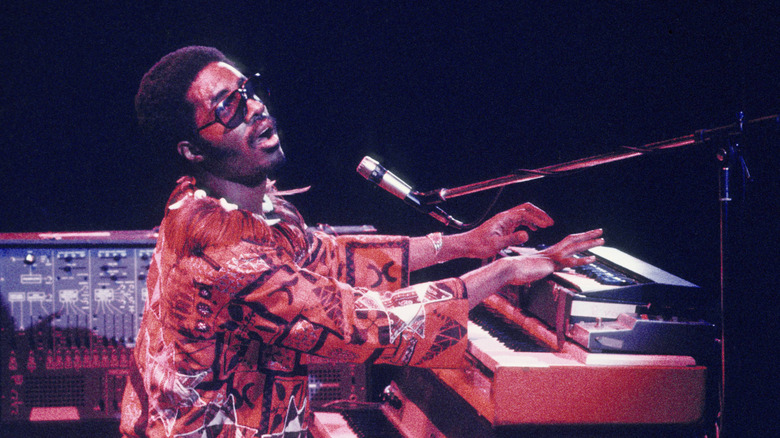
When Wonder turned 21 and let his contract lapse, he left Motown — and, indeed, the music business at large — anxious about what he'd do next. After intense negotiations, Wonder returned to the label and, experimenting with synthesizers and electronic production, began amassing a body of work that turned pop, rock, and soul audiences upside down — all written by him.
The albums "Music of My Mind" and "Talking Book," both issued in 1972, kicked off a run of classics that included the Grammy-winning albums "Innervisions" and "Songs in the Key of Life." He also racked up a slew of self-penned Top 10 hits, including "You Are the Sunshine of My Life," "You Haven't Done Nothin'," and "I Wish" — proving Wonder lived up to his stage name.