

5 Guitarists Who Helped Invent The Defining Sound Of Progressive Rock
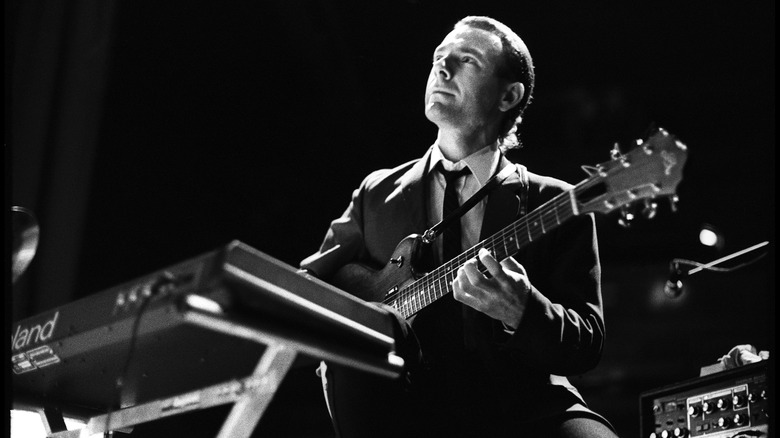
As the one and only Frank Zappa once said in a 1984 interview, "Progressive rock is anything that doesn't sound like regular rock. Regular rock is everything that sounds like itself" (via YouTube). He wasn't exactly wrong, either. So what exactly is prog rock, especially as defined by guitarists? Out of prog's entire, winding history of sinuous, grand, and sometimes overly-stuffed songs from the late '60s through the present, certain guitarists have helped us answer that question more than others.
But how do we choose those guitarists? Firstly, a guitarist that's a bit on the cutting edge in 2026 can't exactly be said to have invented the sound of prog rock. We've got to go back to prog's late '60s through early '70s roots and those bands that were there laying the bricks of rock that would come to be called progressive: ambitious and complex compositions not well-suited for radio, technical and challenging instrumentation, perhaps more abstract lyrical and conceptual themes, a focus on art over commerciality, and challenging harmonic/melodic interplay that you simply can't get from slashing away at basic power chords. Prog's most influential guitarists wrote and performed all of the above, but also crafted the image of an auteur, "out there" progster, and defined the role of a guitarist within a prog band.
We already gave away one of our choices, although he certainly would have despised being included in this article. Folks familiar with prog or classic rock on a whole can probably guess some of our other names, as prog's biggest names loom large.
Steve Howe (Yes, Asia, Anderson Bruford Wakeman Howe, Solo)
Steve Howe. Stand in a circle of progheads, breathe that name, and see how many whistles, shakes of the head, or "dudes!" you'll get. When Howe added his immense talent to Yes in 1970, his creative craftsmanship and masterful guitar work shot Yes to their highest points with 1971's "Fragile" and 1972's "Close to the Edge." He also put out solo work, played in one of the longest-running supergroups of all time, Asia, and contributed to another 1989 supergroup album made by what might be called "Yes-lite," Anderson Bruford Wakeman Howe, composed of four former Yes members.
Howe's impact on prog rock is more firmly rooted in the guitar, as an instrument, than any other guitarist in this list. Howe is a world-class guitarist of the highest caliber, bridging shimmering medieval-sounding folk passages ("Roundabout") with bluegrass-leaning themes ("Clap"), flamenco-inspired segments ("Mood for a Day"), hybrid-picking forays (playing with both a pick and his fingers) and a classical guitarist's comprehension of advanced chord shapes and music theory. His timing and light touch are impeccable to the point of being flawless.
Howe also didn't pre-limit himself to particular confines of genre and style, but, as he said in a 2010 interview with Guitar World on YouTube, was eager to prove himself as a multifaceted guitarist. He just played what he liked and felt, rolled with whatever idea came to him, and happened to work with other musicians who let it happen — particularly in realms of acoustic guitar. So it was that Howe's skill and imagination defined the lack of boundaries for prog rock guitarists and their compositions, raising the bar so high that everyone's been measured against it since.
Robert Fripp (King Crimson, Solo, Session Work)
"I've never really listened to guitarists, because they've never really interested me. In fact, I think the guitar is a pretty feeble instrument. Virtually nothing interests me about the guitar." So said Robert Fripp in a 1974 interview with Guitar Player — Robert Fripp, the guitar virtuoso, master songsmith, and creative head of King Crimson, history's most musically impenetrable prog outfit with a catalogue dating back to 1969's landmark album, "In the Court of the Crimson King."
That statement of Fripp's is as characteristically iconoclastic and idiosyncratic as everything else about him, all of which left a permanent imprint on prog and non-prog rock. He confused everyone by sitting completely still on a stool on stage. His cast terrifyingly focused, unblinking death glares while playing (though he chilled out in the '80s with KC's new lineup and sound). His mechanistically precise picking hand tore across the fretboard so quickly that Steve Vai couldn't reproduce it when subbing for Fripp in Beat, an '80s King Crimson reprisal project. All of this and more added to Fripp's mythos and reputation as an iron-fisted, perfectionist auteur who admits that he's very hard to work with.
But in the end, it was Fripp's approach to music that made the most impact on prog rock. Meandering, orchestrated, full of lengthy digressions, weird turns, and a jazz player's ear for harmonic complexity: King Crimson's music tells the whole tale, right down to his session work. David Bowie hand-picked him to play on 1977's "Heroes." Peter Gabriel called him up, too, as did Talking Heads, Brian Eno, Blondie, and Daryl Hall. Fripp left such an indelible impression on the world of rock that his reputation carried his career past KC's original 1974 breakup.
Steve Hackett (Genesis, Solo)
Steve Hackett stands out on our list because the Peter Gabriel-era Genesis guitarist played in what was ostensibly a keyboard-based band, not a guitar-based one. Hackett was more of an accentuator, like the musical glue between other instruments and spaces in the mix, rather than the dominant instrumental force in the song. But he could still fulfill any role, like on "Dancing With the Moonlit Knight's" shreddy solo or his much-discussed, highly vocal and legato solo on "Firth of Fifth."
Much like Steve Howe (another Steve H., we should note), it's Hackett's addition to Genesis in 1971 that gave the band the creative boost it needed to reach its peak years. This includes their sequence of masterworks, "Nursery Cryme," "Foxtrot," and "Selling England by the Pound," the last of which contains songs that prove 1973 was the band's best year. No matter Gabriel's wacky costumes and high-minded artistic vision, Genesis simply wouldn't have made it onto prog's shortlist of elite bands without Hackett. His clarity of tone, tastefulness of play style, and down-to-earth, band-based songwriting sensibilities proved the perfect compliment to Genesis' ensemble. This is how he helped define prog, on a whole, and the role of a prog guitarist, specifically.
Hackett also stands out as a prog guitarist because he's had a prolific, successful solo career that's still going all the way to the present and his own, actively touring band. He's released a mountain of studio and live albums going all the way back to 1975's "Voyage of the Acolyte." This early work is totally genre-agnostic, often doesn't make sense, and is weird in a spacey/synth/flute kind of way. Prog, in other words.
Frank Zappa (The Mothers of Invention, Solo)
As he said earlier, Frank Zappa would hate being put on this list. To quote his 1984 interview again, "Progressive rock is anything that doesn't sound like regular rock. Regular rock is everything that sounds like itself." But despite his sentiments, and all apologies to his posthumous genius, it'd be disingenuous to the history of rock to deny his impact on progressive music — not just as a composer, but as a guitarist. This is especially true since Zappa was a true improv artist.
Zappa treated his guitar less like a conventional guitar and more like a compositional tool. His entire, weird, eclectic discography still sounds cutting edge today and vastly cooler than most music you'll find anywhere, right down to individual tracks like the bizarrely comical "Nanook Rubs It" from the Yellow Snow Suite off 1974's "Apostrophe (')." Jazz, jazz fusion, orchestral, rock, squeaky noises, clanging mechanical clowns collapsing at a carnival — Zappa sounded like whatever he wanted regardless of genre, niche, convention, etc. This is true of both his extensive individual work, which he was able to have complete control over thanks to forming his own label, Barking Pumpkin, and his work with Mothers of Invention.
Despite Zappa's aversion to anything not absolutely creatively free, he did at least admit to having a favorite guitarist in the aforementioned 1984 interview: the phenomenal and self-taught Allan Holdsworth, a gonzo, virtuosic master who is quite possibly from another planet. But in terms of moment-to-moment fretwork, Zappa said his style comes from Guitar Slim, an up-tempo '40s and '50s guitarist who fused clustered-note lead lines with staccato chord rakes. You can hear it in Slim's work, and so can the rest of progdom at this point.
Alex Lifeson (Rush)
How nuts is it that Rush is so overflowing with talent that one of the most integral prog guitarists of all time gets overshadowed by the band's other members? Arguably, Alex Lifeson reached his potential because of the interlocking magic between him, Geddy Lee on bass, vocals, and keyboard, and Neil Peart, one of history's greatest drummers who all classic rock fans should already know. But no matter the cause, Lifeson is the most recent of our choices who's become a tentpole prog guitarist, beginning with Rush 1974 self-titled album.
Lifeson has been critical to the lineage of prog because he is the most "rock" out of all the guitarists in our list, but can still do anything. On a song like Rush's biggest hit, "Tom Sawyer" (a song we'll be blasting till the end of time), he plays a pretty straightforward rhythm section mixed with inventive lead lines, while on a song like "La Villa Strangiato" he vacillates between otherworldly whines, dizzying shred segments, gorgeous broken chord sections, and more (just within the first minute, we'll add). He's the ultimate toolkit, in other words, who serves the song and not his ego. His approach presaged future virtuosos who can stand in the forefront of a stage but also recede into the tapestry of music as needed, like John Petrucci of Dream Theater.
In this way, Lifeson didn't create any kind of prog playing style — like moment-to-moment, technical picking methods — but more the role of the guitarist within a prog band. That role includes the placement of guitar work within an entire composition as it plays off his fellow musicians, like how YYZ moves from a Peart drum solo to a Lifeson-heavy guitar passage to Lee on the synth.