

5 Songs From The '80s That Define Rock History
Without a doubt, the 1980s definitely had its own very stand-out musical identity. The rise of hip-hop like Public Enemy aside hair metal bands like Mötley Crüe, American new wave bands like Talking Heads, the fallout of '70s rock outfits, like Stevie Nicks evolving into her solo career, plus a whole lot of synths and drum machines, the '80s produced quite the eclectic musical brew. Rock lived on, though it changed dramatically from the classic '70s tracks that folks will still be blasting till the end of time. It divided into subgenres, adopted new elements, and left us with some superb music that defines the decade.
But first, what do we mean by "define" rock history? A song that defined a musical epoch isn't necessarily a song that caused a musical epoch, although they could be the same. Songs that defined the '80s also aren't necessarily the decade's biggest, blow-out hits. Rock history isn't just what was happening in the hugest hooks on the most-played radio songs, but how popular and rising musical leanings converged to form a snapshot of the moment. For this article, we've got to consider how each song matches this criterion, and also how all of our songs, collectively, form an accurate snapshot of the decade. And since rock itself has many faces and definitions, we've also got to portray each of these.
On one side of the rock spectrum, a song like AC/DC's 1980 "You Shook Me All Night Long" encapsulates much of the '80s party-hardy attitude. On the other hand, U2's 1987 "I Still Haven't Found What I'm Looking For" delivers a reply to that attitude. In between and after, other songs define the tenor of the rock moment and the people who listened.
You Shook Me All Night Long
The year is 1980. Four very short hobbits posing as Aussies of Scottish heritage, one of whom is playing hooky from school while doing his weird pogo-jump guitar-shred schtick, detonate the airwaves with "Back in Black." Approximately 99% of the album's songs discuss physical intimacy using subtly-crafted, subtextually evocative titles like "Let Me Put My Love Into You," "Givin' the Dog a Bone," the literarily sublime "Shoot to Thrill," and of course, "You Shook Me All Night Long."
Yep, loads upon loads of '80s rock bands sang about loads and loads of sex, drugs, and rock 'n' roll. It was definitely a hallmark of the times. For the purposes of this article, we can take "You Shook Me All Night Long" by AC/DC to be a stand-in for later '80s songs of varying explicitness, like 1983's "Gimme All Your Lovin' by ZZ Top" 1984's "Slide It In" by Whitesnake, 1987's "Pour Some Sugar on Me" by Def Leppard, 1987's "Paradise City" by Guns N' Roses, and countless others. But as Brian Johnson (a fateful last name) accurately implied in "You Shook Me All Night Long," the guys of AC/DC came first. In 1980, that is.
AC/DC are the standard-bearers par excellence of this particular thread of rock history. Maligned by some as brain-dead, used for actual torture, heralded by others as "rock 'n' roll reduced to its purest essence" (per The Guardian), loved by fans who don't care what anyone thinks, AC/DC are brash, playful, tongue-in-cheek, and perpetually young. As Guitar.com quotes guitarist Angus Young about his band carrying on the legacy and spirit of rock, "we make rock 'n' roll." That's all there is to it, take it or leave it.
Born In the U.S.A.
Few musicians embody what's come to be called "heartland rock" more than The Boss himself, Bruce Springsteen (a nickname he hates, by the way). When terms like "American roots" and "working-class" get tossed around, and when folks start singing about small towns lost to time, the unvarnished struggles of low-income peoples, and do so in an authentic, stripped-back way that focuses on singer-songwriter music told simply and directly? You've got one very important facet of rock's lineage, one that Springsteen embodies. And come 1984's "Born in the U.S.A." off the album of the same name, you've got an '80s song that made history, and not just for its subject matter or even its music.
"Born in the U.S.A." came at the perfect nexus of time. It portrayed a hunger amongst the listening public for a type of rock that was going out of fashion in the '80s, and also reignited that hunger. It got co-opted as a patriotic rallying cry by political campaigners who didn't understand Springsteen's hidden meaning or the song's lyrical takedown of forgotten veterans in equally forgotten towns. The song's instantly recognizable main theme also opened the door for mainstream, au naturel rock to lean into electronic instruments, although Springsteen had been using them since the '70s, anyway, on hits like "Born to Run."
"Born in the U.S.A." also defines '80s rock because its success leveraged a burgeoning tool of the age: music videos. Each single off of its album came with a memorable video, from the mechanic's story in "I'm On Fire," to the father-son baseball memories of "Glory Days," to Courtney Cox getting on stage in "Dancing in the Dark," to the small-town video montages of "Born in the U.S.A."
Just Like Heaven
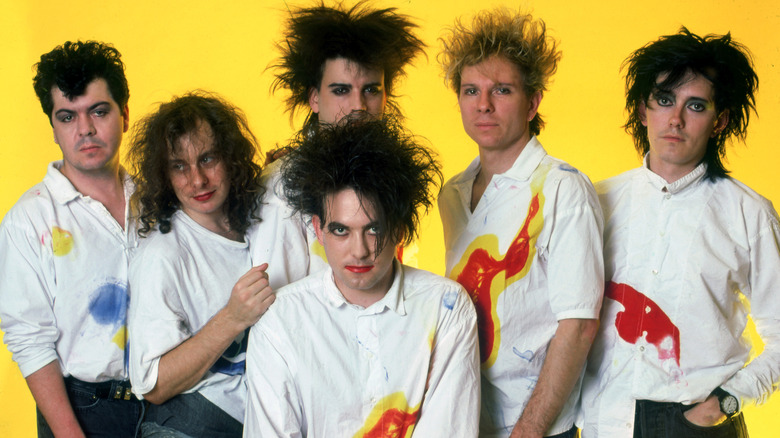
The 2008 Guardian headline says it all: "Admit it: The Cure are important." Those first two words explain a lot. As much as The Cure became a musical '80s beacon for social misfits who wanted to fit somewhere, they've become something of a hush-hush secret for those young goths who now roam amongst us in normie, adult clothes. But it's a mistake to reduce The Cure and their influence to the label "goth" as much as it is to reduce goth to black eyeliner and Robert Smith's frizzy hair. The Cure played a critical role in bringing the Joy Division branch of new wave music into the visible '80s rock sphere. And with 1987's "Kiss Me Kiss Me Kiss Me" and its chief single, "Just Like Heaven," The Cure reached their biggest audience yet.
Full of dreamy, flanged guitar layers and Smith's one-of-a-kind voice, "Just Like Heaven" is a "short and sweet hit pop song" at its core, as The Observer quotes Bauhaus guitarist, Daniel Ash. This is part of the song's genius, and The Cure's on a whole. They managed to package their sad-boy musical leanings into something dressed up in black but 100% pink and oozy on the inside. Other new wave bands played a role in filling out this particular puzzle piece of rock, like The Smiths, the Killing Joke, Sisters of Mercy, and The Sound. But "Just Like Heaven" caught on, especially because it's secretly-not-secretly just a love song written in approachably poetic language. This is how the song not only made its mark on rock, but helped define its '80s rock history and identity.
I Still Haven't Found What I'm Looking For
It's hard to convey just how big of a band U2 was by the end of 1987. Their first four studio albums, 1980's "Boy," 1981's "October," 1983's "War," and 1984's "The Unforgettable Fire," had made them a big-enough name, but 1987's "The Joshua Tree" blasted them off into global mega-stardom. The enduring success of this album is a testament not just to U2's songwriting, but also to the desire of the music-listening public for deep, moving rock — contrary to the decade's glitz. It's also a testament to the oddness of U2's particular style of rock. Because, really, what else sounds like them? What type of "rock" are they, even? This question indicates precisely how and why any of "The Joshua Tree's" singles define the desire for substance that bubbled out of '80s rock.
For the purposes of this article, "I Still Haven't Found What I'm Looking For" typifies this search for musical and cultural meaning. The song's video says a lot about that search, as it shows Bono and the gang poking around the neon-lit streets of Las Vegas to, presumably, find what they're looking for. Real life is there in those streets, no matter how blinded or inveigled by opulence — or perhaps defined by it.
Such musings are what underpin the entirety of "The Joshua Tree," and what led U2 to craft an American-focused album that explored the two halves of the country's identity — stated vs. real. In fact, the original album title was "Two Americas," and one of its outtakes features a musical accompaniment to Bono reciting Alan Ginsberg's searingly U.S.-critical 1956 poem, "America." Judging by U2's success, this indeed seems like what a lot of music listeners were looking for.
Head Like a Hole
It's time to blow your minds, people: Nine Inch Nails' "Head Like a Hole" off of "Pretty Hate Machine" is an '80s track. Trent Reznor wrote the 1989 song in his early 20s when working as a janitor and all-around studio gopher at Right Track Studios in Cleveland, Ohio. A comic book fan, sci-fi nerd, and general loner, Reznor was ensorcelled by the underground, industrial European music of his time. That music had taken inspiration from the dark, stadium pop of Depeche Mode, the demented surrealism of Ministry, the drum machines of The Cure (these guys, again), and the ragged, anti-establishment rage of punk rock. Stuff those all in a blender and sling the musical mince around a guitar-strapped, furiously-driven young man, give it a massive chorus like, "Head like a hole, black as your soul / I'd rather die than give you control," and you've got a watershed moment in '80s rock.
"Head Like a Hole" did a whole bunch of things at once besides drag the inky musical underground to the rocky surface. Yes, it was a big single. Yes, it instantly catapulted Reznor and his lank, black hair into the limelight. But, it also fused the technological with the musical as much as it fused disparate musical elements into one "rock" whole. It proved that wholly-made electronic music — not just synths substituting for pianos — could come from one auteur source, much like later digital-only music. And, "Head Like a Hole" still had obvious rock roots that helped it reach a wider audience and sculpt music for the upcoming '90s. This is the real historical accomplishment of "Head Like a Hole," one that could have only come from its decade's unique combination of forces.