

The Story Of Led Zeppelin Explained In 11 Songs
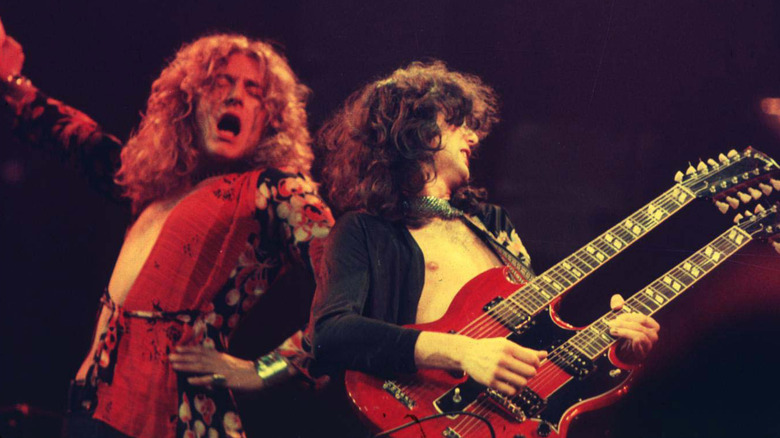
When exploring the untold truth of Led Zeppelin, it's clear that the British quartet was, in many ways, the quintessential rock band of the 1970s. It's no stretch to describe the group as a dominant musical force during that decade, given that it ruled rock radio and sold more than 300 million albums. Led Zeppelin was the brainchild of Jimmy Page, a successful London session guitarist even before joining The Yardbirds (after the band had been blindsided by guitarist Eric Clapton's exit to form Cream).
Originally replacing Paul Samwell-Smith on bass, Page soon joined Jeff Beck on guitar, and their duelling guitar solos were highlighted in a short-lived period before Beck exited the band in 1966 and Page took over as single lead guitarist. When The Yardbirds rancorously broke up in 1968, Page was left with both the name and some unfulfilled touring obligations. As for how Led Zeppelin was formed, Page recruited fellow session musician John Paul Jones to play bass and discovered unknown singer Robert Plant, who encouraged Page to hire drummer John Bonham.
Dubbed "The New Yardbirds," the group then took on the name "Led Zeppelin," a joking moniker that — according to rock lore — was suggested by either The Who's Keith Moon or John Entwistle, or possibly ex-Yardbirds member Chris Dreja. The band's self-titled debut album was released in 1969, with the album's artwork featuring the explosion of German airship the Hindenburg, and the rest is history. Read on to experience the story of Led Zeppelin explained in 11 songs.
Dazed and Confused
At first, rock critics couldn't stand Led Zeppelin, unsure of what to make of Jimmy Page's bombastic new group. The 1969 "Led Zeppelin" album began with a blazing guitar attack in "Good Times Bad Times," followed by the blues of "Babe I'm Gonna Leave You" and "You Shook Me." The first side of the album concluded with "Dazed and Confused," a psychedelia-infused guitar freakout that is the album's centerpiece. A leftover from his tenure with The Yardbirds, "Dazed and Confused" was a Page composition — albeit one he'd allegedly ripped off from singer-songwriter Jake Holmes.
"Dazed and Confused" quickly became a favorite at live shows, often stretching to up to 20 minutes as the song slowly built upon the lumbering bass line and wah-wah pedal. Plant's furious vocals accompanied Page's guitar improvisations, including famously dragging a violin bow across his guitar strings. "Well, 'Dazed And Confused' was basically a vehicle for improvisation. ... from Robert, as well," Page told Guitar World.
There are several sections in "Dazed and Confused" that indicate it's a far more complex work than the album's more blues-oriented tracks. "But there's a hell of a lot to say in that," Page said of the song, "because it wasn't just jamming on one chord, it was going through all manner of movements like a classical piece." Over the years, the song remained a concert go-to, bursting with the creativity and innovation that would become Led Zeppelin's hallmark.
Whole Lotta Love
While the first Led Zeppelin album was recorded in just 30 or so hours, the band took its time with its follow-up. Recording of "Led Zeppelin II" spanned six months, during the band's first bona fide tour. Sessions took place in various cities, the master recordings carted along in a steamer trunk. "It was quite insane, really," Jimmy Page told Rolling Stone. "We had no time, and we had to write numbers in hotel rooms." Despite the inherent challenges in that process, the second album not only demonstrated the band's maturation but also its cohesion. "On the second LP, you can really hear the group identity coming together," Page added.
That was instantly clear in the track that opened the album: "Whole Lotta Love," a straight-ahead rocker that codified the band's signature sound. "I came up with the guitar riff for 'Whole Lotta Love' in the summer of '68," Page told the Wall Street Journal. "When I played the riff for the band in my living room several weeks later during rehearsals for our first album, the excitement was immediate and collective," he later added.
Like "Dazed and Confused," "Whole Lotta Love" boasts a cacophonous middle section bursting with sonic weirdness. "I created most of the sounds with a Theremin and my guitar," Page told Guitar World, revealing he'd detuned his ax and pulled on the strings to create "an assortment of growling noises — evil sounds that you're not supposed to hear on commercial radio."
What Is and What Should Never Be
Another highlight of "Led Zeppelin II" is "What Is and What Should Never Be," which in hindsight can be seen as a major stepping stone in Led Zeppelin's musical evolution. Starting off with a dreamy and delicate feel, the song ascends to a crunching crescendo, a sonic strategy that the band would use to fuel some of its biggest future hits. The song also demonstrates Robert Plant's growing confidence as a lyricist, with evocative lyrics that paint a picture in the mind's eye with imagery of castles, bright sunrises, and sailing away amid blowing winds.
Meanwhile, the track also finds the band starting to gain a mastery of the recording studio, experimenting with new (at the time, at least) recording techniques. The song has become a classic to listen to via headphones, with Plant's phased vocals acting in counterpoint with Jimmy Page's overlaid guitar parts as the sound whooshes from one stereo speaker to the other. As the tune finds its groove, John Bonham's drumming is deceptively subtle — until the final moments, when Page unleashes an ear-shattering riff that takes the song to ascendent heights and back down again, all within less than a minute.
"We were going for studios where the acoustics were very good when you played the music live," Page told Mojo. "I wanted it to be quite extreme and that's what I was going for: Something that showed all the peaks of what we could do."
Immigrant Song
"Led Zeppelin III" demonstrated a distinct shift in the band's musical evolution, embracing a more folk-oriented sound than the iron-heavy blues rock of their debut. Of course, that wasn't apparent in the track that opened their third album, "Immigrant Song." Kicking off with a now-classic Jimmy Page guitar riff, followed by an even-more-classic Robert Plant vocal riff, "Immigrant Song" demonstrated that Plant's abilities as a lyricist were now flourishing. The song evoked a hodgepodge of the wildest stories from Norse mythology, highlighted by Page singing, "Hammer of the gods."
The theme of "Immigrant Song" was inspired by The New Yardbirds' contractually obligatory two-week tour of Scandinavia before entering the studio to record the first Led Zeppelin album. "Robert Plant was really into history," Page told Mojo. "He probably had an A-level in it at school. He knew about the Norse legends, and the Vikings were quite a thing for him. So when we went to Iceland — the land of the ice and snow — and then once he heard the riff I'd come up with, the riff became a vehicle for his words."
According to Page, he'd been building up a small army of riffs upon which to build songs. "There's a little casket that I kept my riffs in," he joked, revealing he'd plucked the opening of "The Immigrant Song" from there. "It's the intensity of that riff that gets you, isn't it?" he observed. "You could stay on it forever. It's relentless."
Tangerine
Following the breakneck intensity of "Immigrant Song," "Led Zeppelin III" showcased a far softer side of Led Zeppelin than their first two albums. Songs like "Friends," "Gallows Pole," and "That's the Way" were all built around acoustic guitars, with the band members wearing their folk influences on their collective sleeves. "With the third album, we had a break from touring and it gave us a chance to work on more of the acoustic stuff," Jimmy Page said in a 2020 interview with Total Guitar (via Music Radar).
That was also the case with what is arguably the album's most inventive track, "Tangerine," a song that Page had kept tucked away in his back pocket for some time. "I'd written parts of that song even before I'd joined [The Yardbirds] but that song is definitely the result of us having met," he told Mojo of how the song evolved into what it became. "I think the original words were different. We tried a version with The Yardbirds and there was a different chorus. It kinda got lost." As Page explained, he had several such leftovers that he brought out from time to time, and "Tangerine" allowed the opportunity to introduce elements of country. "It's this little vignette with the pedal steel on there," he added.
"Led Zeppelin III" also represented Page's refusal to repeat himself, insisting that each successive album maintain its own distinctiveness. "And clearly I wanted to make each album different from the one before," Page told Total Guitar.
Stairway to Heaven
The centerpiece of the untitled album that has come to be known as "Led Zeppelin IV," "Stairway to Heaven" is now widely recognized as Led Zeppelin's signature song. An eight-minute epic that broke all the rules, "Stairway" managed to receive major airplay on rock radio despite the band's refusal to release it as a single. Because of that strategy, fans who wanted the song had to buy the entire album — a big reason why "Led Zeppelin IV" is one of the biggest-selling albums of the 1970s.
Following the template of several of the band's earlier tracks, "Stairway" begins with Jimmy Page's gently haunting acoustic guitar refrain before building to a dramatic crescendo. Yet it was the cryptic lyrics, seemingly inspired by pagan mythology and "Lord of the Rings," that really grabbed listeners' attention. According to Robert Plant, those lyrics had a somewhat mystical origin, with the opening lines coming to him out of the blue as he and Page sat near a crackling fireplace. "I was holding a pencil and paper, and for some reason I was in a very bad mood," Plant recalled in Mick Wall's band biography, "When Giants Walked the Earth." "Then all of a sudden my hand was writing out the words, 'There's a lady who's sure all that glitters is gold / And she's buying a stairway to heaven ...' I just sat there and looked at the words and then I almost leapt out of my seat."
When the Levee Breaks
"When the Levee Breaks" is another track from "Led Zeppelin IV" that continued to demonstrate Led Zeppelin's musical evolution. A cover of an old Memphis Minnie blues number, the slow-groove stomper boasts what is arguably the most iconic drum lick in rock history — John Bonham's thundering shuffle has been sampled more than 200 times by artists ranging from Beyoncé to the Beastie Boys. After a few bars of that solo drumbeat comes the addition of Robert Plant's distorted harmonica and Jimmy Page's snaky guitar riff, transforming an old Delta blues number into the band's declaration that Led Zeppelin could rock harder and nastier than any other band.
The song marked a turning point in Zeppelin's increasing mastery of recording techniques. As recording engineer Andy Johns revealed in an interview with Music Radar, Bonham was a meticulous taskmaster when it came to honing in on the drum sound he was seeking. "I never had Bonzo turn round to me and say, 'Oh that's a great drum sound, Andy,'" Johns recalled. "He'd just say, 'There's not enough 'frudge' on the bass drum.' That was his word and I knew exactly what he meant by 'frudge.'"
Johns discovered that "frudge" with trial and error, via creative mic placement and an echo device Page used for his guitars. When he played Bonham what he'd recorded, the drummer was ecstatic. "And he came in and said, 'Oh yeah, that's more f****** like it!' And everyone was very happy," Johns recalled.
Dancing Days
Kicking off the second side of Led Zeppelin's 1973 "Houses of the Holy" album, "Dancing Days" represented another leap in the band's album-by-album progression. "You can see the expansion and risks we were taking," Jimmy Page told Guitar World of the album. "Or should I say, the new territory that is there to be civilized and conquered."
"Houses of the Holy" is among the first of the band's songs to be influenced by so-called world music, inspired by the exultant sounds that Page and singer Robert Plant had experienced during a trip to Bombay. Recording the song, recalled engineer Eddie Kramer, was a similarly joyous experience. "By the time they started playing the track with me, it just had the most amazing vibe," Kramer told Classic Rock, calling the groove "glorious."
"Dancing Days is interesting because I remember exactly where I was when I laid down those slide guitar parts," Page told Guitar World, recalling the impulsive manner in which he layered on the song's various parts without much forethought. "It sounds like the arrangement to that song was all sort of meticulously worked out, but it all just came out ... It was pretty spontaneous. When the rest of the band came in later, I said, 'I hope you're gonna like this.' They were like, 'Wow!'"
The Rain Song
Another favorite from "Houses of the Holy" is "The Rain Song," a melancholy, tender track that takes the listener through a sonic tour of multiple moods. It is also one of the few Led Zeppelin songs that can be described as a pure ballad — and it turns out there's a very good reason for that. This particular chapter in Led Zeppelin's musical development can reportedly be attributed to former Beatle George Harrison.
According to legend, the song was inspired by a challenge Harrison had issued to drummer John Bonham after complaining about Led Zeppelin's lack of ballads. "George was talking to Bonzo one evening and said, 'The problem with you guys is that you never do ballads,'" guitarist Jimmy Page told biographer Brad Tolinski for his book, "Light & Shade: Conversations with Jimmy Page." "I said, 'I'll give him a ballad,' and I wrote 'Rain Song,' which appears on 'Houses of the Holy.' In fact, you'll notice I even quote 'Something' in the song's first two chords."
Speaking with Rolling Stone, famed producer Rick Rubin pinpointed the importance of "Rain Song" in Led Zeppelin's canon. "I don't even know what kind of music this is," he said. "It defies classification. ... it's sad and moody and strong, all at the same time."
Kashmir
If there's a single Led Zeppelin track that displays the sheer majesty of what the band could achieve, it's "Kashmir." The standout track from the sprawling 1975 double album "Physical Grafitti," "Kashmir" combines the expanding influence of world music on Jimmy Page and Robert Plant with John Bonham's thundering drum sound, expanding magnificently over the course of eight epic minutes. As is often the case with Zeppelin's songs, "Kashmir" is built atop an infectious Jimmy Page guitar riff. Yet in this case, that riff was unlike anything heard in rock music before — a sitar-like drone with an almost orchestral tone. "There's a bootleg where we're just playing the riff repeatedly, it just locks in," Page recalled in an interview with Unut (via Guitar.com). "We know that we're on to something, nobody's ever gone anywhere near this. It was new music, no one had ever heard anything like it."
For lyricist Robert Plant, the grandeur of the song forced him to dig deep, singing of being "a traveler of both time and space" in the evocative lyrics. "It was an amazing piece of music to write to, and an incredible challenge for me," Plant told ABC (per Far Out Magazine). "Because of the time signature, the whole deal of the song is ... not grandiose, but powerful. It required some kind of epithet, or abstract lyrical setting about the whole idea of life being an adventure and being a series of illuminated moments. ... It was like the song was bigger than me."
Fool in the Rain
Following the decidedly mixed reception to Led Zeppelin's lackluster 1976 album "Presence," in 1979 the band unveiled its final studio release prior to the tragic death of drummer John Bonham, "In Through the Out Door." There would be one more album, but 1982's "Coda" was essentially a so-so collection of outtakes released to fulfill contractual obligations after the band's breakup in the wake of Bonzo's death. "In Through the Out Door" was a mixed bag that found the band largely abandoning the heavy sound that had characterized Zep's early output. Instead, the vibe was one of experimentation, resulting in such oddities as the country-western spoof "Hot Dog," an attempt at synth-rock with "Carouselambra," and "Fool in the Rain," built upon a Cuban-style samba shuffle.
The song definitely marked a progression toward maturity for the band, with its samba swing and complex time signature. But it also indicated a group uncertain of how to proceed in a new musical world that had splintered off into genres as diverse as punk and disco, with synth-heavy new wave already on the horizon. That said, "Fool in the Rain" — and the entire "In Through the Out Door" album, for that matter — fulfilled the promise that Jimmy Page had made to himself when he first conceived of the band. "I really did know what I was trying to do with each album and the important thing was making sure they were different from the one that preceded it," he told GQ.