

The Real Story Behind Stevie Wonder's Iconic 1981 Hit Happy Birthday
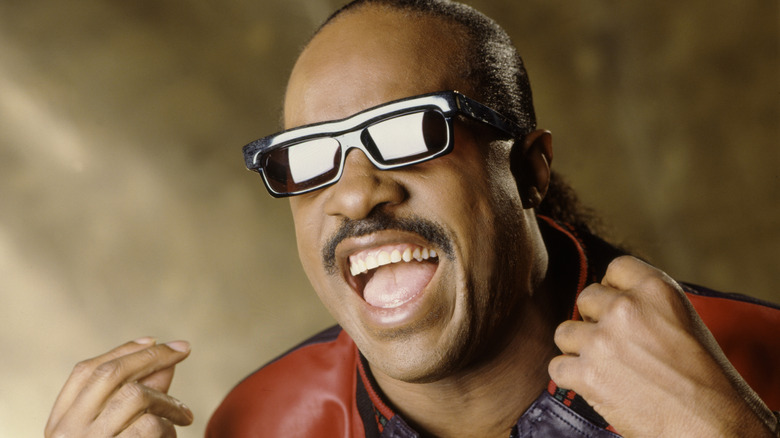
Stevie Wonder's 1980 album "Hotter Than July" featured some of the musician's best known hits, like "Lately" and "Master Blaster (Jammin')." The single "Happy Birthday" didn't make the charts in the U.S., where it was most resonant, but it hit No. 2 in the U.K. in the summer of 1981. Nevertheless, it's one of the most impactful songs in American history — it directly led to the creation of a new federal holiday.
A lot needs to happen to create a federal holiday. The drive to honor assassinated civil rights leader Dr. Martin Luther King Jr. in that manner began in 1968, with Rep. John Conyers presenting a bill to Congress four days after King was killed. A vote wasn't held until 1979, and the bill failed, just five votes shy. It was around that time that Wonder got involved with the movement. He wrote and recorded "Happy Birthday," which became the central focus and literal rallying cry of a push that would end with the establishment of Martin Luther King Jr. Day on the third Monday of every January. Here's how the life story of Stevie Wonder came to include the superstar wishing Dr. King a very grand "Happy Birthday."
Happy Birthday was the result of a dream by any definition of the word
In January 1979 — on what would've been Dr. Martin Luther King Jr.'s 50th birthday — Stevie Wonder performed at an event at the Georgia state capitol building, calling for the day to be made a holiday. Wonder told the audience to start taking the day off of work and to contact their congressional representative to ask them to make King's birthday an official observance.
"Happy Birthday" came to Stevie Wonder — who'd met King in the 1960s, when he was a teenager — in his unconscious mind. Remembering enough to compose the song, he then called King's widow and keeper of his legacy, Coretta Scott King, to tell her of the song's creation and intent. "I said to her, you know, 'I had a dream about this song. And I imagined in this dream I was doing this song. We were marching, too, with petition signs to make for Dr. King's birthday to become a national holiday,'" Wonder told CNN in 2011.
After trekking across the country on a four-month concert tour that was really a King birthday holiday awareness campaign, Wonder went into the studio to record "Hotter Than July." It included "Happy Birthday," along with an image of Dr. King and a note imploring listeners to write their representatives to help get the holiday created.
Stevie Wonder's tireless work paid off
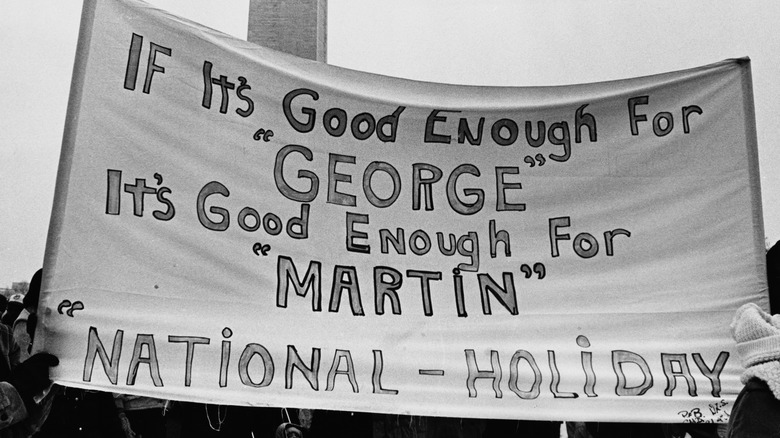
Stevie Wonder spent much of the early 1980s on his efforts to establish a January holiday in Dr. King's honor. He played rallies at the National Mall in Washington, D.C. — a 1981 event on King's birthday attracted an estimated 25,000 people according to The Washington Post that year (though later estimates claimed hundreds of thousands were there) — and also paid for a lobbying office in Washington, D.C., and met with the Congressional Black Caucus. "I had a vision of the Martin Luther King Birthday as a national holiday. I mean I saw that. I wrote about it because I imagined it and I saw it and I believed it. So I just kept that in my mind till it happened," Wonder later told Rolling Stone.
In 1983, with Wonder's public and pervasive argument undeniable, the House of Representatives finally and easily passed the King birthday bill. After some resistance in the Senate, it made its way through that chamber, too, and on October 19, 1983, President Ronald Reagan signed it all into law. The first Martin Luther King Jr. Day was celebrated on January 20, 1986. At the end of that day, Wonder headlined "An All-Star Celebration Honoring Martin Luther King Jr.," a nationally televised concert that concluded with the musician leading a star-studded singalong to "Happy Birthday."