

5 Rock Songs From 1986 That Sound Even Cooler Today
In 1986, Ronald Reagan was the U.S. president, the Space Shuttle Challenger disaster shocked the world, among other life-changing events that year, and Madonna was topping the music charts. The cultural landscape of 40 years ago may seem completely alien today, especially when it comes to fashion, when Day-Glo and shoulder pads were hot, and mainstream music was awash in heavy synthesizers. But there were also songs that actually sound as cool if not cooler today than they did when they came out in 1986.
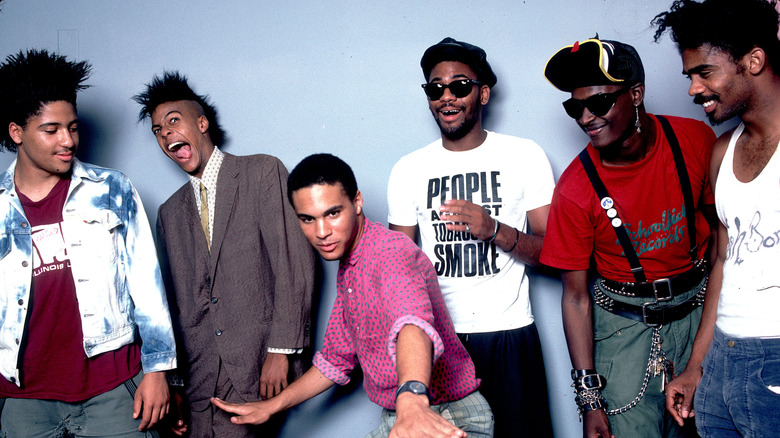
Whether it's the post-punk experimentation of Siouxsie and the Banshees, who put out their seventh album "Tinderbox" that year, or Fishbone with their first album "In Your Face" that combined funk, ska, and heavy metal, there were plenty of bands whose work was both of their time and still timeless. What you'll find in all the songs in this article are honest lyrics, a sound that defied the mainstream in 1986, and melodies that stick with you even 40 years after they were released.
Siouxsie and the Banshees left other bands in the dust
From the moment the unique bell-like chiming that sounds like a haunted toy piano comes floating in on a densely layered wave that's still somehow lighter than air, Siouxsie and the Banshees's "Cities in Dust" announces itself as something unique, even for a band as experimental as this British quartet was. Released as the first single on the band's 1986 album "Tinderbox," it marked a new direction that bridged experimentation with a more pop sensibility, but retained Siouxsie and the Banshees's vital sound.
Siouxsie Sioux's sharp-edged wail contrasts with the shimmering guitar and dance-friendly beat. Lyrically, this song is about Mount Vesuvius' destruction of Pompeii in 79 AD that begins with the shiver-inducing lines, "Water was running, children were running/You were running out of time." It's rife with metaphor and warning as well. Just as this bustling Roman city has fallen so can our modern equivalents. When Siouxsie Sioux intones "Your city lies in dust, my friend/Your city lies in dust," it sounds less like an archeological observation and more like a forecast of what may lie ahead. It's an apocalyptic vision that makes you want to dance.
R.E.M. begins again
Peter Buck's overdriven guitar kicks off R.E.M.'s "Begin the Begin," and the band is off, chugging down the track as Michael Stipe laments the state of the world that advances, then retreats, decade by decade like a "tiger run around the tree/Follow the leader, run and turn into butter." But it's not only the so-called leaders to blame since "life's rich demand creates supply in the hand/Of the powers, the only vote that matters."
Stipe seems to indicate consumerism is at the heart of the problem since it drives corporate profits, which are then channeled into political influence. It may have been true in the 1980s when Stipe penned these lyrics, but it's even more prescient today. While Stipe's lyrical lament rolls on, the rest of the band provides a driving rhythm that gets you up out of your seat. The song, which appeared on R.E.M.'s album "Life's Rich Pageant," helped make them one of the most important bands of the 1980s. The album marked a more forceful sound that retained the band's lushness, thanks to producer Don Gehman, which is perhaps why it sounds so timeless.
New Order gets stark but stays danceable
New Order's "State of the Nation" is by no means musically stark. Quite the opposite, it's densely layered and textural with a funky bassline, percussive guitar, ethereal but forceful synthesizers, and a metallic guitar line that punctuates it all. But lyrically, this song presents a stark view of the world as Bernard Sumner sings, "My brother said that he was dead/I saw his face and shook my head/Can you see where we can't be/We're losing our blood in the sea." In a way, it echoes some of the existential angst that inundated Joy Division's music, the band that gave rise to New Order after the death by suicide of singer Ian Curtis in 1980.
The music plays off Sumner's lyrics, exuding an anxious quality that remains incredibly danceable. It was released as a stand-alone single in 1986 and reached No. 30 on the U.K. singles charts before finding a home on the CD version of the band's album "Brotherhood." It still sounds fresh 40 years on, thanks in part to this duality between the subject matter and the music. "State of the Nation" is a multifaceted song that defies easy categorization.
Fishbone breaks the mold
Fishbone's "When Problems Arise" starts with a driving organ part (in tandem with a tambourine) before a funky-as-hell bassline takes over to be joined by electric guitar and singer Angelo Moore's distinctive vocal delivery. And that's before the punchy horns and snaking, intricate metal-infused guitar part comes in. The song is a microcosm of the unique sound of Fishbone, the LA-based band that could never be pigeonholed. It's what helps make this song sound so new, even though it was on the band's first album, "In Your Face," way back in 1986.
Beyond the music, the words in "When Problems Arise" adhere to Fishbone's long-running lyrical exploration of themes of self-expression, social injustice, racism, unity, and staying positive while fighting the good fight. In this song, Moore sings about trying to spread truth only to find that people refuse to listen — "You close your eyes and hide/Behind a storybook/When I have something new to tell." Sadly, 40 years on, these problems persist and in some cases have only gotten worse. So put on "When Problems Arise" and dance it out until it's time to get back to the work at hand.
David & David's beautifully bleak vision
With its atmospheric electric guitar with a bowed-like sound that seems to sing, David & David's "Welcome to the Boomtown" has a spare ethereal quality that matches its subject matter. The song, from "Boomtown," is the sole album put out by the duo of David Baerwald and David Ricketts. With its cinematic storytelling and noir edge, the song tells a gritty tale of addiction, desperation, and materialism in the City of Angels, where you can "pick a habit/We got plenty to go around." The two characters, Miss Cristina, with her Porsche and "bars on her doors," and Handsome Kevin, who "got a little off track," represent two sides of the complex relationship between user and dealer that mimics the dynamic of American consumerism.
The song went to No. 8 on the rock charts and No. 37 on Billboard's Hot 100 singles chart in 1986. Although David & David never made another album, they've stayed in the music business. Ricketts co-produced Sheryl Crow's debut album and, along with Baerwald, was among the co-writers of her hit "Leaving Las Vegas," among other credits. But "Welcome to the Boomtown" stands as a singular achievement for its timeless sound and subject matter that remains as vivid today as it did in the mid-1980s, just as the other songs on this list have done in their own ways as well.