

High School Hits From The '50s Millennials Should Check Out ASAP
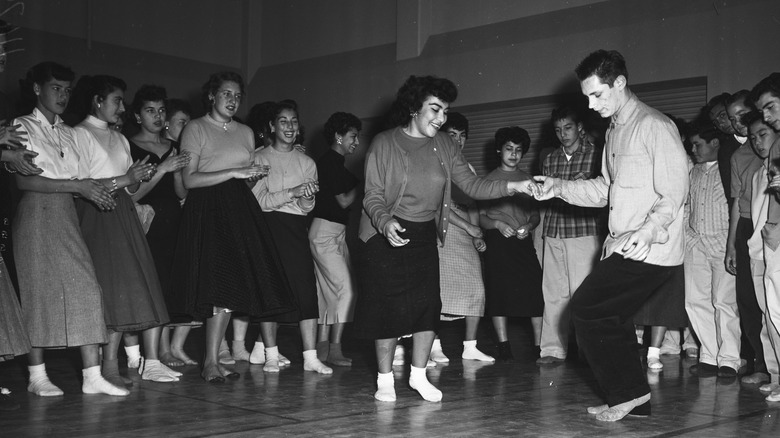
What are the oldest songs on your playlists? A bit of 1970s soul, maybe? Or a few Beatles classics from the band's mid-1960s heyday? Okay, okay, maybe you actually have quite a few favorites that are now more than half a century old, and which shuffle seamlessly among more modern releases. But look any earlier, and it's likely that the numbers drop off significantly: perhaps you have a couple of Elvis Presley hits that do it for you, some Chuck Berry, or some Buddy Holly, but odds are that the 1950s are woefully underrepresented in your library. So let's change that.
The 1950s were the decade that pretty much invented the teenager, and that was thanks to the advent of new forms of entertainment that targeted young people, most notably new forms of pop music such as rock 'n' roll, rockabilly, and doo-wop. There was a huge amount of great music made during this decade, and although recording production methods of the day were relatively primitive, many still stand up as great tunes in their own right for their musicianship, raw energy, or timeless emotional appeal.
So, omitting the work of the big names listed above, here are five tracks that would definitely have appealed to high schoolers in the 1950s. Though these songs are not utterly unheard of today, they are certainly under-loved considering their timeless quality, and they deserve a place on any Millennial's throwback playlist alongside the likes of Berry's "Johnny B. Goode" or Elvis's "Jailhouse Rock." Enjoy.
Danny & the Juniors – At the Hop
The ultimate 1950s high school dance tune, "At The Hop," was a major hit for Danny & the Juniors back in 1957 and into 1958. Originally titled "Do The Bop," the lyrics were changed at the time of recording to tap into a new craze that was sweeping the nation: the sock hop. Generally held in school gymnasiums, cafeterias, or auditoriums, these social dance events — which typically required dancers to remove their shoes to avoid scratching the floor as they danced, hence the name — were at the epicenter of youth culture for many music-loving American teenagers of the day.
No wonder the vocal quartet decided to cash in on the craze, and they did so in style, with a rocking number that highlighted the band's exceptional harmonies while remaining catchy and danceable. Incorporating barber shop, rock 'n' roll influences, as well as the penchant for bands of the day to accompany their songs with a choreographed dance that fans could replicate, "At The Hop" was initially a local hit in the group's home city of Philadelphia, but it eventually went gold and topped the charts, setting Danny & the Juniors — who were still high schoolers themselves — up for a career that would see them continue to release singles until splitting in 1963.
Little Richard – Lucille
Perhaps the most influential artist from the 1950s who is deserving of far greater attention from younger listeners is Little Richard, whose signature song "Tutti Frutti" was a game-changer at the time of its release, and still sounds utterly electrifying if you play it loud enough. But while a good proportion of the Millennial generation will be familiar with Richard's "A wop bop a loo bop a lop bam boom" classic, there are other tracks in his discography that are just as worthy of your time, such as the equally riotous "Lucille."
An uptempo rock 'n' roll dance floor filler, "Lucille" has many similarities to "Tutti Frutti" but sees an even more powerful vocal performance from Richard, with the title word delivered in such a way that it culminates in a spine-tingling screech. It is a track with the kind of swaggering low-end that could see it appear over the opening credits of a Quentin Tarantino movie, and an effective use of stop-time in the choruses that urge you to stop up and pay attention. The song is an undeniable crowd-pleaser, with the same ability as Ray Charles' "Mess Around" to get people of all ages worked up into a fever.
Ritchie Valens – La Bamba
Ritchie Valens' "La Bamba" was a groundbreaking song for 1950s rock 'n' roll, an early Spanish-language hit that proved the new genre could accommodate South American influences with aplomb. It speaks to the song's infectiousness that it was quickly adopted as a favorite of teenagers across the land after its release in 1958, and has remained one of the classics of the rock 'n' roll era since, despite Valens perhaps no longer being a household name the way many of his contemporaries still are.
Born Richard Valenzuela, Valens was of Mexican and Native American heritage, and though he didn't speak Spanish at home during his California upbringing, he was taught traditional songs by family members, from which he derived "La Bamba." It reached No. 22 in the charts, and Valens looked set to enjoy superstar status in the years that followed. Tragically, he died the following year in a plane crash alongside other young talents Buddy Holly and The Big Bopper, an event immortalized in the Don McClean song "The Day The Music Died."
Most Millennials are too young to remember the Valens biopic "La Bamba," which was released in 1987 and prompted a wave of renewed interest in his work among Gen Xers. The song arguably remains the most recognizable on the list thanks to its use in various movies and TV shows, but even if you're aware of it already, it's well worth giving the full version a few spins to enjoy the sustained joy and energy that Valens brought to this electric performance.
The Platters – Only You (And You Alone)
High school sock hops weren't all about doing the twist to upbeat rock 'n' roll tracks. More importantly for the love lives of many newly infatuated high schoolers, it was also an opportunity to slow dance, and the most successful groups of the day wasted no time when it came to delivering swoonworthy numbers to hold your partner to. The Platters' "Only You (And You Alone)," for example, is an achingly romantic doo-wop number that undoubtedly broke a sweat on the brows of a few chaperones back in the day.
"Only You" is notable for the pristine performance of lead vocalist Tony Williams, whose warm tenor avoids any sense of melodrama with precise, truly emotive phrasing and tasteful trills and hiccups, backed up by effective, understated support from his backing singers. The song peaked at No. 5 on the pop chart in 1955, topped the R&B chart, and set The Platters up for an even bigger hit, "The Great Pretender," later that year. But it's certainly "Only You" which has fared better over the years, with the lightness of touch used throughout the production elevating it above more plodding ballads of the same era. It's definitely one to add to the playlist for a romantic night in.
Santo & Johnny – Sleepwalk
The sock hop is winding down, and there is time for just one more slow dance before the attendees go home. So what better time could there be than to play "Sleepwalk," the magical instrumental number from Brooklyn brothers Santo and Johnny Farina, better known simply by their stage name Santo & Johnny?
The 1959 track is memorable thanks to the sound of Santo's steel guitar, an instrument played horizontally that creates those incredible slide textures that made the duo's sound so unique in the rock scene at the time. As Johnny recalled in a 2012 interview with The Guardian: "We were exposed to mandolins, acoustic guitars and accordions [sic]. So for us to take lessons on a steel guitar ... No one really wanted to hear it. Everyone was doing doo-wop. They associated the steel guitar sound with country and Hawaiian music. Although really, the way we play it is not Hawaiian at all." But eventually the steel guitar did catch the ear of the record-buying public, and it hit the No. 1 spot on the pop charts, inspiring many big names in the decade that followed, including the Beatles. It remains weirdly smooth and evocative even today.