

Top Classic Rock Artists' Most Notable Flop Songs
Not every single can be a hit, and that's a lesson that even the biggest, best-selling, and most popular classic rock acts learned the hard way. So many of the most monumental bands and solo artists who defined rock in the '60s, '70s, and '80s put out a flop so egregious, so objectively terrible, that not only did mainstream audiences reject it, but so did their most loyal fans.
Classic rock acts are musical artists, and all artists want to grow — to try new things and explore subjects and milieus not previously broached. But they also have to earn a living, and when their influence fades a little, these once-mighty acts might feel they have little choice but to chase trends to stay relevant. It's a fate that befell some significant classic rock acts.
We think these are the biggest flops ever foisted upon the world by some of the most important classic rock musicians. They're the singles that missed the Top 40 or sold poorly, breaking a long period of sustained commercial success. We also think they're clunky creative departures for acts that had a whole sound figured out — no wonder fans just couldn't get on board. These dud singles derailed careers, either permanently or temporarily.
Kiss - A World Without Heroes
By 1981, the messed-up reality of Kiss, among the most important bands of the '70s, was defined by uncertainty. Drummer Peter Criss had left the band, and leaders Paul Stanley and Gene Simmons worried Kiss had upset its long-standing supporters by recording two pop LPs. So, they brought in producer Bob Ezrin, who'd worked on Kiss' 1976 album "Destroyer." Ezrin had an idea: Make "The Elder," a fantasy short story written by Simmons, into a concept album. "The Elder are a life-form without body," Simmons told Classic Rock. "They are benevolent, but committed to the balance of opposites. And when darkness gets too strong, a hero is born to restore the balance."
Kiss got some support on the album "Music From 'The Elder'" from rock icon Lou Reed of the Velvet Underground, who co-wrote "A World Without Heroes." The LP carried that title because it was supposed to be a movie soundtrack, but the film version of "The Elder" fell apart in pre-production. "A World Without Heroes," which falls in the middle of the album and doesn't provide a very clear explanation of the story, was the one and only single released, and it hit a middling No. 56 on the Billboard Hot 100. A combination of dated '70s progressive rock and dull '80s soft rock, it didn't sound like classic Kiss at all. "It bombed. There's just no other way to look at it," Simmons said of the whole endeavor.
Elton John - Slow Rivers
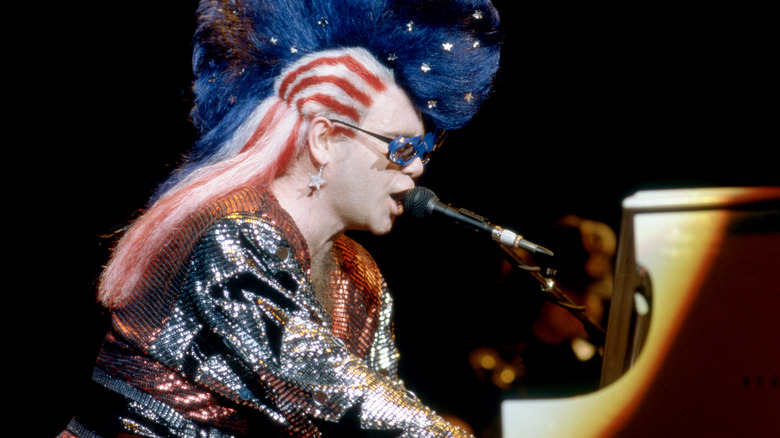
By 1986, Elton John was flailing. The 1970s, which John dominated with dozens of hit singles and multiple acclaimed albums, were long over, and the singer-pianist faced professional and personal turmoil. He was in the middle of an unhappy marriage and was using cocaine heavily, which resulted in some of the worst music of John's career. "'Leather Jackets' comes to mind," he said in "Elton John: The Biography." John was unreliable and not at his strongest vocally, and the album tanked, peaking at just No. 91 in the U.S.
An LP's singles are supposed to be its flashiest and most widely appealing so as to draw attention and drive sales. It's no wonder that "Leather Jackets" bombed when the best option for a single was "Slow Rivers." Presented as a landmark in pop music, it was a duet between John and Cliff Richard, a massive pop star you've probably never heard of. While he's one of the most consistently popular and prolific hit-makers in U.K. history, he only ever landed a few Top 10 hits in the U.S., and none since 1980. The song itself didn't merit such superstar treatment — "Slow Rivers" is sappy, overproduced, and seems purpose-built to play on adult contemporary radio. Synth-drenched and plodding, "Slow Rivers" isn't slow enough to be considered a ballad, it's not fast enough to light up a room, and John doesn't try very hard to sing it. It didn't even make it onto the Hot 100.
Neil Young - We R in Control
After signing a multi-million-dollar deal with Geffen Records in 1982, Neil Young released "Trans" the following year, abandoning folk rock in favor of synth-pop and electronics. Of the three singles from "Trans," the public embraced the most mechanical and future-gazing one, "We R in Control," the least. It barely charted at all, peaking at No. 42 on the rock countdown. The song finds Young sounding like an evil robot spewing lyrics that read like passages from a dystopian sci-fi novel. "We control the data banks, we control the think tank," Young cries out under layers of voice modulation. "Computer age, now the precious metal lies in harm's way, we will prevail and perform our function."
Geffen was so furious with "We R in Control," and "Trans" in general, that it sued Young for $3.3 million, claiming the musician recorded deliberately uncommercial music. That suit was soon dropped, as was Young's $21 million countersuit.
Meat Loaf - I'm Gonna Love Her for Both of Us
Marvin Aday, or Meat Loaf, a powerfully voiced singer with a background in musical theater, teamed with composer Jim Steinman in 1977 for the exciting and fun rock opera "Bat Out of Hell." It sold 14 million copies in the U.S. and made Meat Loaf a superstar. Meat Loaf gave so much to the demanding "Bat Out of Hell" songs during live shows that he damaged his voice and needed a lengthy recovery period. He passed on recording a follow-up LP that Steinman had already written and instead waited until 1981 to issue his next album, "Dead Ringer."
It lacked Steinman's deft touch, and that was abundantly clear on the lead single, "I'm Gonna Love Her for Both of Us." The song is utterly joyless and wildly sexist. It's about an idealized woman, but Meat Loaf doesn't sing it to her, but rather to her abusive partner. "I can't stand to see it no more the way you're living with a goddess," the singer whines. "But you treat her like a slave and you can't hold her back anymore." Both men treat this woman like property, and Meat Loaf tries to negotiate a deal. "If you give me your girl and then you give me your trust," he suggests, "I'm gonna love her for both of us."
Audiences emphatically passed. "I'm Gonna Love Her for Both of Us" spent just three weeks on the pop chart and sputtered out at No. 84.