

Songs From The Last 100 Years That Sound Even Cooler Today
It's easy to dismiss other generations' popular music, and to an extent it's sort of a rite of passage. Traditionally, what your parents listened to is boring, and what your children and/or "kids today" listen to is simply awful and cacophonous — barely music at all. And while every living generation is guilty of a certain number of assaults against musical taste, it's important not to let the worst stand for the whole. Despite how boomers vote, Gen Xers complain, millennials kill everything from mayonnaise to mortgages, and Gen Z dresses (feel free to insert your own favorite intergenerational beefs here), every cohort has laid down a few tracks worth revisiting.
For this list, we've chosen one song from every sixth year for the past 100, so 1926, 1936, 1946, etc. Some of these songs are especially representative of their eras, in either theme or musicianship, while others have timeless themes that contemporary audiences still respond to, and a couple showcase the work of artists and genres that had significant influences on subsequent music. We've shied away from the most famous songs in each era to give some more obscure classics time to shine, though some of these are B-sides from big-name artists. And most importantly, they all still slap.
Muskrat Ramble — Kid Ory (1926)
What is it about muskrats? It's not immediately apparent, at least to non-musicians, why these unglamorous rodents tend to inspire songs (that flopped), but here we are. Kid Ory's 1926 "Muskrat Ramble" is a fun, bouncy instrumental that shows off his trombone chops. Jazz has a reputation for being inaccessible and hard for newcomers to get into (a reputation that arguably stems more from some gatekeeping fans than any inherent challenge in the music), but there's nothing hard to parse with Ory's musicianship here. It's happy, hummable, and wiggle-in-your-chair danceable. "Muskrat Ramble" doesn't feel modern, but neither does it feel old-fashioned: The music is appealing enough that modern listeners can understand why a whole era of American history is called "The Jazz Age."
Kid Ory was born upriver from New Orleans in LaPlace, Louisiana, cutting his teeth in the Big Easy before moving to Los Angeles. A pioneer of the trombone's role in jazz and its related genres, he recorded with huge names like Louis Armstrong and Jelly Roll Morton before retiring to raise chickens in 1930. Luckily, the hen life couldn't keep him, and he came roaring back in 1939.
Gloomy Sunday — Paul Whiteman and His Orchestra (1936)
In 1933, Hungarian composer Rezso Seress wrote "Gloomy Sunday," pairing it with lyrics from his friend, the poet Laszlo Javor. The grim but gorgeous tune quickly became the topic of an urban legend in which the "Hungarian Suicide Song" was responsible for a number of deaths by suicide among people who heard it, but despite the song's alleged dangers, it was soon translated into English and recorded by various artists: it was just too good to ignore.
Billie Holiday's recording from 1941, with its tacked-on happy ending of a final verse, is probably the most famous, but the 1936 version by Paul Whiteman and His Orchestra is not to be missed. The orchestral sound effects and Whiteman's wavery phrasing make it a strange little gem perfect for a Halloween mix, with the exaggerated creepiness making it into an elevated alternative to a haunted-house scary sounds track. The "vocabulary" of how you make a song creepy is on full display: "Gloomy Sunday" walked (out of the grave) so "Spooky Scary Skeletons" could run.
Salt Pork, West Virginia — Louis Jordan and His Tympany Five (1946)
Making sense is overrated, a lesson not lost on singer and saxophonist Louis Jordan. "Salt Pork, West Virginia" was recorded by Louis Jordan with his band the Tympany Five (which had six members aside from Jordan and no timpani) and released in 1946. The borderline-nonsense lyrics center on Jordan's desire to get back to a girl he likes, who lives in a town with the unlikely name of Salt Pork, West Virginia. (She must have been awfully special to merit a trip back to Salt Pork.) Ostensibly, the song references an incident in which Jordan charmed his way out of a West Virginia traffic court by amusing the judge, an endearingly relatable action.
Playful lyrics like those in "Salt Pork, West Virginia" were a trademark of Jordan's songwriting. Audiences loved him, and Jordan was among the few Black performers to find a broad white audience in the 1930s and '40s. His star faded in the postwar decades even as artists like Chuck Berry and Muddy Waters covered his songs, but he was nonetheless inducted into both the Blues and the Rock and Roll Halls of Fame, albeit posthumously.
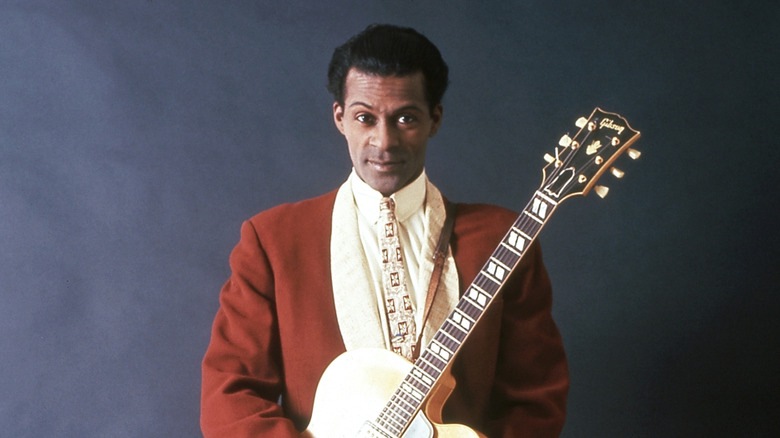
Brown-Eyed Handsome Man — Chuck Berry (1956)
Chuck Berry, a master observer of the human condition, captures a certain enthusiastic self-destructive urge in the lyrics to 1956's "Brown-Eyed Handsome Man." The women in the song interfere with court cases, reject successful suitors, and even walk to India (though from where is undisclosed) in their enthusiasm to meet a brown-eyed handsome man. The type is identified by Berry, himself dark-eyed and appealingly suave in his youth, as an ancient enemy of women: "... ever since the world began/ There's been a whole lotta good women sheddin' tears/ Over a brown-eyed handsome man" (Some bad women and some men, too.) This psychodrama all plays out over the bouncy, energetic guitar work that makes Berry one of the best-loved and best-remembered of the early rock musicians.
Beneath the obvious reading, though, Berry was also making a certain point about race with the song. Black sexuality was still considered dangerous in the 1950s, with lynchings even occurring when white women were perceived as threatened. A Black man singing about the attractive properties of dark features, even one as common and shared by some white people as brown eyes, was making a statement and taking ownership of a perceived attribute that was, in some contexts, extremely dangerous.
That's Life — Frank Sinatra (1966)
Karaoke has done a number on Frank Sinatra's reputation: If your main point of reference is very, very drunk people trying to get through Sinatra's late-career signature song, "My Way," which is significantly more difficult than it initially sounds and relies on strong delivery from a mature performer... yeah, you're going to think he's overrated. But Sinatra's catalogue has much more to offer than just "how 'My Way is supposed to sound,'" and a particular highlight is the classic dust-yourself-off ballad celebrating keeping on keeping on, "That's Life."
Because "That's Life" was recorded in 1966, it's got some absolutely wild synth organ going on in the background, but fortunately, it never quite competes with the vocals for attention. Sinatra catalogues his disappointments ("You're ridin' high in April, shot down in May"), acknowledges the desire to give up ("I've thought of quittin', baby/ But my heart just ain't gonna buy it"), and keeps on trucking. If Ol' Blue Eyes can do it, so can you!
There's a charming piece of trivia about "That's Life": Frank Sinatra got to be on the Billboard charts at the same time as his daughter Nancy, of future "These Boots Are Made for Walkin'" fame. Her "Sugar Town" overlapped with the early weeks of "That's Life" on the airwaves.
I Wanna Be Your Boyfriend — The Ramones (1976)
On some level, it can seem weird that the 1970s came right after the 1960s. Jackie Kennedy and her pillbox hats only happened about 15 years before disco and punk, and that just doesn't seem long enough for such a tectonic vibe shift. Happen it did, and the Ramones lived through it, as evidenced by the 1976 track "I Wanna Be Your Boyfriend."
"I Wanna Be Your Boyfriend" is the rare song that works musically even though it's kind of a joke. The Ramones, arguably the first punk band, reaching back into the '50s and '60s doo-wop to do a sweet little teenybop song about having a crush? Complete with girl-group-style "oo-oo" vocalizations? The same "I Wanna Be Sedated" Ramones? It works when it seems like it shouldn't simply because they play it straight: it sounds like the Ramones singing a bashful love song, and if that's hard to reconcile with what we can imagine of the Ramones' probably real-life courtship habits, the illusion lasts for the approximately two and a half minutes of the song. Plus, if any single Ramone sang this to you in 1976, you would have gone out with him. Admit it.
The Thing That Should Not Be — Metallica (1986)
"The Thing That Shouldn't Be," from Metallica's seminal 1986 album "Master of Puppets," perfectly captures a certain kind of metal, a sort of "what people who don't listen to metal think metal is." Grinding, driving guitars underlay six-plus minutes of singing about monsters, with lyrics like "Crawling chaos, underground/ Cult has summoned twisted sound." Various lyrical references make it clear that this isn't just any monster: it's the fabled octopus-headed heavy sleeper Cthulhu, the most famous creation of H.P. Lovecraft. And while Lovecraft, a fussy racist, was not especially cool, his creations are some of the most influential nightmares in the history of modern horror, with fans just as rabid (shambling, indescribable, unnameable) if not more than in Lovecraft's heyday (or, for that matter, Metallica's).
It's an open question if Metallica itself is still cool. Some metalheads unsubscribed when the band members showed up with short hair and a more "alternative" sound around the time of their 1996 album "Load." For others, they lost the room when they sued Napster into oblivion in 2000. And in 2026, they released official branded Doc Martens, which is a little too precious, a little too "Metallica Family of Brands." But in the 1980s? Hell yes, Metallica was cool. They were loud, they were rebellious, and they sang about Lovecraft's Cthulhu mythos – which at least makes "The Thing That Should Not Be" even cooler now.
The Curse of Millhaven — Nick Cave and the Bad Seeds (1996)
The second-longest track from Nick Cave and the Bad Seeds' 1996 album "Murder Ballads", and the one with the highest body count, is "The Curse of Milhaven," in which a teenage girl kills dozens of people in a small town with knives, power tools, arson, and the timely removal of signs warning of thin ice on a frozen pond. (To her credit, she denies responsibility for the death of a terrier.) The nearly seven-minute song, sung by Cave voicing the murderous Lottie, plays out over a rapid, frantic backbeat, supported by licks that sound like carnival music. "The Curse of Milhaven" is one of the classic scream-sing the rage out songs, and it's long enough that you might get it all out in one go. If not, though, hit replay.
Nick Cave and the Bad Seeds recorded an album full of songs about death, violence, and mayhem because they were tired of touring and wanted to put out something no one would ask them to take on the road. Oops, it became one of their most popular albums, as fans loved the sometimes tongue-in-cheek, sometimes heartrending gore, as well as the presence of Kylie Minogue and PJ Harvey.
Hard Rock Hallelujah — Lordi (2006)
Weird things happen most years at the Eurovision Song Contest, but in 2006, something especially odd went down. The love songs and schmaltz were blown out of the water by "Hard Rock Hallelujah," a track by death metal band Lordi. Performing as monsters in heavy makeup and costumes much like Gwar, Lordi crushed second-place Russia by over forty points to bring Finland its first — and so far only — win in the contest, though they just missed the crown with a second-place finish in 2023.
Protesters in Finland and, oddly enough, Greece objected to the "demonic" metal band's inclusion in Eurovision, but they missed the point, as moral panics often do. Despite its screamy vocals, "Hard Rock Hallelujah" is silly. It discusses the "a-rock-alypse": In the official music video, a band of high school cheerleaders become zombies due to Lordi's power and pledge themselves to an unpopular (but still pretty) brunette student, who then leads them on a rampage through the school. It's nothing you haven't seen before; it's just done especially well.
Sit Still, Look Pretty — Daya (2016)
As long as people feel hemmed in by societal expectations, they'll be writing and performing songs about it. And while no one likes the feeling of being constricted by the world they live in, this frustration and defiance have given music lovers some of the best eff-you anthems in popular music history. Daya's "Sit Still, Look Pretty," from the 2016 album of the same name, is in many ways an heir to songs like Lesley Gore's "You Don't Own Me" or Nancy Sinatra's "These Boots Are Made for Walkin'": A woman looks at the role and the games she's expected to play and firmly, and only barely politely, refuses. Combined with Daya's musicianship and surprisingly mature delivery from the still-teenage singer, "Sit Still, Look Pretty" is a solid entry in the generations-long feminist playlist.
After a very successful 2016 that saw her win a Grammy for "Don't Let Me Down," a collaboration with the Chainsmokers, Daya retreated for a few years to enjoy her youth out of the spotlight. If she's not quite the airplay phenomenon she was before her hiatus, she's still recording, performing, and very much not sitting still. (Looking pretty is, of course, subjective.)