

5 Songs From 1974 That Made Rock History
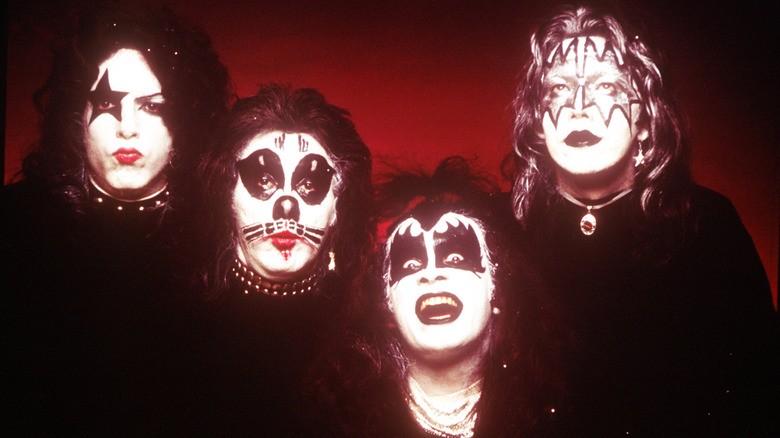
Rock history is full of watershed moments going all the way back to The Beatles' first single, 1962's "Love Me Do." And while not each year has produced songs as obviously era-changing as "Love Me Do," each has produced songs that have charted the course of rock history — moments that built on what came before and paved the way for what came next. This is especially true of 1974, a year that demonstrated that the countercultural rock movement of the '60s had not only gone mainstream but was giving way to the excesses of the '80s rock scene.
By the time 1974 rolled around, '60s visions of peace and love were already a thing of the past. Woodstock was five years over, the Vietnam War was drawing to a close, and rock was transitioning from its countercultural heyday to the glitzy arena rock of the future. The songs that made rock history in 1974 dog-ear this moment. They're not necessarily "the best" songs from that year (however we define that), the ones that got remembered the most over time, or even the ones that people realized were making history at the time. No, these are the songs that best illustrate where rock came from and where it was going while still being imminently of the moment. That might mean demonstrating rock's turn toward big stage performances and production gimmicks or representing the dogged desire of roots rock to remain grounded in singer-songwriter fare. Or the song might reflect a willingness for rock to change or show that auteurs and genre-defying artists still had plenty of room to develop in coming decades.
Nothin' to Lose — Kiss
Say what you will about Kiss and the quality of its music (or lack thereof), but the band changed rock forever. Fusing hard rock with glam, drenching the whole thing in theatrics and big hooks, and giving it a shiny coat of pyrotechnics and eye-catching face paint, Kiss fashioned the spectacle-over-substance blueprint of arena rock to come. Admittedly, the group's self-titled 1974 debut album is pretty underwhelming and doesn't contain any monster hits like 1975's "Rock and Roll All Nite" (a very short song that's basically one big chorus). But Kiss' impact started with its debut, beginning with its first single, 1974's "Nothin' to Lose."
We're not going to pretend there's some grand vision or immense musical depth underlying the song's AC/DC-like opening riff, generic guitar stylings, ultra-simple chorus, and ultra-repetitive rhythm section. That's not why Kiss made such an impact, anyway. Besides, the song is about a particular bedroom practice. Hence lyrics like, "Before I had a baby / I didn't care anyway / I thought about the back door." This, at least, tracks with Kiss' cultural footprint and that of future hedonistic '80s hair bands.
Also, despite the group's apparently nonconformist appearance, Kiss and its debut presaged what's called "corporate rock," i.e., radio-friendly (despite the above lyrics), approachable pop-rock that's more of a commercially minded, money-making, branding exercise than an art form. There probably isn't a better way to define Kiss, right down to merchandising themselves and engaging in stunts like becoming characters in a comic written in ink that used their own blood (yes, for real, and there's even more to the messed-up reality of Kiss).
On the Beach — Neil Young
If the coming of Kiss and its decadence marked one branch of rock history, then Neil Young and his refusal to be a star marked the exact, polar opposite branch. And when we say "refusal to be a star," we really mean it. Young famously despised the commercialization of music and loathed feeling like a product. This is why he said "no" to attending his own Rock & Roll Hall of Fame induction in 1997 (with Buffalo Springfield), because he "decline[d] to take part in this TV presentation and be trotted out like some cheap awards show," as the Tampa Bay Times quotes. All such sentiments are on full display in Neil Young's 1974 song "On the Beach" from his album of the same name.
"On the Beach" is a crushingly sad, even hopeless song about Young's struggle with fame. More specifically, his 1972 album "Harvest" had gotten so huge that it more or less scarred him. He shifted from the heartfelt sentiment of songs like "Heart of Gold" and brooded, saying in "On the Beach," "I need a crowd of people / But I can't face 'em day to day / Though my problems are meaningless / That don't make them go away."
In this way, "On the Beach" was a landmark song in multiple ways (its album, too). In the broadest, most cultural sense, it represented a rejection of fame and showed that musicians needn't be swept away by the zeitgeist. It also affirmed the power and depth of "roots rock" and its particular thread of rock history. From an artist as prominent as Young, this couldn't help but set an example of equal parts defiance and artistic authenticity.
Help Me — Joni Mitchell
Even as Kiss defined the face of rock to come and Neil Young pivoted fully away from rock's bravado and luster, folk hero Joni Mitchell changed with the times. She changed so much that we can now qualify her as a "rock artist" in this article, albeit of the soft and jazzy variety. This updated persona was on full display on "Help Me" from 1974's "Court and Spark," a song that made rock history both for what it was and what it wasn't.
Musically, "Help Me" marks the completion of Mitchell's pivot away from the pared-back, solo guitar outings that brought her into the limelight. That era arguably reached its zenith with 1971's masterful "Blue," which could be taken as both the apex of her songwriting and a holdover of the '60s singer-songwriter folk boom (e.g., Bob Dylan, Joan Baez, Leonard Cohen). The first few seconds of "Help Me" could be mistaken as a song from that era — at least before the drums, flute, lead electric guitar lines, and saxophone kick in atop a syncopated, shuffle beat and some unusual, jazzy-snazzy chord structures. And indeed, this was the first song that Mitchell did with the LA Express, a jazz fusion group. It was also her highest-charting song ever.
In this way, "Help Me" didn't just mark the end of one musical era and the beginning of the next — its success also indicated that the former times were well and truly gone. Or at least, they'd changed forms along with Mitchell into something a bit more left-of-center, a bit more eclectic in influences and sound, a bit harder to define, and a bit more adventurous. This, too, was rock come 1974.
Rebel Rebel — David Bowie
There was no way we were going to leave David Bowie out of this article, right? Not with an album that featured his short-lived Halloween Jack character, aka the one with the eyepatch, fuzzy red hair, and neckerchief. This character made its debut after Aladdin Sane and before the Thin White Duke on 1974's "Diamond Dogs," which featured a huge single that's made its way into top-tier Bowie songs that even casual listeners will recognize on cue: "Rebel Rebel."
We could easily classify "Rebel Rebel" with the same descriptors we'd use for other Bowie work and even glam rock writ large: flamboyant, over-the-top, glitzy, fashion-and-style-focused, etc. Within rock as a whole, you can reasonably think of glam as a less ragged precursor to punk and a less brute take on spectacle-focused bands like Kiss. But because this is Bowie we're talking about, we've got added artistic layers like "Diamond Dogs" growing out of a failed stage production of George Orwell's "1984," after Orwell's widow denied Bowie the rights to make it. "Rebel Rebel" itself, meanwhile, deals plainly and openly with sexuality and sexual ambiguity, beginning, "You've got your mother in a whirl / She's not sure if you're a boy or a girl."
"Rebel Rebel" made rock history by bundling all these elements together into one rock whole. Accessible to mainstream audiences but coming from a very singular auteur vision, fusing quality music with a glossy veneer, aiming above its art form by wielding that art form with exceptional panache: "Rebel Rebel" was 1974's statement about how rock could be rock while also being much more.
Starless — King Crimson
If "Rebel, Rebel" made rock history by being the flamboyantly dressed guy in the middle of a party chatting to everyone, "Starless" by King Crimson made rock history by being the guy in the corner who's perfectly happy not talking to anyone. Both albums are flipsides of the same auteur drive, but 1974's "Starless" from King Crimson's "Red" — often regarded as the band's darkest, heaviest album — took that drive to a musically dense, highly architected conclusion. The result isn't radio-friendly at all, takes patience and time to absorb, and represents all manner of genre-defying prog rock and prog metal that came after.
"Starless" is a musical odyssey if there ever was one. Written more as an orchestral composition than anything else, the song takes four-and-a-half minutes to evolve from its dreamy intro into a polyrhythmic, percussion-and-riff-heavy third section that veers, careens, courses, and eventually settles back into the song's opening musical theme — all while making sense. Band leader Robert Fripp (who calls himself "a very difficult person to work with," per The Telegraph) characteristically described the creation of "Red" in abstract terms, basically saying that the needs of the music drove the album's songwriting, take it or leave it.
This attitude and approach to songcraft fills out our portrait of 1974 songs that made rock history. While 1974 saw Rush release its debut, self-titled album, as well as other prominent prog bands like Yes release albums, "Starless" epitomizes an uncompromising, genre-defying artistic vision better than anything else. It stretches the boundaries of what we call "rock" as far as possible, even to the point of breaking, and it left a permanent signpost in its wake.