

'80s Rock Fizzled Out With These 5 Songs
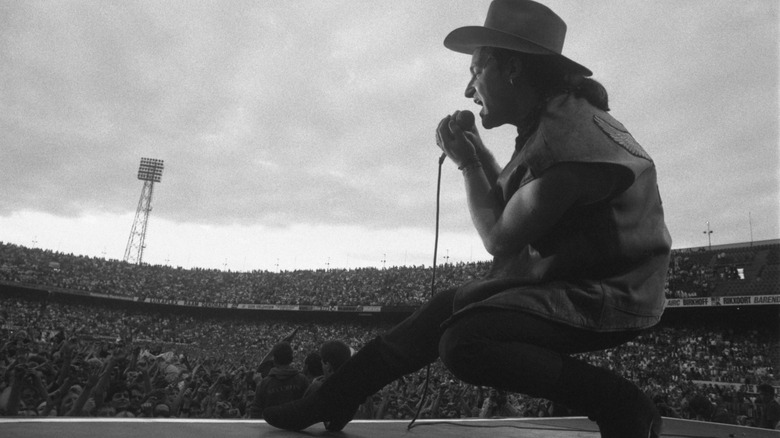
What does the reader think when hearing the words "'80s rock?" Bon Jovi, perhaps? Van Halen, Mötley Crüe, Guns N' Roses, with a side of Bruce Springsteen? Bright spandex, frizzed-out hair, angular guitars, and lots of stupid faces pointing at cameras? Right. So, when did this whole era of time end? Was it a snap of the fingers or a slow death? "Yes" is the correct answer to that last question. And, certain songs heralded the demise of '80s rock better than others.
But first, we need to narrow our definition of '80s rock, an umbrella that can extend to new wave acts like The Police, The Cure, or even occasionally synth-pop acts like Kate Bush. For the purposes of this article, we're going to focus on the above-cited, widely-understood definition: dudes with guitars and big hair, anthemic hooks and stadium shows, an inordinate preoccupation with sex, etc. Songs that heralded the death of '80s rock need not be '80s rock themselves, though, or even need to be released in the '80s. We also need to cover the various reasons that '80s rock fizzled out, including the rise of competing trends, market saturation, reliance on genre tropes, and out-of-the-blue dark horse outfits that changed the musical landscape (e.g., U2), and so forth.
On that note, the prime '80s rock killer was definitely "Smells Like Teen Spirit" by Nirvana, a true game-changer in musical history. Other songs like "Cherry Pie" by Warrant showed that the gimmicks of '80s rock had run their course, while "Welcome to the Jungle" by Guns N' Roses helped reorient '80s rock towards something less glitzy. And of course, who could forget the influence of U2 on the decade?
Smells Like Teen Spirit — Nirvana
Bet you didn't see this one coming, huh? When Nirvana's "Smells Like Teen Spirit" came out in 1991 on the band's now-classic "Nevermind," the song not only crushed the tail end of '80s rock, it stomped on its dying corpse and chucked its carcass in the bin along with some shredded spandex and a half-used can of hairspray. Unpretentious to the extreme, rough and ragged, caring little to nothing for appearance — the exact opposite to '80s rock in all ways — "Smells Like Teen Spirit" swept the playing field clear of all musical players but grunge and paved the way for rock's entire musical future. It did so in a flash so dramatic and instant that it's hard to convey to those who didn't live through it.
Even though Nirvana struck the musical zeitgeist like a lightning bolt, the rollover from '80s to 90s rock had been brewing for quite some time. After all, if there wasn't a need in the public for a return to raw rock, would the Seattle scene's particular punk-laced, metal-leaning take on the genre have caught on like it did?
It's not that everyone across the world was tired of '80s bling rock by the time Nirvana scraped together $606.17 to record their 1989 debut album, "Bleach." But if '80s rock had been as healthy by the end of the decade as it was earlier, then we could argue it could have held on a bit longer. It had already been fizzling out by the time Nirvana, Pearl Jam, Soundgarden, and Alice in Chains reached a wider audience. The grungy death blow, however, was brutal to the extreme.
We Built This City — Starship
Out of context and with no knowledge of the band's history, "We Built This City" by Starship could be taken as just another cornball, throwaway, hooky, synth-saturated '80s pop-rock anthem with loud and obnoxious snares. For a debut single from a first album — 1985's "Knee Deep In the Hoopla" — it was a total smash, spending 24 weeks on the Billboard Hot 100 and reaching No. 1 in November, where it stayed for two weeks. But when we learn that Starship had roots in the late '60s, San Francisco-based acid rockers Jefferson Airplane, which themselves mutated into Jefferson Starship, then Starship, we can see how "We Built This City" represented the end of '80s rock.
In short, "We Built This City" shows that '80s rock, even by the middle of the decade, had painted itself into a stylistic corner. It's not that it's a "bad" song, it's more: Where do we go from there? Light, silly, and approachable were in, and heavy, deep, and challenging were out. Continuing along this trend, further and further from the band's original psychedelic origins — their biggest album as Jefferson Airplane, "Surrealistic Pillow," came out ahead of 1967's wild Summer of Love — how much more corporate and sellout could rock get? How much less "rock" could rock get? In demonstrating the fullness of '80s rock, commercially, "We Built This City" also defined its absolute limitations, musically and culturally.
On one hand, it could seem ironic that a song that presaged the end of '80s rock came from the end of '60s rock. On the other hand, few songs could so poignantly tie together rock's history to one of its dead-end branches.
Cherry Pie — Warrant
Coming right at the top of the '90s, "Cherry Pie" by Warrant illustrates precisely how much '80s rock had run its course, gotten reduced to cliches and cannibalizing its own best ideas, had little left to offer, and was already on life support by the time the grunge boys showed up. The first, soul-shrivelingly embarrassing 20 seconds of the song's music video ought to explain it all, as it and the song's big, power-chorded rhythm and chorus hook already, even by 1990, seemed like they belonged to a bygone era.
Indeed, Warrant was late to the game. They slotted into the same cadre of '80s hair bands as Whitesnake, Poison, Def Leppard, Cinderella, etc., but released their debut album at the end of the decade in 1989, when the zeitgeist was already ready to shift. The title of that album is just as telling of the times as it is out of step with itself: "Dirty Rotten Filthy Stinking Rich." Although the album cover seemed to deride '80s excesses, Warrant sought to ride the wave that wielded those excesses — excesses that were going out of fashion.
"Dirty Rotten Filthy Stinking Rich" contained an achingly diecast, song-write-by-numbers ballad called "Heaven" that was actually Warrant's biggest hit on the Billboard charts. But it's 1990's "Cherry Pie" — both the song and album — that illustrated just how much '80s rock had deteriorated. Warrant singer Jani Lane struggled with the song and its stigma for the rest of his life until he died of alcohol poisoning in 2011.
Welcome to the Jungle — Guns N' Roses
"Welcome to the Jungle" by Guns N' Roses (GNR) is a song from a band at peak power on an album regarded as one of the best rock albums of the '80s: 1987's "Appetite for Destruction." The song and its album sing and sneer with the essence of rock 'n' roll (perhaps better than Axl Rose sings), set out to kick ass and make a statement rather than cater to musical trends, and exude unapologetic, swaggering bravado. So why would "Welcome to the Jungle" indicate that '80s rock was fizzling out and not at the top of its game? Well, because Guns N' Roses was never squarely an '80s rock band nor even an '80s band. Though they formed in the '80s, their success signaled the end of the rock age from whence they came.
GN'R were always more of a bridge band between decades than anything else. Not truly a hair band but retaining some hair band musical qualities (and some hair band hair), birthed in '80s DNA (and '70s DNA, in the case of "Sweet Child O' Mine") but retaining elements of '90s rougher-around-the-edges rock, GN'R's rise to fame meant that the public was ready for a change, same as the band helped initiate that change.
GN'R were also always a bit more punk (in spirit) than their peers and a bit more wild in an actual way, not a staged, made-for-MTV way. Really, we could choose any big single from "Appetite for Destruction" to illustrate this point. But, since "Welcome to the Jungle" is the most rockin' of the album's singles, it wears the biggest boot to kick the fizzled-out ass of '80s rock out the door.
I Still Haven't Found What I'm Looking For — U2
When U2 released their 1987 masterwork, "The Joshua Tree," the album struck the public like an antidote to the excesses of the decade. Overtly sincere, lofty, and spiritual, built around musical minimalism and trance-inducing rhythms, the Irish quartet's success dealt a killing blow to '80s rock by being everything it wasn't. And with "I Still Haven't Found What I'm Looking For," it's as though the public took the song name as a reflection about how they'd felt about their musical choices until then.
"I Still Haven't Found What I'm Looking For" and its fellow singles didn't deliver a humble, unassuming alternative to '80s rock, however. It also didn't erase the public's need for a rock icon built in the '80s fashion. It just delivered to the public another type of rock star. U2 had started to fill the mold of '80s stadium rockers with their own image from 1984's "The Unforgettable Fire" to 1988's "Rattle and Hum," with "The Joshua Tree" as the fulcrum in the middle. The '80s built the throne, and U2 sat down.
U2 was also a critical darling, which helped shift the entire music industry away from stereotypical '80s rock. In addition to reaching No. 1 on the Billboard Hot 100, "I Still Haven't Found What I'm Looking For" was nominated for Song of the Year and Record of the Year at the 1988 Grammys. U2 also won Album of the Year for "The Joshua Tree" and made such a massive impact that U2 kept winning awards long past their prime — 22 Grammy wins total.