

5 Classic Rock Bands That Became More Famous Than The Headliners They Opened For
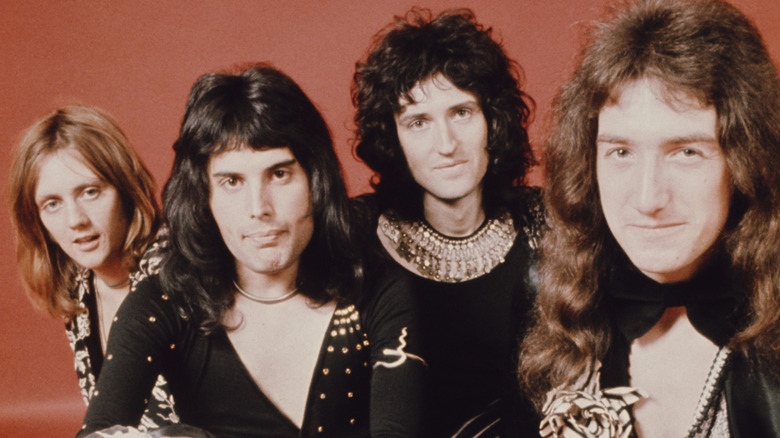
The opening act is supposed to drum up support for the headlining band, not make itself more popular and famous — but that's just what happens sometimes. At most rock concerts, the group that the crowd came to see only plays after a couple of other, lesser-known acts. That theoretically gets fans warmed up and ready to rock out when the main event begins. Newer bands pay their dues by being an opening act, and they may only get to play a few songs to a half-interested crowd, but it's good exposure.
Once in a while, though, the musical explosiveness of the opening act is simply undeniable. So destined for fame, so able to enchant a crowd, it winds up completely overshadowing the headliner. It's kind of like a Cinderella story, the way some bands go from relative obscurity to almost instant mega-stardom, only with way more shredding and wailing. Here are five of the most important classic rock bands that got their big break opening for other musicians, whom they subsequently outpaced in terms of fame.
Led Zeppelin
Undoubtedly one of the hardest and heaviest bands of the 1970s, Led Zeppelin dominated rock with its electric blues-influenced proto-metal. But before the band could fill seats on its own, it had to pay its dues by hitting the road as the opening act for one of the hardest and heaviest bands of the late 1960s: Iron Butterfly. The group's best-known song defined and influenced the psychedelic rock era, from which Led Zeppelin would pick up the proverbial baton. "In-A-Gadda-Da-Vida" is a woozy, druggy, epic journey of a song. The full version is 17 minutes long, and it has flashes of what Led Zeppelin would attempt later on.
Led Zeppelin and Iron Butterfly matched up in sound and vibe, and the newer, former band acted as the older, latter act's opener for a few shows in early 1969, including a two-night series at the Fillmore East in New York City. The supporting act played future classics like "Dazed and Confused" and "Babe I'm Gonna Leave You" at the gig, which occurred right when Led Zeppelin's debut LP was charting in the Top 20. Across the lifespan of Led Zeppelin, the band sold about 94 million albums in the U.S. alone. Meanwhile, Iron Butterfly never had another hit after "In-A-Gadda-Da-Vida."
AC/DC
In 1975, guitarist Ritchie Blackmore left Deep Purple for a while to team up with singer Ronnie James Dio for the ambitious, metal-leaning side project Ritchie Blackmore's Rainbow, later known as just Rainbow. In the fall of 1976, the group set out on a European tour, playing to venues full of fans of both of Blackmore's bands. But before Rainbow took the stage each night, another group opened — an act little known outside of its Australian home base called AC/DC, promoting its international debut album, "High Voltage." "We knew they were hot in Australia and would help us sell tickets," Rainbow keyboardist Tony Carey later told Classic Rock.
The very loud, hard-hitting, but straightforward, no-nonsense rock of AC/DC impressed both the crowds and the band that had invited the group on tour. "I think they blew us off stage every single night," Dio told Classic Rock. "They were exciting, fresh, and really got the crowd going." AC/DC received routine encores, a sign of their future, long-term success. By 1979, the band's albums were hitting the upper reaches of the charts in the U.S. and the U.K. As for Rainbow, it remained a cult favorite before splitting apart in the mid-1980s.
The Doors
Them, one of the edgier and rowdier British Invasion bands, arrived in the U.S. in 1966 for a series of concerts to make Americans aware of its second album, "Them Again." At that point, Them had reached the U.S. Top 40 with a couple of minor hits, "Here Comes the Night" and "Mystic Eyes," the latter written by frontman Van Morrison. The band headed to West Hollywood's legendary rock club Whisky a Go Go, where it headlined a slew of shows. The unofficial opener was the club's house band, hired only a week before — a local to Los Angeles but still little-known and unrecorded group called The Doors. The first band the group played alongside was Them. "And we jammed during the last set of the night," The Doors keyboardist Ray Manzarek recalled to Billboard.
About a year later, The Doors released its first, self-titled album, which would go on to sell 4 million copies. The Doors quickly became a foundational band of the psychedelic scene and counterculture era. "Light My Fire" and "Hello, I Love You" hit No. 1 on the pop chart, and frontman Jim Morrison became one of the most celebrated and worshipped figures in rock history. Them never scored another hit single in the U.S., but Van Morrison became a successful solo act, best known for the classic "Brown Eyed Girl."
Queen
At least in the U.K., Queen's objective commercial breakthrough came with its third album, "Sheer Heart Attack," a No. 2 hit. But the band was still relatively obscure in the U.S., having never even notched a hit single there. Breaking into the American market was a big reason why, in 1974, Queen headed stateside for a series of shows as the opening act for frequent U.K. hitmaker Mott the Hoople, known primarily in the U.S. for its 1972 Top 40 hit "All the Young Dudes."
The shows with Mott the Hoople, led by Ian Hunter, marked the only time that Queen was the supporting act for another band on a U.S. stage. By the end of 1974, the promotional tour had exposed Queen to America, and by 1976, the group was headlining concerts both in the U.S. and the U.K. Riding the strength of smashes like "Killer Queen" and "Bohemian Rhapsody" (Queen's biggest hit ever, despite Elton John predicting it would fail), the band could fill arenas for multi-night stands in the same large American cities it played as a supporting act.
The Beatles
You've probably heard of Beatlemania — when the Fab Four from Liverpool became an all-encompassing musical juggernaut and the best-selling band of all time in the U.S. But one myth you can stop believing about The Beatles is that this fanaticism began after the group played on "The Ed Sullivan Show" in 1964. In reality, the sensational explosion of the Beatles actually happened in 1963, in the U.K., in the midst of a tour.
Along with acts like Gerry and the Pacemakers, David MacBeth, and Louise Cordet, The Beatles was just one of many supporting acts on the first U.K. tour by Roy Orbison, the cool and soulful American singer best known at the time for smash hits like "Only the Lonely," "Running Scared," and "Crying." The stature of both Orbison and The Beatles was on the rise, but by the tour's end, The Beatles' fame had surpassed that of one of the group members' stated idols. As it wound around the U.K., the Beatles were promoted to co-headliners.