

5 Classic Rock Hits That Aren't Worth As Much Money As You Might Think
Some old rock staples generate revenue year after year, while other familiar favorites surprisingly don't seem to make very much at all. While a few omnipresent classic rock songs from the '70s are worth a head-turning amount of money, plenty of tunes stretching from the 1960s through the early 1980s aren't bringing in a lot of money anymore.
Some songs that seem to be part of the cultural firmament are actually not all that objectively popular, and thus not big moneymakers for artists, songwriters, record labels, or music publishers. As a result, they haven't sold as many copies as you might think, and haven't earned a gold or platinum record even 50 or 60 years later. And in the age of streaming, when people can listen to a song anytime they want for a pittance, these supposed classics just aren't getting selected very often relative to other oldies or tunes by the same artists. They also don't even register much airplay on the one place where they'd be expected to live forever and endure endlessly: classic rock radio, nor are they the beneficiary of costly soundtrack use in many movies and TV shows. These five songs just aren't all that lucrative, or at least not the cash cows we all thought they were.
You're No Good — Linda Ronstadt
Among all the hard-rocking classic rock bands of the 1970s came Linda Ronstadt, a solo act who primarily sang covers. Her signature song and only No. 1 hit is "You're No Good," which topped the chart for a week in February 1975. Ronstadt was adept in a variety of styles and kept racking up hits into the 1990s, but she's probably still best known for "You're No Good," a brutal breakup song bound to get Boomers mad all over again.
In the 2020s, classic rock and oldies radio stations don't play "You're No Good" as often as other, similarly successful songs from 1975 — it airs about 70 times a week across thousands of radio stations in the entire U.S. On Spotify, "You're No Good" has been queued up 78 million times, a relative pittance compared to the 1975 hit "One of These Nights" by the Eagles, whom Ronstadt helped form, which has spun 408 million times as of February 2026. "You're No Good" never went gold, meaning it sold fewer than 500,000 copies, and another place where it hasn't generated much money is with needle drops: "You're No Good" has been used barely a dozen times in narrative films and TV shows in the past 50 years, missing out on that major income stream.
Just Dropped In (To See What Condition My Condition Was In) — The First Edition
Before the life of Kenny Rogers would bring fame and fortune as a singer of country classics and sappy ballads, the musician fronted the groovy late-1960s rock band the First Edition. The group, with Rogers on vocals and guitar, explored its trippy side with the psychedelic "Just Dropped In (To See What Condition My Condition Was In)," a No. 5 hit in 1968.
A canonical countercultural track, "Just Dropped In (To See What Condition My Condition Was In)" faded from oldies radio station playlists over the years, to the point that it no longer brings in much revenue for Rogers' estate or the rest of the First Edition. During an average week in the 2020s, it doesn't get played on American radio stations at all. The 45 never sold very well at all either, and only a First Edition hits album ever broke the million-copies-sold milestone, and that was way back in 1997.
There's little evidence that the song received a boost in interest or commercial success the following year, when it was featured in the cult classic film "The Big Lebowski," the first of only seven all-time uses in scripted content. "Just Dropped In" has proved to be a mostly overlooked gem on Spotify, bringing in 75 million listens over its lifetime — a fraction of what Rogers' solo hits have attracted.
Hello, I Love You — The Doors
Perhaps the quintessential rabble-rousing and rollicking rock act of the late 1960s, the Doors — and front man Jim Morrison — have endured as icons of the baby boomer generation. The Doors' music has always generally sold well; 14 of its studio albums, live LPs, and hits collections have sold at least a million copies each, while singles like "Light My Fire," "Riders on the Storm," "People Are Strange," and "L.A. Woman" have reached seven-figure territory. Oddly, the freewheeling band's tamest and most mainstream smash, "Hello, I Love You," which we also happen to think was one of the worst No. 1 hits of the 1960s, hasn't stood the test of time, and never sold more than half a million copies.
"Hello, I Love You" is very much stuck in the '60s, because later generations demonstrably aren't interested in listening to it or paying for the privilege — or at least not as much as they are in other, flashier Doors hits. "Light My Fire" and "Break on Through (To the Other Side)" have been employed dozens of times by filmmakers and showrunners to set a narrative in the hippie era. "Hello, I Love You" doesn't lead to many such payouts, having shown up in only seven movies and shows.
Over on streaming, Doors fans choose many other songs over "Hello, I Love You" — it's not even among the band's 10 most-streamed tracks on Spotify, despite it being a No. 1 back in the day.
Stand Back — Stevie Nicks
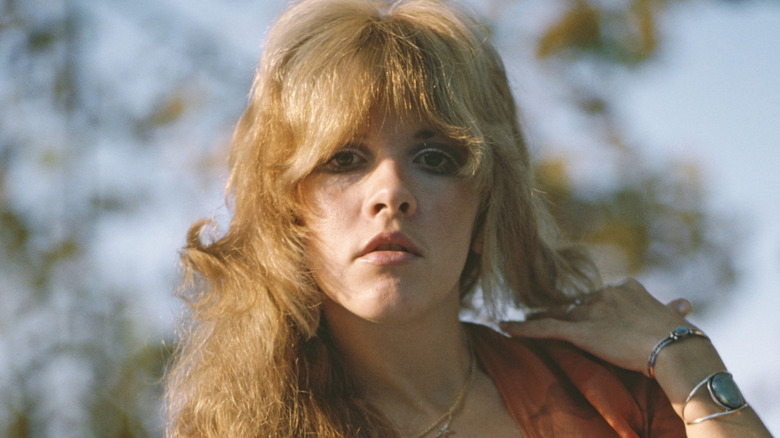
The emotional and musical wallop of '70s classic rock met the sounds of the '80s in 1983 with Fleetwood Mac star Stevie Nicks' propulsive, dramatic, and synth-driven "Stand Back." Upon release, "Stand Back" was a Top 5 pop hit and was even bigger on rock radio, topping out at No. 2 on that genre's chart.
Not even counting Nicks' very valuable work with Fleetwood Mac, Nicks has earned a slew of platinum albums. However, no such awards were given for "Stand Back," which apparently never even crossed the gold record level of 500,000 sales. A song placement in a scripted series or film can bring an artist or their publisher a massive paycheck, but those haven't come either for "Stand Back," employed only once in a 2022 episode of the streaming series "The Mysterious Benedict Society." Unlike other decades-old Fleetwood Mac and Nicks songs, there's not a lot of demand for "Stand Back" in the contemporary era, and so it doesn't accrue a lot of funds. It's been played 46 million times on Spotify, a mere drop in the ocean compared to Fleetwood Mac's "Dreams" (2.5 billion listens) or Nicks' "Edge of Seventeen" (622 million listens).
Black and White — Three Dog Night
Rock band Three Dog Night reliably and repeatedly topped the charts. The band with three alternating lead singers, who primarily interpreted the works of acclaimed outside songwriters, landed a No. 1 smash in 1970, 1971, and 1972. The first two of those chart-toppers, "Mama Told Me (Not to Come)" and "Joy to the World," are still often-played money-makers. The third well-known Three Dog Night No. 1, "Black and White," a catchy and chugging plea for racial harmony, hasn't been as successful.
"Black and White" sold half a million copies around the time of its release in 1972, but it hasn't moved enough units since to go platinum. The tune doesn't create much revenue from modern streaming services, either. Three Dog Night's other No. 1s have each been listened to on Spotify more than 100 million times, towering over the comparatively paltry 7 million for "Black and White." The legacy of Three Dog Night — as well as its money-earning potential — comes from the use of its songs in films and TV shows. "Mama Told Me (Not to Come)" and "Joy to the World" have shown up on more than a dozen soundtracks apiece, while "Black and White" was only used in an episode of "My Name is Earl" in 2007 and "Life on Mars" in 2008.