

'70s Rock Songs So Corny Our Ears Are Still Burning From Embarrassment
Corniness is a bit like that classic definition of pornography: It's hard to define, but you absolutely know it when you see (or hear) it. Trite lyrics, cheap sentiment, and a general obliviousness to how the world really is all contribute to corniness. Corniess is also often pleased with itself, presenting a performative "gosh-wow, look-Ma-no-hands" attitude that serves weapons-grade cringe. And during the '70s, certain popular musicians were locked in an intense struggle with the entire state of Iowa to see who could pump out the greatest quantity of corn.
As far as we're concerned, corniness frequently goes hand in hand with a perceived laziness, a phoned-in quality. "Here," the corny musician says, "I'm in a hurry, but this is good enough for you." When making our choices for this list, we've considered the kinds of lyrics that usually make a song corny, but contenders can certainly be helped to arrive at "Peak Corn" by uninspired or schmaltzy musicianship. That said, some of these songs may be among your secret pleasures, and that's perfectly fine. But these tracks are pleasures perhaps best enjoyed behind closed doors, with the window shades drawn, and after the kids have been put to bed.
Georgy Porgy – Toto
A few years before they were blessing the rains down in Africa and being a bit too optimistic about how much of that continent you can indeed see from Kilimanjaro, Toto released one of the most cringey, cheesetacular tracks ever to curdle '70s airwaves. "Georgy Peorgy" sets a second-tier nursery rhyme to music and then surrounds it with confusing verses that don't seem to connect to the thesis — such as it is — of the chorus.
"... I'm an addict for your love" is a creepy lyric, but so far, so 1978. Where this song really goes down the tubes is how very, very many times it repeats the "Kissed the girls and made them cry" line from the nursery rhyme. And why? The verses are about a man who's sad about a woman. If he's a playboy, now repentant after a girl beat him at his own game, that's nowhere made clear. The song is also simply not all that good, musically. The energy and catchiness that made "Africa" the eternal bop it is are embryonic at best in this interminable nothingburger. We're left with weak and creepy lyrics over music that should be a B-side at best.
Love Will Keep Us Together – Captain & Tennille
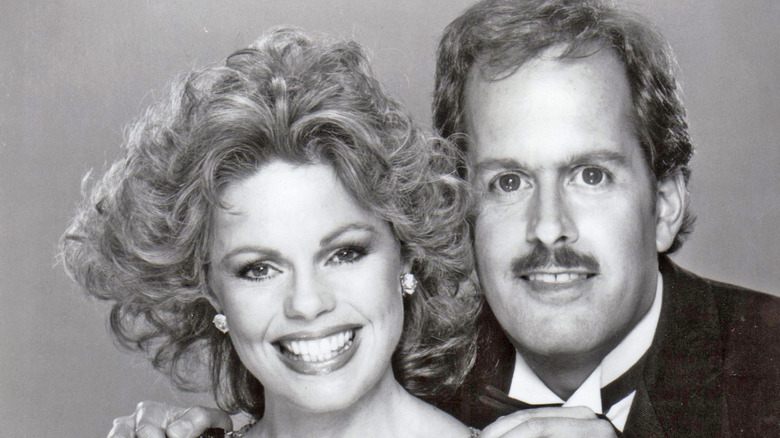
Even if their music isn't to your taste, it's hard to truly dislike Captain & Tennille. They seemed like nice people, and they never pretended to be anything they weren't. If that doesn't quite make them cool, it at least makes them admirable. But the fact that Captain & Tennille seem like they would have been fun to have a pitcher of daiquiris with doesn't make their biggest hit, 1975's "Love Will Keep Us Together," any more listenable.
The musicianship is fine, but at no point do Tennille's vocals or Captain's keyboard ever seem to work that hard. The song seems to have been written expressly so that they could keep playing it until their respective deathbeds, with nothing in the score to tax an aging body or annoy a fellow patient. There's a difference between restraint and sloth, and our friends C & T are audibly just chilling here. And that's fine for some contexts, but then the lyrics are about other women chasing Captain. And Tennille is so sublimely confident in the power of love — not even her love, not even their love, just "love" as an airy concept — that she walks her delivery home with all the urgency of a Sunday morning stroll. Anyone old enough to know that love is, above all else, hard work, can't help but roll their eyes at this low-calorie whipped topping of a track.
It Never Rains in Southern California – Albert Hammond
Albert Hammond's 1972 "It Never Rains in Southern California" is the '70s soft-rock equivalent of an Oscar-bait movie. It's possible to make a narrative song an absolutely devastating heartbreaker — look no further than Mary Hopkin's sledgehammer to the heart about an aging barfly, "Those Were the Days" — but Hammond's effort is a cheesy soap opera next to Hopkin's eloquent tragedy.
"It Never Rains in Southern California" was apparently inspired by a rough patch he had gone through, panhandling in Spain when his music career wasn't taking off, while accidentally hitting up his honeymooning cousin for spare change. So then why, oh why, didn't that real-life incident inspire better lyrics than rhyming "California" with "don't they warn ya?" The next line is just "It pours, man, it pours," an astronomically trite comparison of bad times to rain. The backing strings and vocals are so corny that they have to be heard to be believed, but alas, they cannot easily be un-heard.
Cat Scratch Fever – Ted Nugent
The seeds of Ted Nugent's ultimate decline into punchline status were sown early in his career, as a glance at the lyrics for 1977's "Cat Scratch Fever" reveals. The song, an ode to the ickily vehement version of heterosexuality that apparently drives Nugent's life, is two lazy double entendres in one: Cats are women, via the obvious crude slang term, and cat scratch fever is either an obsession with them or gonorrhea. Or both, it's hard to be sure. And while sex is a perfectly reasonable topic for a rock song — it's sex, drugs, and rock 'n' roll, not prayer, needlepoint, and rock 'n' roll — Nugent's apparent desire to shock with lazy innuendo is flatly unimpressive. Literally millions of songs have been written about how men feel about women; make it fresh or give up.
Nugent's guitar work on the track is excellent, but with lyrics so lazy and cringe, who cares? He's so weird, creepy, and off-putting that the fact that he can, or at least could, absolutely shred winds up being the sixth or seventh most relevant fact about him. Indeed, as one of a few musicians from the '80s you wouldn't want to meet in real life, Ted Nugent is America's Morrissey, which we hope annoys them both.
Make It with You – Bread
Bread's "Make It with You" snagged a week at No. 1 on the Billboard charts in 1970, and the only clear explanation is that a lot of people had been lulled to sleep by the track that week. The song's title is, presumably, a double entendre about sex, but the lyrics are so dull and uninspired that it's hard to imagine they worked on any of Bread's girlfriends or admirers. Almost every single line is quotably bad, such as: "Dreams, they're for those who sleep/ Life is for us to keep." A song from 1970 is decades too early to have been written by a large language model, so we're left with the grim conclusion that songwriter David Gates thought like AI 50 years before its widespread emergence.
The music is arguably even worse, with high, gentle singing, technically accomplished but so gentle and inoffensive, backed by instrumentals that seem to want to avoid calling attention to themselves. "Make It with You" has all the seductive force of, well, white bread, and the nonsensical lyrics and sway-along melody are best left in that somnolent week in August 1970, when they inexplicably captured the national mood.