

9 Rock Bands Who Lost Their Original Singer But Found A Second Life With A New One
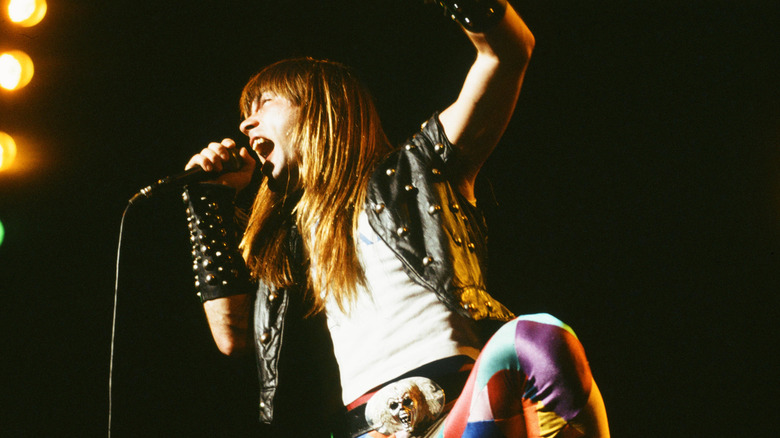
Being in a rock band is a lot like sport. All the pieces for a perfect team could be assembled, but then a critical component — the singer — falls away and it's necessary to build again to try and find the magic. It's not uncommon to see the struggle experienced by bands who have lost key members to everyday family life, creative disputes, or even death. Not all of them bounce back from the personnel setbacks, and even fewer survive the storm to come out stronger on the other side. However, there are groups who received a second lease on life after their original vocalist departed.
Now, this isn't a question about which version of the band is better — since that all comes down to personal preference and everybody will have their own thoughts. This is about clear-cut examples where artists have been able to rejuvenate their careers after losing their voice — figuratively and literally. With all that said, let's turn up the volume and appreciate the rock bands who lost their original singer but found a second life with a new one.
Van Halen
From the late '70s to the mid '80s, Van Halen exploded on the music scene. Everybody's tongue wagged at Eddie Van Halen's virtuoso guitar skills, but the energetic voice of David Lee Roth turned the group from every musician's favorite band into a legitimate mainstream darling. In 1984, Van Halen experienced a monumental first as their single "Jump" hit the top of the Billboard Hot 100, while the album it was from — "1984" — climbed to the No. 2 position on the Billboard 200 chart.
At the peak of this success, Roth departed in 1985. While there are varying accounts over whether he jumped or was pushed, the point is the voice of the classic rock band exited. Here's the even bigger shocker: Van Halen arguably got better with the addition of Sammy Hagar. Speaking to People in 1986, Eddie Van Halen referred to this version of the band as "the real Van Halen." Is it true, though? In rock 'n' roll, the proof isn't in the pudding but the chart performance — and the group's next four albums all went to No. 1 on the Billboard 200.
Hagar's powerful and poetic pipes carried the band for the next decade before Roth returned to the fold. Then the game of musical chairs began as Gary Cherone filled in for a few years, Hagar came back and left, and Roth popped in for another stint as well.
Linkin Park
In the 2000s, Linkin Park's controlled chaos saw the rock band rise from nu-metal newbies to bona fide megastars. While Mike Shinoda laid down the raps over the amalgamated musical backdrop of hard rock and hip-hop, it was Chester Bennington's undeniable vocals that became the voice of a jilted generation. Harboring the ability to oscillate between sentimental and guttural, Bennington's raw emotional output turned out to be a major catalyst for the onslaught of hits like "Numb," "What I've Done," and "Crawling."
In 2017, Chester Bennington tragically died. It was clear that nobody knew what the future held for Linkin Park at the time, and neither did the band. "For me, it just felt like too much," Shinoda revealed on "The Howard Stern Show" in 2023. "To get back on it and try to do some version of music and also be seen through the lens of what had happened — for that to be attached — it was like being a member of a club that I didn't want to join."
Linkin Park would remain dormant until 2024 when the group announced former Dead Sara singer Emily Armstrong as their new co-vocalist. While the shadow of Bennington still loomed large, the band got to work to demonstrate this was another chapter in their legacy. "From Zero" — Linkin Park's first album with Armstrong — went to No. 2 on the Billboard 200 chart and even received a Grammy Award nomination for best rock album.
Black Sabbath
Is it Black Sabbath without Ozzy Osbourne? That's the million-dollar question. Indisputably, the Prince of Darkness will forever be connected to this rock band, while the songs he sang like "Iron Man," "War Pigs," and "Paranoid" remain quintessential Black Sabbath tracks, but there was a time when fans got to experience an Ozzy-less band for a while.
Black Sabbath established themselves as one of the most important rock bands of the 1970s, but turbulence rocked the outfit in 1979 and Ozzy was booted. While Ozzy's nasally vocals became a trademark of the group's sound, Black Sabbath replaced him with a technically better singer in the form of Ronnie James Dio. The band's first recording with Dio — the 1980 album "Heaven and Hell" — proved to be a godsend, landing at No. 28 on the Billboard 200, which charted higher than the previous two records with Ozzy. The 1981 follow-up "Mob Rules" also performed well.
Dio was exactly what Black Sabbath needed after a tumultuous period with Ozzy. "For us, it was so frustrating for those 11 months where we hadn't done anything it was such a great relief when somebody comes along and these things were working finally," guitarist Tony Iommi told Spinner. "And that's no disrespect to Ozzy; he just wasn't in the right state of mind then." Well, the honeymoon in heaven went to hell a few years later after tensions and disputes during the recordings of a live album, so Dio bolted.
Genesis
Looking back at the genesis of Genesis, it's almost a case of you had to be there to believe it. Formed in the late '60s, this outfit experienced a spike in popularity because of their technical brilliance and artistic leanings — largely due to the influence of their supremely gifted frontman Peter Gabriel. In those days, Genesis was appreciated as a progressive rock band rather than a chart-topping juggernaut.
This all changed in 1975 after Gabriel decided to depart the group. "I just felt I was getting to be part of a machine," he said in the documentary "Genesis: A History." "And I also felt I was becoming a sort of stereotype of a rock star or falling into wanting that ego gratification" (via UCR).
His replacement didn't come from outside of the band but within. Drummer Phil Collins took over lead vocals and catapulted Genesis into the mainstream. The group's highest-charting singles on the Billboard Hot 100, including the No. 1 single "Invisible Touch," all came from the Collins era, delivering an unparalleled level of commercial success that they hadn't tasted with Gabriel at the helm. Funnily enough, Collins never planned to step up into the role. "It was not in my mind to become the singer," Collins told Drumeo. "It was just that nobody else really wanted the job."
Alice in Chains
Needless to say, the tragic death of Alice in Chains' Layne Staley changed everything for the Seattle rock band. Even though the group had been on hiatus since the mid '90s, Staley's passing in 2002 hit exceptionally hard; it was at this moment that everybody realized one of the most talented singers of his generation would never perform with his band again.
A few years after Staley's death, Alice in Chains reformed with William DuVall as the new lead singer. Like Staley before him, he shared singing duties with Jerry Cantrell, as the pair complemented each other's strengths and harmonies. DuVall not only received the seal of approval from his bandmates to carry on the legacy, but he also has the support of Staley's parents. "It means a great deal," DuVall told "Loudwire Nights" in 2018. "Both [Staley's father] Phil and Layne's mom, they've always been very kind and I appreciate it so very much. It's really great."
In terms of achievements, Alice in Chains' time with DuVall has also reaped significant success and ushered in a new era. While the group hasn't had another Billboard 200 No. 1 hit again, the records with DuVall have landed in the top half of the chart, with 2013's "The Devil Put Dinosaurs Here" peaking at the No. 2 spot. More importantly, the fans embraced their new singer, who had some mighty big shoes to fill.
Iron Maiden
At this point, you'd be forgiven for thinking that Bruce Dickinson is Iron Maiden's original vocalist. He joined the band in 1981 in time for 1982's "The Number of the Beast" — the album that turned them into heavy metal behemoths — and has been mostly ever-present since. Dickinson briefly parted ways with Maiden in the '90s and was replaced by Blaze Bayley for two albums. However, he returned for 2000's "Brave New World," and the rockers have continued to enjoy great success since then.
Once upon a time, though, Paul Di'Anno fronted the British metal pioneers. The singer lent his gruff vocals to the band's self-titled debut and "Killers" albums, both of which were positively received. However, Di'Anno was forced to leave Iron Maiden in the early '80s, with bassist Steve Harris claiming that the change was necessary for the band's long-term survival.
Despite the band's success with Di'Anno, the arrival of Dickinson had a transformative effect on Iron Maiden. His stadium-sized, operatic vocals provide the sing-alongs for "Run to the Hills," "Fear of the Dark," "The Trooper," "Can I Play with Madness," and other hits that rank among the best heavy metal songs of all time. Di'Anno is an important chapter in the crazy story of Iron Maiden, but Dickinson launched the band into the stratosphere.
Faith No More
Faith No More experimented with several vocalists in their early years, including Courtney Love and Paula Frazer. The band eventually settled on Chuck Mosley, who helped them establish their funk-laden metal sound on the "We Care a Lot" and "Introduce Yourself" records. The union didn't last long, though, as Mosley was fired in 1988, paving the way for Mike Patton to join the fold. This led to the creation of "The Real Thing," the album that produced "Epic" and "From Out of Nowhere."
Patton joining Faith No More saw the band achieve mainstream success and become even weirder. "The Real Thing" is a continuation of the funk rock sound of the Mosley era with added falsettos and rapping. However, subsequent releases like "Angel Dust," "King for a Day... Fool for a Lifetime," and "Sol Invictus" are experimental efforts that defy classification (in a good way).
Mosley's vocals brought a punk rock energy to the band's early work that helped put them on the map. Be that as it may, there aren't many rock singers who possess Mike Patton's versatility, and the success Faith No More experienced following his arrival speaks for itself.
Slipknot
Did you know that Corey Taylor wasn't Slipknot's original vocalist? The mask-wearing metalers' independent debut, "Mate. Feed. Kill. Repeat.," sees Anders Colsefni on death growl duties, but that record is now a footnote in the band's discography. Colsefni was replaced by Corey Taylor shortly after.
Slipknot's story has been tragic at times, but the band's success is undeniable — and Taylor has been key to it. The Stone Sour frontman's arrival coincided with the band pursuing a more melodic sound, but don't mistake that for selling out. Taylor can roar with the best of them, and songs like "People = S**t," "The Heretic Anthem," and "All Hope Is Gone" are masterclasses in brutality. That said, Taylor's ability to sing like an angel and roar like a demon has enabled Slipknot to branch out and become one of the world's most popular metal acts.
Colsefni's tenure in Slipknot was short and sweet, and one could be forgiven for never knowing he was a member. Taylor was front and center when the band announced themselves to the masses with "Wait and Bleed" in 1999. However, bands hiring new frontmen and altering their sound always risks alienating the O.G. fans. Slipknot just so happened to gain legions of new ones after making some big changes.
AC/DC
How do you replace the vocalist who gave us "Highway to Hell," "T.N.T.," "Whole Lotta Rosie," "It's a Long Way to the Top (If You Wanna Rock 'n' Roll)," and other headbanging classics? Most bands would probably call it a day and accept that their run at the top is over. But AC/DC aren't most bands, so when Bon Scott tragically died in 1980, Brian Johnson stepped in and further cemented their status as rock royalty.
AC/DC announced Johnson's arrival with "Back in Black," the biggest-selling hard rock album of all-time. As of 2026, the record has shifted 50 million copies and is widely regarded as a bona fide classic. What's more, Johnson's era has given us bangers that are just as iconic as the band's biggest hits with Scott — "Thunderstruck," "Hell's Bells," "You Shook Me All Night Long," "Back in Black," to name a few.
Rock fans can argue over which vocalist is better, but Johnson and Scott both helped AC/DC become rock 'n' roll gods. Still, Johnson helping the band bounce back from a tragedy with one of the most successful albums of all time is quite the achievement.