

The 5 Longest Keyboard Solos In Rock And Pop History
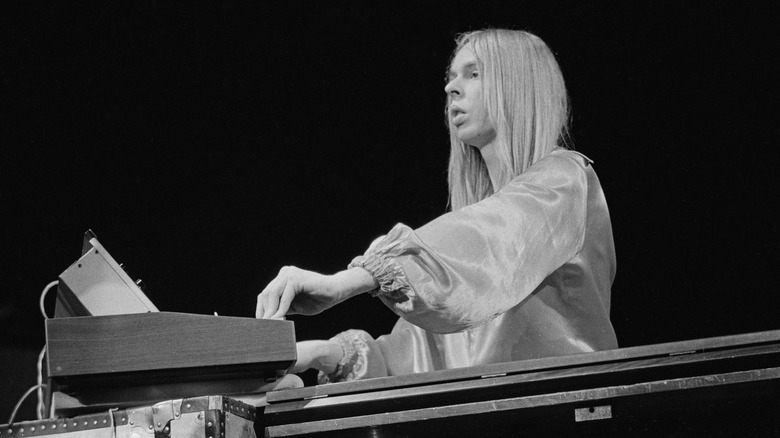
For the most part, keyboards have long faded from their once-prominent place in pop and rock history in favor of copy-pasted guitar/drum/bass/vocal arrangements. But keyboards, whether they be organs, synths, pianos, or whatever else, can produce music just as dazzling, moving, and virtuosic as the flashiest guitar solo — arguably more so. And just like the longest guitar solos in rock history, the longest keyboard solos in the great pantheon of pop and rock stretch the limits of creativity and endurance.
Pianos actually predate guitars in popular music, back to ragtime (late 1800s through 1910s) and big band (1910s through 1940s), before electric amplifiers gave guitars the upper hand in making bigger sounds for bigger audiences. Early rock pioneers like Little Richard in the '50s still banged on the ole' ivories, before bands as we know them, such as the Beatles, cohered into influential cultural cornerstones. But as popular music quickly evolved into its more experimental, psychedelic leanings in the late '60s and early '70s, keyboards became prominent in prog outfits like Yes, Genesis, and Emerson, Lake & Palmer. That era of overflowingly artsy rock, from 1968 to 1973, generated the longest, most complex keyboard solos in modern musical memory.
Call such solos a symptom of song bloat and pine for the days of simple, hummable tunes that finish in under three minutes all you want: Some of these solos will just be getting started by then, so strap in.
Karn Evil 9 — Emerson, Lake & Palmer (Keith Emerson)
Emerson, Lake & Palmer's "Karn Evil 9" from 1973's "Brain Salad Surgery" features easily the most notoriously long and complex keyboard solo in pop music history, courtesy of Keith Emerson. Written more as an orchestral piece, "Karn Evil 9" is a colossal, nearly 30-minute-long undertaking composed of four discrete sections ("1st Impression — Part 1," "1st Impression — Part 2," "2nd Impression," and "3rd Impression") that interweave with multiple keyboard solos throughout. Over the whole piece, those solos become less solos than they do the song's main instrumental spine broken into solo-like segments.
It's hard to say precisely how long the whole solo is, collectively, but let's give you an idea of what we're talking about. Emerson switches between organ, synth, and piano starting when Greg Lake's vocals drop out around the one-minute mark of "1st Impression – Part 1." At that point, an organ solo takes over until one minute, 37 seconds, when Lake comes back with his "Suffering in silence, they've all been betrayed" line. The vocals and keyboard then alternate every few minutes, and the seven-minute-long "2nd Impression" is the longest uninterrupted piano solo of the entire 30-minute-long four-part piece.
"Karn Evil 9" is as grand in intention as it is in musical scope, charting the entirety of human history, from passages of idyllic, innocent bliss to our ultimate demise at the hands of our own technological creations. In June, 2026, it was even announced that a sci-fi movie was being made after it.
The Cinema Show — Genesis (Tony Banks)
Long before Genesis transformed into a mainstream pop-rock outfit in the '80s with Phil Collins as their frontman, they were one of the most eccentric prog bands in existence with Peter Gabriel at the helm. Their string of '70s albums arguably reached a zenith with "Selling England by the Pound," an album with songs that proved that 1973 was the band's best year. The album's second-to-last track, "The Cinema Show," features one of the longest keyboard solos in pop/rock history at over five minutes long, starting about five minutes and 20 seconds in and lasting until the end of the 10-minute-plus song.
Keyboardist Tony Banks had already tackled a long keyboard solo with "Supper's Ready" from 1972's "Foxtrot," which lasts about two-and-a-half minutes. The keyboard solo on "The Cinema Show" approaches twice that length, though. It doesn't limply linger along the way, but remains interesting over its entire length by switching through rhythmically unique passages. Some of those echo the grandiosity of church organ music while others are soundscapes of textural experimentation. It's not extremely flashy, or even extremely difficult to play (with the exception of some arpeggios), but does the most with every note, which is more than lots of musicians can do.
As Peter Gabriel said in a later 2014 interview with John Edginton, the band more or less assembled "The Cinema Show" from fragments of ideas that each member loved, including Gabriel's lyrical melodies and Bank's keyboard passages. But no matter how they did it, "The Cinema Show" is a masterpiece, and its keyboard solo is as magical as it is long.
Close to the Edge — Yes (Rick Wakeman)
Yes' "Close to the Edge" from 1972 is consistently ranked amongst the best prog rock albums of all time from an epoch of peak prog. Yes made keyboards integral thanks to the cape-wearing keyboard wizard, Rick Wakeman, whose work shines on "Close to the Edge." The LP contains an 18-minute titular track, two 10-minute tracks ("And You and I" and "Siberian Khatru") divided into movements — one of which nails the meaning of life – and a three-and-a-half-minute-long keyboard solo.
Wakeman's keyboard remains centered in the "I Get Up I Get Down" movement of "Close to the Edge," extends into "Seasons of Man," and is broken up into specific segments. Featuring a church organ segment, the solo starts around the 12-minute mark and, after a couple of tonal changes, lasts until just under 16 minutes into the epic, when Jon Anderson's vocals return in full. The entire solo sounds utterly majestic, playful, and harmonically fascinating all at once, yet also completely organic and called for. This is true of all of Wakeman's work, all of which is as virtuosic as the most shreddy-shred guitar passages you could think of.
Wakeman's keyboard solo on "Close to the Edge" also takes advantage of the technology of the day. He was often surrounded by numerous keyboards on stage, including synths like the Minimoog, weird electromechanical keyboards like the Mellotron, the Hammond organ, and even full grand pianos. Thusly the keyboard wizard wove his magic.
In-A-Gadda-Da-Vida — Iron Butterfly (Doug Ingle)
Iron Butterfly is one of those one-hit wonders of the '60s that time almost forgot, save for their humorously named, 17-minute-long proto-metal masterpiece: 1968's "In-A-Gadda-Da-Vida." Along with one of the strongest, most witchy hooks in classic rock history, it's got one of the best drum solos and one of the longest keyboard solos ever. After Ron Bushy's drum solo runs its course a little over nine minutes into the song, Doug Ingle's three-and-a-half-minute-long keyboard solo takes over.
The keyboard in this case is a Vox Continental, which Ingle plays throughout in a manner conspicuously reminiscent of a church organ, carrying the influence of his church-organist father. There's even a passage around 11 minutes, 40 seconds that we're sure is lifted from "God Rest Ye Merry, Gentlemen." This dark cathedral-like approach 100% fits "In-A-Gadda-Da-Vida's" more ominous aspects, especially when Ingle's keyboard solo gives over to Erik Brann for a very fuzzy guitar solo that eventually reconverges with the rest of the band for a final verse and chorus. This makes "In-A-Gadda-Da-Vida" a series of melody-noodling solos bookended by a shorter, central song, i.e., the three-minute radio edit that kept its album in the Billboard 200 for a bonkers 140 weeks.
Like the best solos on our list, Ingle's solo expands on the core ideas of its song and doesn't overstay its welcome, no matter its length. When it's over, you won't even realize that it was longer than "In-A-Gadda-Da-Vida's" entire radio edit.
Light My Fire — The Doors (Ray Manzarek)
Ray Manzarek's keyboard solo from the Doors' "Light My Fire" is considered by many to be one of the best keyboard solos in rock history. Released on the Doors' 1967 self-titled debut during the best year of their career, Manzarek's solo is probably the most hummable of our choices, being full of little chunks of easily memorized notes that reiterate the song's main melodic structure. This also makes it the most guitar-like out of our chosen solos in terms of phrasing, and ironically from a band known for its focus on keys.
Manzarek's solo comes in about one minute, seven seconds and lasts until about three minutes, 18 seconds, when it passes the baton to the guitar. Robby Krieger then riffs on the song's main ideas until Manzarek rejoins him in a kind of dual-solo before the song's main refrain returns at about five minutes, 33 seconds, making "Light My Fire" a series of solos sandwiched between a central hook.
This kind of unconventional form wasn't unusual for the Doors, who were defined by unusualness. Their songs range from the seven-minute-long "Riders on the Storm" and its long keyboard interlude to the two-minute-long "People are Strange," a tiny ditty that sounds like carnival music. Somehow the Doors didn't just pull it off, but with "Light My Fire" they landed a highly influential No. 1 Billboard Hot 100 hit, long keyboard solo included.