

The Jackson 5 Motown Hits That Made Billboard History In Less Than A Year
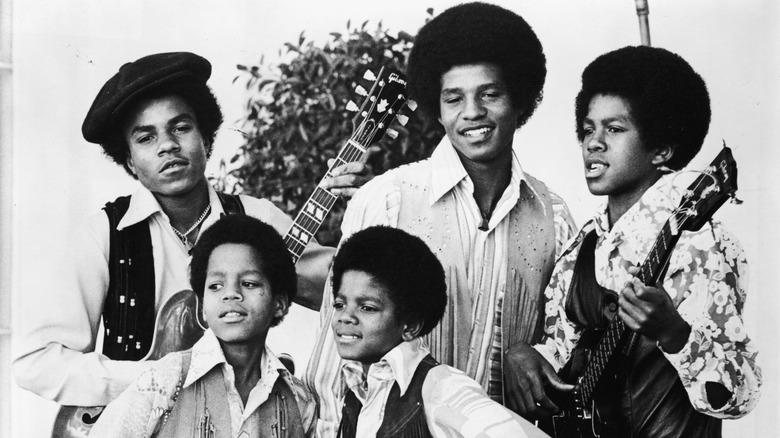
Motown Records moved into the 1970s in a big way after an impressive decade as one of the most important labels of the 1960s. From the social impact of Marvin Gaye's "What's Going On" to a westward move to Los Angeles, big changes were happening — but the rise of the Jackson 5, one of Motown's biggest '70s hitmakers, proved that the label's ability to sell great music by great singers hadn't changed a bit.
Hailing from Gary, Indiana, the Jackson 5 were a quintet of brothers — Jackie, Tito, Jermaine, Michael, and Marlon Jackson — who enjoyed an unlikely meteoric rise at the end of the '60s and the start of the '70s. When the first four singles they released for Motown all went to No. 1, they achieved a feat that no group before had ever accomplished. For pre-teen frontman Michael Jackson, it was the first of many records he'd shatter within the music industry.
The first Jackson 5 hit was an immediate smash
Motown founder Berry Gordy saw such incredible potential in the Jackson 5 that he got personally involved in ensuring they'd become hitmakers. Though Bobby Taylor, a member of the Motown group the Vancouvers, brought the group to audition for the label after they opened for him in Chicago, Gordy established Diana Ross, soon to exit from the Supremes for a solo career, as the group's sponsor on their 1969 debut "Diana Ross Presents the Jackson 5." Gordy also took an active role in crafting songs for the group, forming a special team with songwriters Deke Richards, Freddie Perren, and Fonce Mizell that he called "the Corporation."
The Corporation's first song started life as "I Want to Be Free," a potential song for Gladys Knight & the Pips, but with Gordy's direction, it turned into "I Want You Back" — a deliriously upbeat song that almost masks the lyrics from the perspective of a heartbroken singer who sent a lover away, only to realize their mistake too late. Michael Jackson, with Jermaine and Jackie offering counter-melodies after the bridge, sang it like he was going through the heartache personally, and audiences went nuts. "I Want You Back" soared to No. 1 on the Billboard Hot 100 in January of 1970. Today, it's still one of the most addictive songs to become a hit that year.
Keeping it simple for the Jackson 5's next hit
After "I Want You Back" became a hit, the Corporation was tasked with writing the Jackson 5 another winner. They went to an obvious inspiration: themselves. Co-writer Deke Richards remembered a late-night conversation with Lamont Dozier of the famed Holland-Dozier-Holland songwriting team that inspired their methods. "He got on the piano and started playing a little medley of his hits," Richards explained in the liner notes to "The Complete Motown Singles Volume 10: 1970." "That's when I heard it. He was just recycling his progressions; sometimes flipping them inside out [or] embellishing on it to create a main or theme progression for a new song. Simple, but brilliant." Richards applied the same logic to "I Want You Back" and found the seeds of "ABC" in the chorus.
In keeping with the callback theme, the lyrics to "ABC" recall the earliest lessons in school, like reciting the alphabet and counting, while offering lessons in love that are just as simple. With a rhythm that wouldn't sound out of place on the playground, the Jackson 5 had another No. 1 hit on their hands — and this one was major, knocking the Beatles' "Let It Be" out of the top spot in April 1970.
In 1970, Jackson-mania was in full force
The Jackson 5's third single was "The Love You Save," and it also peaked at No. 1 on the Billboard Hot 100 — even, once again, ending the reign of the Beatles at the top of the chart. (This time, it was "The Long and Winding Road.") To have their first three singles reach No. 1 was a dizzying feat, and it put the group in a class with little precedent. Within a year of the song's peak, the Jackson 5 weren't just hitmakers; they were a brand, even getting their own animated TV show.
Michael Jackson, who would grow up to be one of the most successful singers in history, had mixed feelings about his time in the spotlight from a young age. He was open about yearning for a more normal childhood, but he also found value in being an entertainer. "A lot of celebrities say they don't want their children to go into show business," he wrote in his 1988 memoir "Moonwalk." "I can understand their feelings, but I don't agree with them ... To me, nothing is more important than making people happy, giving them a release from their problems and worries, helping to lighten their load. ... To me, that's what it's all about."
A heartbreaking ballad helped the Jackson 5 make pop history
With three straight No. 1s under their belts, what could the Jackson 5 do for a follow-up? The answer was nothing short of extraordinary: "I'll Be There," a gentle, romantic ballad that further underlined Michael Jackson's ability to carry the emotional weight of a song. The track became not only the fourth straight Jackson 5 chart-topper, but also their longest-lasting hit, staying atop the Hot 100 for five straight weeks. (Twenty-two years later, another superstar took "I'll Be There" back to No. 1.) With this song, the Jackson 5 became the first group to send their first four consecutive major-label singles to the top of the pop chart.
Life stayed pretty sweet for the Jackson 5 through the '70s. Michael and Jermaine each had solo hits on Motown, and while the group eventually left the label — necessitating a change in name and personnel — they'd keep crafting songs that made audiences dance. After Michael solidified his reputation as the King of Pop, he and his brothers embarked on one final tour; they were inducted into the Rock & Roll Hall of Fame in 1997 and made one last appearance in 2001, eight years before Michael's passing in 2009.