

The 5 Best One-Hit Wonders To Ever Come Out Of Motown
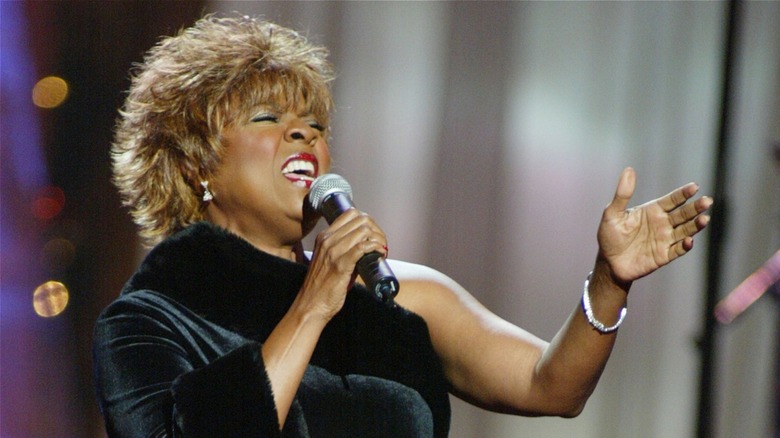
There are quite a lot of underrated Motown artists you ought to know, but some stand out for the rather poignant situation of putting out truly excellent work ... that only ever managed to get them one-hit wonder status. It's odd, really. These songs come from artists who were truly dedicated to their craft, with the energy, creativity, and vocal power that propelled many other big-name acts to worldwide stardom. Yet, the music fates proved somewhat less kind. For our purposes, a hit is defined as a single that broke into the Billboard Top 40, though of course the nebulous cultural zeitgeist and changing audience tastes makes all that very subjective on a personal level. Moreover, even if an artist achieved that Top 40 benchmark again, we argue that they're still one-hit wonders if people generally can't name their next-best-performing single.
Of course, all this should say more about the fickle landscape of the music industry and audience trends than an artist's abilities. Music history is awash with one-hit wonders who deserved more than the brief flash of attention they enjoyed, and these Motown acts are no different. Just listen to the pristine vocal stylings of Thelma Houston and tell us you believe differently. Even Rockwell's "Somebody's Watching Me," often dismissed as a Halloween novelty with a famous backing singer, deserves closer examination. And, hey, who knows? As much as musicians slapped with the one-hit wonder title may feel frustrated or calmly resigned to their fate, there's always the chance that a happy accident brings them back to life decades later.
Money (That's What I Want) — Barrett Strong
You know you've written something with real staying power when just about everyone wants to cover it, from Etta James to Pearl Jam. So, full honors to Barrett Strong, the artist behind "Money (That's What I Want)," released as one of the first big Motown singles in August 1959. Originally, the songwriting credits only included Motown founder Berry Gordy Jr. and collaborator Janie Bradford, though later research revealed that Strong had originally gotten a credit, too. The track dismisses the syrupy-sweet sentiments of so many hit singles of the day in favor of more practical financial matters — and with a killer beat.
It reached No. 23 on the Billboard Hot 100, yet Strong left Motown in 1961 before soon returning to work there as a songwriter. While he never had the same success as a recording artist, his Motown songwriting career is nothing short of tremendous. Some of the very best of Motown, like Marvin Gaye's "I Heard It Through the Grapevine" and the Temptations' eminently groovy "Papa Was a Rollin' Stone," were Barrett Strong co-creations (often with fellow songwriter Norman Whitfield). Yet Strong remained pretty down to earth, electing to stay in Detroit even when Motown moved to Los Angeles in the '70s. He was hardly snooty about his success, telling the Los Angeles Times in 1990 that "we wrote maybe 300 songs, and we had 12 good ones. So 288 were bad ones." Hopefully, he included his own smart and catchy track amongst them.
Do You Love Me — The Contours
For much of the Billboard Hot 100's history, chart toppers have had a certain widespread appeal that dulls their edges. But we also yearn for something really interesting, which is where the Contours' saucy 1962 hit, "Do You Love Me," fit perfectly. In it, lead singer Bill Gordon — whom Berry Gordy said "sounded just like me, but stronger, better" (via Classic Motown) — proclaims that he's now a fully accomplished dancer. The object of the song, who rejected the singer for his disappointing moves, is now left to watch him work it on the dance floor.
It took quite a few weeks from its initial release, but the Gordy-penned "Do You Love Me" eventually reached No. 3 on the Billboard Hot 100 and stayed there for three weeks. It also reached No. 1 on the R&B chart; in fact, the Contours had further success on the R&B charts, though they never managed the same performance on the Hot 100.
Originally, Gordy had meant the track for another Motown act, the Temptations, but they missed out because Gordy just couldn't seem to get ahold of them. With the Temptations out of reach, Gordy crossed paths with the Contours at the studio and, interested in their high-energy act, asked them to record his newly penned song. Group member Joe Billingslea was skeptical, initially proclaiming, "This song ain't gonna do nothin', man." Only after the highly successful release did Billingslea realize that he really did love it (from Mojo magazine, via Songfacts).
Don't Leave Me This Way — Thelma Houston
Thelma Houston was an established artist when her 1977 cover of "Don't Leave Me This Way" topped U.S. charts. Yet, it hadn't been an easy path. She signed to Dunhill Records in the '60s, but it dropped her not long after. Houston then signed with Motown in 1971. Her first album there, "Thelma Houston," fizzled, continuing the frustrating push-pull of excitement surrounding an album release, only to see it garner nice reviews but few sales. Her hit finally came on 1976's "Any Way You Like It," which included a disco-fied version of "Don't Leave Me This Way," originally recorded by Harold Melvin and the Bluenotes.
Her cover was a standout disco track of 1977 and beyond, with an eminently danceable beat backing up Houston's marvelous singing showcasing a beautifully strong, artfully controlled voice influenced by gospel traditions, one so good that she's drawn comparisons to Aretha Franklin. With the wider attention, other good reviews rolled in, and she even won a Grammy for best R&B vocal performance.
Did she ever have a subsequent single that reached the heights of "Don't Leave Me This Way"? Not quite. She did break into the Top 40 again with "Saturday Night Sunday Morning" in 1979 and snagged higher spots on the R&B charts, but the runaway success of "Don't Leave Me This Way" was hard to replicate. Still, Houston has had an acclaimed career, with albums and singles regularly released into the 2020s, film and television appearances, regular live performances, and work as an advocate for those living with HIV/AIDS.
I've Never Been to Me — Charlene
Look, we all need to admit that even the most grungy punk out there has a secret place in their heart for some good adult contemporary. Take Motown singer Charlene's "I've Never Been to Me," which is soft as a cloud yet has real artistic investment and emotional maturity. A cover of a Randy Crawford song, it's a standout of Motown's output from the 1980s, though it was originally released in 1977.
Charlene, originally a songwriter and jingle performer, was reportedly bold enough to approach Berry Gordy while he was dining out in LA. Gordy asked Charlene to sing for him right there, then signed her to Motown. However, her self-titled debut album, which came out in 1976, failed to make much of a splash.
Then, a Tampa radio station played "I've Never Been to Me" in 1982. It proved so popular that Motown reissued the song, which then reached No. 3. With all the attention, Charlene re-signed with Motown with the agreement that she would release both a pop and a gospel album. Yet, neither performed so blazingly well as "I've Never Been to Me," and, because of a contract detail, Motown claimed much of Charlene's royalties. Though kept recording, money troubles dogged her. Speaking of her time in the music industry, Charlene told Cross Rhythms in 2010 that "it was like a monster that was on my back. It was like I could not give this up." However, she's continued releasing singles as recently as 2026.
Somebody's Watching Me — Rockwell
Long a favorite of Halloween party playlists, Rockwell's synth-filled anthem to paranoia deserves more attention. Yes, yes, "Somebody's Watching Me" features Michael Jackson (and his brother Jermaine) carrying the song on backing vocals, but there's more to it. First, Rockwell is actually Kennedy William Gordy, son of Motown Records founder Berry Gordy. That made it pretty easy to bring a demo to his dad's attention, but getting farther proved tricky. Rockwell told Rolling Stone that he basically received a quasi-encouraging shrug from the elder Gordy. "I was devastated," he recalled, though he admitted his early songwriting efforts were "mediocre at best."
Gordy chose the mononym of "Rockwell" to distance himself from his surname (a tactic possibly also inspired by mega-successful artists like Prince and Madonna). This tricked even his own father, who was surprised to learn his son had been signed to Motown. As for the backing vocals, Rockwell was already friends with Jackson, so it was natural enough for him to play the demo for his pal, who reportedly agreed to do backing vocals with little prompting.
"Somebody's Watching Me" came out in January 1984 and peaked at No. 2, helped along by its delightfully surreal music video, catchy hook, and winking self-satire. Technically, Rockwell's follow-up song was a minor hit, too, but can you name it right now? (It's "Obscene Phone Caller," which, despite the questionable title, made it to No. 35.) After two more albums, Rockwell stepped back from the music industry. Speaking to Rolling Stone, he said, "I just needed to stop 'cause it wasn't fun anymore. It became more of a job."