

Rock Stars That Hid A Tragic Secret For Years

We may receive a commission on purchases made from links.
There's no reason that being good at playing a certain type of music means you need to have a personality type that's just as loud, strong, and aggressive. But rock musicians often used to play up to this stereotype, trashing hotel rooms, romanticizing abusive relationships both with romantic partners and bandmates, and presenting a tough-as-nails exterior to their fans. But underneath, many of these seemingly invincible rock stars were hurting, badly. No matter how rich or famous they became, it couldn't keep bad things from happening. The best one can hope for as a rock musician who has dealt with trauma is that money and a flexible schedule will make it easier to get therapy and other treatment.
Unfortunately, there is also the added burden of deciding if they want to tell their fans about the issues they're dealing with. For a variety of very valid and personal reasons, many choose not to, which means having to deal with the stress of hiding their secret, in some cases for years. Many rock stars who went through something horrible will eventually tell the world about what happened after they have had time to process it themselves. Other times, they take the secret to the grave, and fans only learn the terrible weight their hero lived with after their death. Here are rock stars who hid a tragic secret for years.
This article contains references to sexual assault, child abuse, eating disorders, suicide, and addiction issues.
Jackie Fuchs
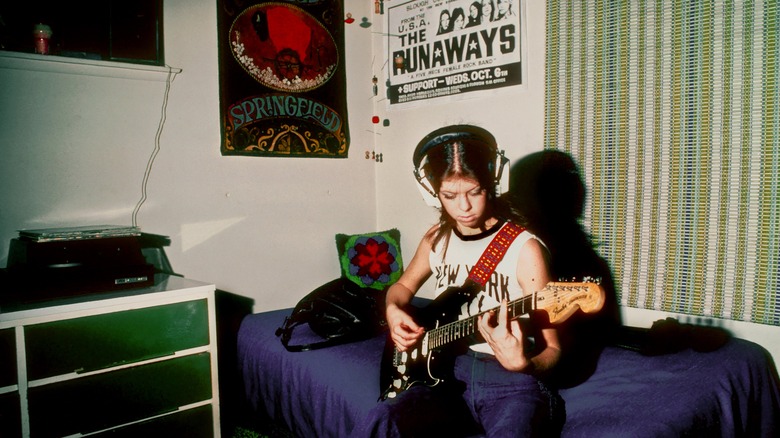
Women in the music industry are still treated terribly. Now imagine how much worse it must have been to be a young, inexperienced girl in the music industry in the 1970s. Jackie Fuchs of the all-girl rock band The Runaways learned what powerful people could get away with, and what girls had to put up with.
In 1975, Fuchs and the band finished a gig and then went to an afterparty, where the barely-16-year-old girl was given Quaaludes. She lay down, drifting in and out of consciousness. Fuchs and others present allege that her manager, Kim Fowley, then in his mid-30s, raped her while the party guests watched. Because of her age, level of intoxication, and the fact that she said no, Fuchs did not and could not consent. Some people left in disgust, but no one did anything to stop it or report the crime.
Fuchs says that when she went to band practice a few days later, it was obvious none of the other girls wanted to talk about it or acknowledge what had happened. She says that was when "the elephant joined the band." She didn't tell the wider world the truth about what happened until she spoke to the Huffington Post's Highline in 2015. Why? "I didn't know if anybody would have backed me," she said. "I knew I would be treated horribly by the police—that I was going to be the one that ended up on trial more than Kim. I carried this sense of shame and of thinking it was somehow my fault for decades."
Daniel Johns

Daniel Johns of Silverchair was just 15 when his band released its debut album. By the time he was 18 and their second album was an even bigger hit, he was experiencing depression. There was another mental health problem he was dealing with, too, and from what the papers printed at the time, it should have been obvious. "Johns is slim to the point of thin," the Sydney Morning Herald wrote in 1997. "His jeans and shirt hanging loosely from him." Another reporter called him "dangerously emaciated." In "The Book of Daniel," Johns' biographer Jeff Apter said it was almost as if he was trying to physically disappear."
Looking back at his struggle, Johns explained: "The only way I can describe it is to say that it felt comforting to be in control of something, like I hadn't totally lost it." As a way to have that sense of control over his life, he restricted what he ate more and more until he would only eat when forced to or when he was about to pass out. Eventually, this led to the paranoid belief that "every chef in the world wanted to poison me" and that apples contained hidden razor blades. After getting a cold that wouldn't go away and finally seeing a doctor, Johns was told in no uncertain terms that he had to start eating again or he was going to die. Johns eventually recovered, but he kept his experiences from the public until his biography was released in 2018.
Michael Hutchence
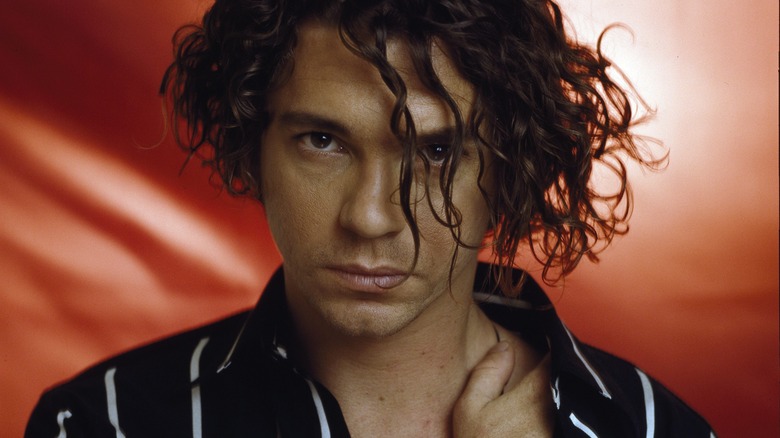
It wasn't a secret that INXS frontman Michael Hutchence was punched by a taxi driver outside a Danish pizzeria in 1995. But until decades after he died, only one person knew just how badly that single punch had injured him. Overnight, Hutchence's personality saw drastic changes, with filmmaker Richard Lowenstein telling Sky News that the singer experienced "sudden mood swings and temper outbursts." He also lost his sense of taste and smell. Only his girlfriend at the time, supermodel Helena Christensen, knew just how bad the situation was, and he made her swear not to tell anyone. To others, the outbursts were just seen as regular rock star behavior.
Lowenstein directed some of INXS's music videos and made a 2019 documentary, "Mystify," about Hutchence. It was during filming that he first learned about the singer's extensive brain injuries from interviewing Christensen and reading the full autopsy report: The punch had done serious injury to Hutchence's frontal lobes. Why keep it secret, though? "If it had gotten out — even just between the band members — that he had serious damage to the brain, they would have come in and started writing the songs themselves," Lowenstein said. "And that was his worst nightmare." As for why Hutchence didn't even tell his final partner and mother of his child, Paula Yates, Lowenstein says he might have worried she would "maybe not love him quite so much or treat him like an invalid. He didn't want to be seen as less of a person than he was before the accident." Hutchence died by suicide in 1997.
Bobby Darin
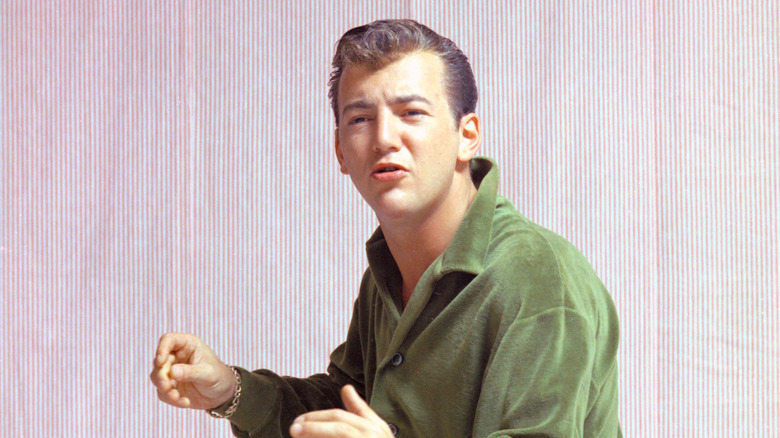
Bobby Darin's early death at just 37 had come as no surprise. As his son Dodd explained to People Magazine in 1994 (via BobbyDarin.net), as a boy, Bobby's heart was damaged from an illness. "My father knew he wouldn't live long," Dodd said. "He was trying to pack a lifetime of ambition into what little time he had." He was a very successful singer in the 1960s, with a close family. But five years before he died, he'd learn that some of his family members weren't who he thought.
It was Bobby's talk about running for office that changed everything. In Michael Starr's biography, "Bobby Darin: A Life," Bobby's half-brother Gary (not his cousin, like he believed) spoke about how it was their sister that convinced their mother, who he had grown up thinking was his sister, to come clean. "You've got to tell [him] ... if he goes into politics, they will uncover the truth," she said. "And better that he knows it up front than trying to find it out in some other way."
Bobby's mother, Nina, was only 17 and unmarried when she got pregnant with him, leading to the deception that his grandmother was his mother. Nina also refused to tell him who his father was. "Obviously, Bobby didn't take the news well." Gary explained. "The beauty of the whole thing is that Bobby never questioned it. Once he heard the words said to him, 'I'm not your sister, I'm your mother,' he knew it was the truth ... Unfortunately, he could never accept it." Bobby took the secret to his grave.
Ray Charles
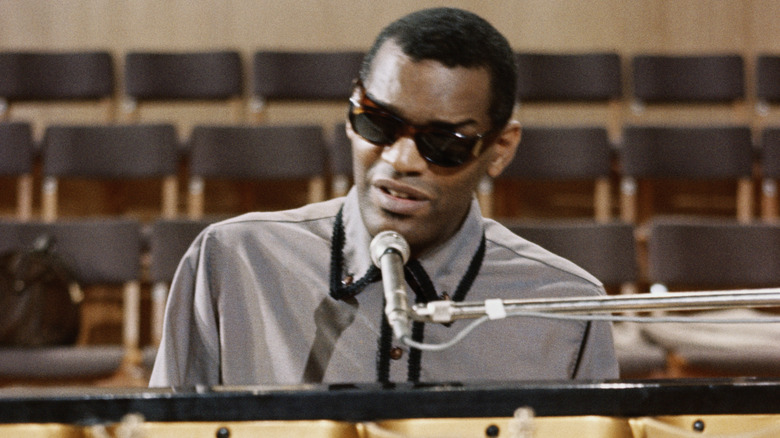
Addiction is a painful and complicated disease, and legendary singer Ray Charles had the extreme misfortune of being a celebrity whose excessive drug use was paraded in front of the world in the cruelest way possible. While at a tour stop in Indianapolis in 1961, Charles received an unsolicited phone call offering to sell him drugs. He purchased weed and heroin and later got high. Two days later, however, cops showed up at his hotel room door saying the drug dealer had tipped them off.
Charles was purposely humiliated, both with the charge of being a "common addict" — a charge he received — and by being paraded in front of the media. "How did you get started on drugs, Ray?" one reporter asked, per The Weekly View. He told the sad story. "I started using stuff when I was 16," Charles recalled. "When I first started in show business. Then I had to have more and more. ... A guy who lives in the dark has to have something to keep him going. The grind is just too much."
The public spotlight on his secret did not stop Charles from using heroin. As he told Rolling Stone in 1973: "Let's face it, man, if a guy doesn't want to stop doin' somethin', the judge, the psychiatrist, the jailer, ain't nobody gonna ... it's a made-up mind of what you want to do with yourself." Charles finally got clean after another drug bust in 1965.
Dolores O'Riordan

In 2013, lead singer of The Cranberries, Dolores O'Riordan, told reporter Barry Egan of the Irish Independent a horrible secret she'd been carrying around for decades: "For four years, when I was a little girl, I was sexually abused. I was only a kid."
While telling anyone that information, let alone a reporter, took incredible bravery, O'Riordan found it was worth it. A month later, when speaking to Egan again, she told him how it was "amazing to have the burden lifted off my shoulders." "[It] is almost like going into therapy and confessing it, except you do it the other way around, because when you are famous you just open up and that is it," she continued. "It does feel good to have that off the shoulders. I feel a definite sense of relief. I don't have to explain it to people. It happened. And you know, I think it makes people understand who you are and how you are a little bit better." They discussed everything that had happened in her life since the horror of her childhood, and she seemed genuinely happy with how it had all worked out.
Tragically, O'Riordan died of accidental drowning in a London hotel room in 2018. The incident reportedly happened after she passed out from alcohol intoxication in the bathtub. She was 46.
Nikki Sixx
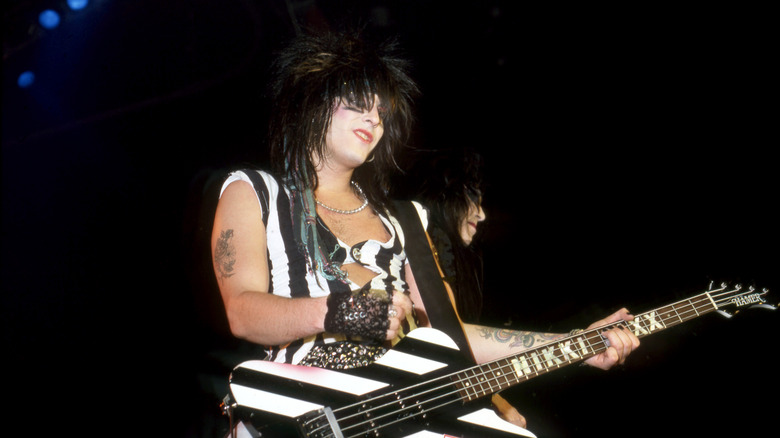
Nikki Sixx was maybe the hardest rocking of all the hard-partying members of Mötley Crüe. In 2007, he released a book about his life during the band's heyday, framed around diary entries he wrote throughout 1987.
One entry's first line is especially shocking: "I've decided I should do something for Valentine's Day to mark the anniversary of the day that I died." Considering Sixx titled the book about his life "The Heroin Diaries," it's not surprising what almost killed him. He explains what happened the year before, on February 14, 1986, in London. Right after getting offstage, he went to a drug den, and the first hit was too much: "I OD'd on the spot. My lips turned purple: I was gone. The story I heard was that the dealer grabbed his baseball bat and tried to beat the f****** life into me. He couldn't, so he flung me over his shoulder to dump me in the trash, because nobody wants a dead rock star lying around. Then I came to ... and I guess I had yet another dark secret to never tell anybody."
It was far from the first time this had happened to him. Later in the book, Sixx notes that by 1987, he'd had "many secret overdoses and seizures." One final OD at the end of that year would, thankfully, lead to him and the rest of the band getting clean.
Alanis Morissette
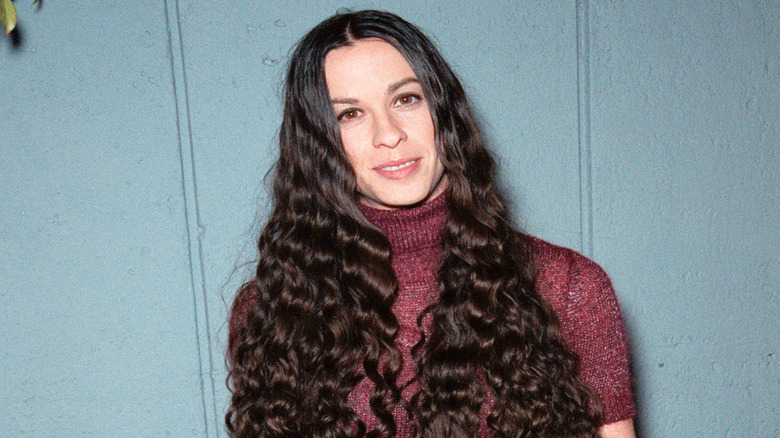
Singer-songwriter Alanis Morissette was huge in the 1990s, but she'd actually entered the entertainment industry even earlier. At just 10 years old, she appeared on Nickelodeon's "You Can't Do That On Television," and she snagged her first record contract at 14. The music industry is rarely good to young girls, and in 2021, Morissette told a documentary filmmaker she'd been abused at that age.
"I never talk about this," she said in the It took me years in therapy to even admit there had been any kind of victimization on my part," she said in the film, "Jagged." "I would always say I was consenting, and then I'd be reminded like 'Hey, you were 15, you're not consenting at 15.' Now I'm like, 'Oh yeah, they're all pedophiles. It's all statutory rape." Horrifically, even though she did try to tell people what was happening, no one intervened. "I did tell a few people and it kind of fell on deaf ears," Morissette said. "It would usually be a stand-up, walk-out-of-the-room moment."
Morissette had also spoken in more general terms about exploitation and abuse in the industry the year before. However, a weird controversy erupted over the documentary in which Morissette told the world her tragic secret. She never named the people who assaulted her and never took the accusations back, but she backed out of supporting the documentary about her career after she was unhappy with what she called a "salacious" final product (per the CBC).
Chester Bennington

Linkin Park frontman Chester Bennington had been open with his fans about his substance abuse issues, but it wasn't until 2008 that he told a reporter he'd been using drugs to cope with horrible childhood trauma. Bennington revealed to Kerrang (via The Irish Sun) that around the time he was 7 years old, a "friend a few years older than him" began sexually abusing him. The abuse continued until he was 13. "It escalated from a touchy, curious, 'what does this thing do' into full-on, crazy violations," Bennington said. "I was getting beaten up and being forced to do things I didn't want to do. It destroyed my self-confidence."
The abuse lasted for six years and stopped when Bennington turned 13. His parents were distant, and there was no one he trusted to tell. "I didn't want people to think I was gay or that I was lying," he explained. "It was a horrible experience." While Bennington opened up to his fans about the assaults, he never said who the perpetrator was. Tragically, the singer died by suicide in 2017. He was 41.
Elton John

In his 2019 autobiography, "Me," Elton John revealed to his fans that two years previously he'd been diagnosed with prostate cancer, and he kept his treatment a secret. He was in the middle of preparing for his massive, worldwide farewell tour at the time, and the diagnosis must have been terrifying. The only good news was that the cancer was found in its early stages, so John's doctors gave him the choice of chemotherapy or having his prostate removed.
The musician took the more aggressive approach. "I went straight for the surgery," he wrote. "A lot of men won't have it, because it's a major operation, you can't have sex for at least a year afterwards and you can't control your bladder for a while. But effectively my kids made the decision for me. I didn't like the idea of cancer hanging over me — us — for years to come: I just wanted rid of it."
But while the surgery was successful (and John was onstage again just 10 days later), he wasn't out of the woods yet. He writes that he then "contracted a major infection in South America," which was so serious that his doctors told his husband, David Furnish, that John "was 24 hours away from death." But he pulled through, saying, "I wasn't ready to die yet." Even fans who'd seen him in concert in the years between his diagnosis and his book coming out likely had no idea Elton John had been having such serious health problems.
David Cassidy
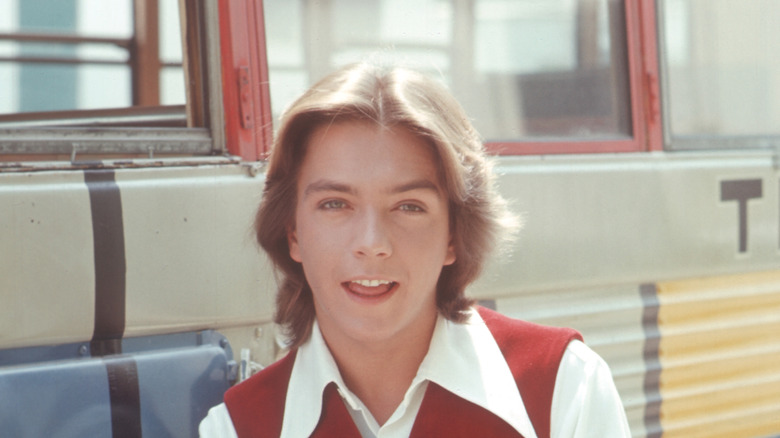
David Cassidy fancied himself a rock star, but he was more of a pop-oriented teen idol. He portrayed musician Keith Partridge on the family band sitcom "The Partridge Family," and it's his vocals on the 1970 No. 1 hit "I Think I Love You." With that fictional band and under his own name, Cassidy regularly appeared on the pop charts in the 1970s before he moved into acting and musical theater.
In 2008, Cassidy announced at a fundraiser for The Alcohol and Substance Abuse Prevention Council of Saratoga County that he was an alcoholic. Two years later, he was arrested in Florida and charged with driving under the influence, and in 2013, police in New York State arrested Cassidy for driving while intoxicated. Then, in 2014, police in California arrested him on suspicion of driving under the influence, and a judge ordered the musician to enroll in a rehabilitation program. Fast forward to 2017, and Cassidy chalked up his near-fall from a stage during a February concert to dementia. A
bout nine months later, Cassidy died at 67 years old, but not from the effects of dementia. Rather, it was the result of alcohol abuse — specifically liver and kidney failure. Just prior to his death, Cassidy told a documentary producer that he'd never actually found sobriety, as he'd publicly claimed. "I lied about my drinking," he told A&E producer Saralena Weinfield (via The Washington Post), saying he did it "to cover up the sadness and the emptiness."
Dan Hartman
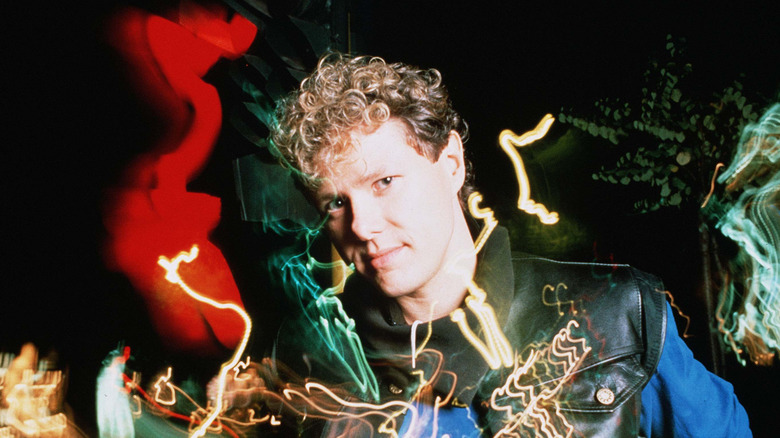
Dan Hartman made a significant impact on radio rock in many ways across two decades. A bassist and guitarist, he was a member of the '70s rock collective the Edgar Winter Group, and it's his voice on the band's big 1972 hit "Free Ride." After starting a solo career as a pop artist in the late '70s, Hartman scored a Billboard Top 10 hit in 1984 with the synthy soft rock gem "I Can Dream About You." He also produced and co-wrote James Brown's 1980s comeback hit "Living in America" and served as executive producer of Joe Cocker's popular 1987 album, "Unchain My Heart."
Fearing personal or professional career-ending backlash in the far less tolerant 1970s and 1980s, Hartman only ever told a few close and trusted associates that he identified as a gay man. The musician also told just a handful of people that he believed he'd been exposed to HIV, the virus that causes AIDS, toward the end of the 1980s. In March 1994, Hartman died at the age of 43, and the singer's manager, Julian Able, told media outlets that the cause of death had been a brain tumor. It was only after he died that it became publicly known that Hartman was a member of the LGBTQ+ community, and the brain tumor that ultimately took his life was related to an AIDS diagnosis.
Mick Mars

Mick Mars, the long-serving guitarist for the definitive '80s LA sleaze-metal band Mötley Crüe, always loomed over the stage in an imposing fashion. Little did fans know that throughout the band's entire heyday, Mars was in a tremendous amount of pain characteristic of a rare spinal disease. The guitarist has ankylosing spondylitis, a severe and degenerative variety of arthritis that affects the spine. Over time, bones in the vertebrae merge, resulting in a permanently hunched-over posture, breathing issues when the disease spreads to the ribs, a decreased ability to move smoothly, and a marked and consistent discomfort in the pelvis, back, hips, and chest.
Mars began to experience intense tailbone pain at age 14, long before he helped form Mötley Crüe. Around 19, and having joined the Los Angeles music scene, the symptoms became tough to ignore. "My hips started hurting so bad every time I turned my body that it felt like someone was igniting fireworks in my bones," Mars revealed in the 2001 band memoir "The Dirt: Confessions of the World's Most Notorious Rock Band." That was the first time the guitarist publicly shared his diagnosis. Three years later, Mars agreed to hip replacement surgery. "I have days that are worse than others, and there is always some amount of pain with my hips," he admitted to Goldmine.
Layne Staley

Heroin addiction loomed over Alice in Chains. Frontman Layne Staley wrote about his experiences taking the powerful opiate and trying to stop taking it, and so his involvement was well known to fans. It wasn't until after Staley died of a drug overdose in 2002 that it was clear just how severe and profound his substance use issues had been. Guitarist Jerry Cantrell disclosed that Staley had been too intoxicated to pull off a fully professional performance during the band's 1996 episode of "MTV Unplugged." Before long, Staley was suffering from complications of routine heroin abuse: He'd lost a lot of weight and was missing teeth.
Alice in Chains went on a long break in 1996, as Staley was unable and unwilling to leave his Seattle apartment much after the death of his partner, Demri Parrott. In April 2002, Staley's mother, Nancy McCallum, asked Seattle police to help her perform a wellness check on her rock star son following a curious lack of activity on his bank accounts. Among various drugs and drug-taking equipment, they came across the decomposed remains of Staley. The 34-year-old musician had been deceased for as long as two weeks before the tragic discovery. The cause of death was an overdose of drugs, following Staley's tireless efforts to quit. According to McCallum, Staley had entered drug rehabilitation programs 10 times and nearly died from an overdose five times.
Deryck Whibley

When snide, sniveling, and youthful pop-punk came to the fore for a big moment in the early 2000s, Sum 41 was a big part of the movement. The group was all over alternative rock radio for years, with catchy, hard-charging anthems like "Fat Lip," "Still Waiting," "Motivation," and "In Too Deep." The face, voice, and primary guitarist in the operation: Deryck Whibley, who formed the band at age 16.
In his 2024 memoir, "Walking Disaster: My Life Through Heaven and Hell," Whibley wrote about his previously well-documented personal problems, such as mental and physical health issues and alcohol use issues that resulted in kidney and liver failure. He also discussed, for the first time anywhere and with anyone, the grooming and abuse he allegedly endured by Sum 41's earliest manager, Treble Charger's Greig Nori. Beginning when Nori was 34 and Whibley was 16, the musician says he was subjected to both verbal and sexual abuse that lasted for several years. In addition to plying him with alcohol and drugs, Nori convinced Whibley that the repeated abuse constituted a relationship and that he ought to cut off contact with his parents.
If you or someone you know needs help with mental health, please contact the Crisis Text Line by texting HOME to 741741, call the National Alliance on Mental Illness helpline at 1-800-950-NAMI (6264), or visit the National Institute of Mental Health website.
If you or anyone you know has been a victim of sexual assault, help is available. Visit the Rape, Abuse & Incest National Network website or contact RAINN's National Helpline at 1-800-656-HOPE (4673).
If you or someone you know may be the victim of child abuse, please contact the Childhelp National Child Abuse Hotline at 1-800-4-A-Child (1-800-422-4453) or contact their live chat services.
If you need help with an eating disorder, or know someone who does, help is available. Visit the National Eating Disorders Association website or contact NEDA's Live Helpline at 1-800-931-2237. You can also receive 24/7 Crisis Support via text (send NEDA to 741-741).
If you or anyone you know needs help with addiction issues, help is available. Visit the Substance Abuse and Mental Health Services Administration website or contact SAMHSA's National Helpline at 1-800-662-HELP (4357).
If you or someone you know is struggling or in crisis, help is available. Call or text 988 or chat 988lifeline.org.