

5 Rock Songs From The '80s We'll Be Blasting On Repeat 'Til The End Of Time
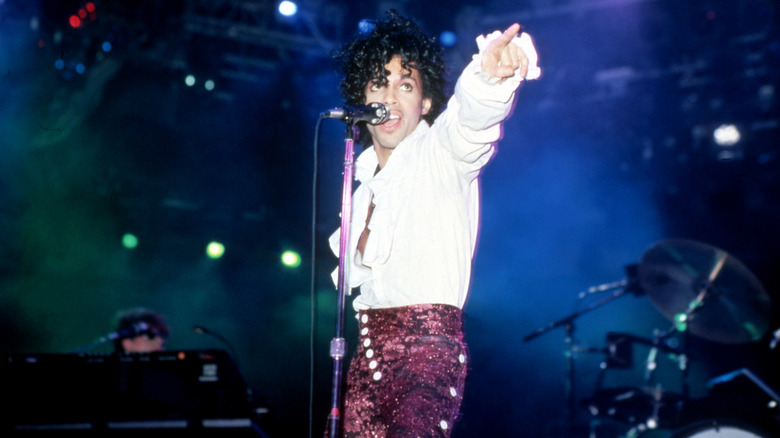
Whether it's huge, anthemic bands like Def Leppard or Bon Jovi, pure rock-out groups like AC/DC, or gentler, high-minded fare like U2, the 1980s produced some superb exemplars of rock music. The '80s were also a time when rock bifurcated beyond its classic "golden era" (around 1964 to 1982) and turned increasingly eclectic in terms of sub-genres and contemporary influences, such as electropop. And just as '60s and '70s bands produced rock music we'll keep blasting till the day we die, so did the '80s.
Choosing a mere five songs from the entire decade is quite a feat. So for the purposes of this article, we've got to get thoughtful and avoid songs that are too obvious or read like a mindless assemblage of greatest '80s hits. At the same time, we can't get too obscure. Our songs should retain some broader, non-niche appeal. Songs also need to be nuanced or substantive enough to not get repetitive over time, meaning they can't rely too heavily on big, hooky choruses.
We're also steering clear of metal, like Black Sabbath under Ronnie James Dio, Iron Maiden, and Metallica's legendary '80s albums. Much of this music is approachable enough in comparison to modern metal to skew hard rock, but is, by definition, not rock. On that note, we've got to cover a variety of styles that accurately portray the full range of '80s rock that properly encapsulates the decade. Whether it's the unapologetic, balls-to-the-wall energy of Motörhead's Ace of Spades, the emotionally teeming roots-rock of "I'm On Fire" of Bruce Springsteen, or The Purple One himself crying out for "Purple Rain," there's a lot of music to celebrate.
Ace of Spades — Motörhead
If ever there was blistering rock that punched you in the face while stealing your keys and speeding off in your Harley, it was Motörhead. We say "was" because legendary Motörhead front man, Lemmy Kilmister, sadly died of a last-minute cancer diagnosis in 2015, and Motörhead is no more. But no matter, because as Lemmy eternally rasps in 1980's "Ace of Spades," "You know I'm born to lose, and gambling's for fools / But that's the way I like it, baby, I don't wanna live forever."
Lemmy told it as straight and no-nonsense as "Ace of Spades," right down to his description of Motörhead's entire identity and raison d'être during a late career concert: "We are Motörhead, and we play rock-'n'-roll." It's as simple as that. That's part of the appeal and timelessness of Motörhead's music, and why it still hits hard today as it did when it came out, and will continue to do so in perpetuity.
The tale behind "Ace of Spades" only adds to the song's coolness and status, a song that quickly became Motörhead's greatest hit. Guitarist "Fast" Eddie Clarke and drummer "Philthy Animal" Taylor holed themselves up in a Rockfield, Wales, studio to work on songs for their band's fourth album, complete with "the vodka and everything else," as Louder Sound quotes Clarke. Lemmy later assembled the lyrics in a "transit van while speeding down the motorway at 90mph," as he professed. Clarke, however, said, "He [Lemmy] might have written it in the f***ing sh***er for all I know."
Tom Sawyer — Rush
Rush diehards might have our necks for this choice and start blubbing, "Yeah, yeah, yeah, but what about song X on album Y?? And we don't mean "YYZ" off 1981's "Moving Pictures." To that, we say that we're not choosing the best Rush song. Rather, we're choosing Rush, one a whole, one of the most unlikely groups of weird, unique uber-nerds that sound like they came from musical outer space. Out of their whole '80s catalogue, we're going to give our nod to "Tom Sawyer" off the aforementioned "Moving Pictures" as a song to which we could listen in perpetuity.
"Tom Sawyer" scratches our proggy, experimental, oddball itch that extends back to acts like late '60s King Crimson and early Genesis. Like the band, the song never gets old or tired no matter how many playthroughs, largely because it's still so one-of-a-kind. At the same time, it retains an accessible veneer no matter how complex, partly because the band started writing "tighter, more economical" songs come the '80s, as guitarist Alex Lifson told Louder Sound.
"Tom Sawyer" also represents some top-tier Rush musicality, between its odd time signatures and polyrhythms, the very groove-based pre-chorus, the left-of-field synth motif that comes in during verse two, and so forth. Written as a lyrical collaboration between the band and Canadian poet Pye Dubois, it also demonstrates a hallmark of Rush songs: Each song is very specific about its subject matter. "Tom Sawyer" is about the Mark Twain character as representative of a timeless theme: the desire to lead an independent, free life. As the song famously says, "No, his mind is not for rent / to any god or government."
I'm on Fire — Bruce Springsteen
It might seem odd that such a short song — just under two and a half minutes — makes a cut of '80s songs that you could replay again and again, but it's the precise brevity of Bruce Springsteen's 1984 "I'm On Fire" that helps make it so special. It's a strange choice for a hit song, too, from Springsteen or anyone else. But, it's actually got more listens on Spotify at the time of writing than the monstrously huge, anthemic, ever-misinterpreted veteran story of "Born In the U.S.A."
"I'm On Fire" has a simple seven-note chorus, three notes of which are "Oh, oh, oh," an unusual structure that has two mini-verses and one longer verse, no bridge, no real intro, no real outro, no digressions, and nothing but the nearly hypnotic rephrasing of the same musical motifs again and again. And that's precisely the point. The song flares like the feelings it describes, like a lit match, and wields mesmerizing musical phrasing to do so — phrasing that feels as mesmerizing as the restrained, unfulfilled desires that Springsteen describes: "Only you can cool my desire / Oh, oh, oh, I'm on fire." Lots of other musicians have connected to "I'm On Fire," too, leading to loads of edgy and dull covers.
On the practical, songwriting front, "I'm On Fire" was the last song that Springsteen wrote for side one of his 1984 album, "Born in the U.S.A." He'd had the lyrics already written, and the song came together after listening to some of Johnny Cash's music. Rather than wield the entire E Street Band for the recording, Springsteen only used himself, drummer Max Weinberg, and pianist Roy Bittan to record its deeply evocative, dreamy, yet intense feelings.
Marian — Sisters of Mercy
The Sisters of Mercy was a lesser-known act that played a critical role in birthing the goth movement, bridging post-punk with drum machines and dark, synth-powered acts like Nine Inch Nails, and which satisfies The Cure family of pop-rock. Our choice? "Marian," off their 1985 debut, "First and Last and Always."
"Marian" stands as one of the most captivating songs from Sisters of Mercy's catalogue, brimming with Byronesque lyrical broodiness, a thickly dark soundscape, a fanciful, but direful tale about a dude drowning in hand's reach of an oceanic siren, all delivered by singer Andrew Eldritch's potent baritone and drum machine, Doktor Avalanche. Gothic, much? And even though the same 2-4 snare hits throughout the entire song's length, the layering of "Marian's" instrumentation and mini-vignettes — floaty yet cascading — especially the mandolin-sounding high-pitched strumming motif, keep it endlessly interesting to the ear.
Unlike the other songs on this list, "Marian" and its musical origins remain shrouded in mystery. Speculation amongst online fandoms on sites like Reddit link the song's name to a Leonard Cohen song, "So Long, Marianne." And indeed, Sisters of Mercy got their band name from a Cohen song, and from the same album as "So Long, Marianne," 1968's "Songs of Leonard Cohen." While this era of Cohen was very much not goth, unlike the dark musings of later songs like 1971's "Avalanche," Eldritch doesn't care for the goth label, anyway.
Purple Rain — Prince
Is it even possible to talk about Prince without resorting to massive hyperbole? Blending funk, soul, pop, finger-shredded guitarwork, multi-instrumentalism, and self-produced albums with an unparalleled, commanding stage presence and creative grasp that actually matched his reach, Prince truly was a one-of-a-kind artist. But even if the only '80s song that Prince had written across his multi-decade career was 1984's "Purple Rain," or if "Purple Rain" had been a one-off hit from some other artist, it'd still be worthy of being played again and again.
"Purple Rain's" ringing, singable chorus, iconic solo followed by Prince's stellar falsetto, then languorous, symphonic outro, elevate "Purple Rain" from a mere song on a record to a true musical journey. The song even came with its own movie, "Purple Rain," a fictionalized version of Prince's life story that he pitched to Warner Brothers, and which helped skyrocket The Purple One's 1984 album, "Purple Rain," into the stratosphere. And of course, who could forget Prince's mindblowing 2007 Super Bowl performance where he played "Purple Rain" in the rain while somehow not getting electrocuted?
Folks might not realize it, but "Purple Rain" started as a collaboration between Prince and Stevie Nicks. Nicks originally approached Prince after "Little Red Corvette" inspired her to write "Stand Back," and Prince gave her a demo track of "Purple Rain" to write lyrics to. She felt overwhelmed by the scale of the song, however, and backed out. As for what purple rain means, it's a combination of blue sky and red blood, which together make the color purple. As Prince once said of the song's apocalyptic meaning (via American Songwriter), "Purple rain pertains to the end of the world and being with the one you love and letting your faith/God guide you through the purple rain."