

5 Overplayed Hits From The '80s We Never Want To Hear Again
How is it that a good song becomes bad? Oh yeah, that's right. It's played a kajillion-bajillion-quadrillion times till it loses all meaning and provokes glimpses of cthuloid insanity. Who can hear the opening flute of Celine Dion's "My Heart Will Go On" without shrieking in madness? How about the exasperatingly overplayed "Wonderwall," aka, every aspiring guitarist's first learned song, ever. Or, how about the annually dethawed Mariah Carey's "All I Want For Christmas Is You," which recently broke records by becoming the longest song to sit at No. 1 on the Billboard Hot 100, at 20 weeks. God help us all.
The '80s were no exception to the "thou shall not be overplayed" rule. In fact, as a decade, it's arguably one of the worst offenders. Characterized in part by big, arena rock driven by hooky choruses (think: AC/DC, Bon Jovi, Boston, and so on), such music is more prone than others to fall into the overplayed trap. And, it's inherently more repetitious than other music. Certain instrument tones can also make things worse, like synths characteristic of the '80s (Van Halen, we'll get to you). To make this article's cut, a song has to meet such criteria and also have some hard-to-define quality — schmaltz, pompousness, a lack of self-awareness, etc. — that makes it especially intolerable on repeat listen.
Such things are subjective, of course, and everyone has different limits. And to new listeners, such songs might sound as fresh as morning dew. But, this article is taking the perspective of someone who has long-endured these songs' aural punishment. Whether it's Journey's gushingly mawkish "Don't Stop Believin'," Van Halen's ultra-annoying "Jump," or Foreigner's endless quest to find what love is, here are some of our picks.
Please Stop Believin'
We can all stop believin' at this point, can't we? Or believe, if you must, but keep your volume low. We can stop the journey. We can get off this midnight train goin' anywhere. We can stop livin' just to find emotion. Judging by "Don't Stop Believin's'" nearly 2.7 billion Spotify listens, plenty of people have already been livin' that way and still are. In May, 2024, Journey's 1981 "Don't Stop Believin'" reached No. 121 on the Billboard Global 200. At the time, it had stayed in the charts for 124 weeks. By June, that year, it reached No. 80. The song is coming for us and will never stop. Believe it.
Ok, ok. "Don't Stop Believin'" isn't a bad song. But is anyone going to deny that it's a seriously, seriously (insert many more seriouslys here) overplayed song? This is all a bit odd because it didn't even reach No. 1 on release, but peaked at No. 9 in December, 1981. "Open Arms" from the same album, "Escape," reached No. 2 the following year. But, it's "Don't Stop Believin'" that's had legs — up and down the boulevard, let's say — for decades beyond its release.
As far as inherently annoying qualities are concerned, "Don't Stop Believin'" is excessively sentimental, but that's probably helped its staying power. Neal Schon's opening guitar arpeggios lean into the cheese, but the song's keyboard tone is piano-like and not grating. Former singer Steve Perry's soaring vocals are mushy, but undeniably well-executed. Maybe the song's annoying qualities boil down to what Schon himself told Rick Beato in a November, 2025 YouTube interview. He wrote the song's main riff after being asked to "write something dumb."
Definitely Gonna Give You Up
Are we rickrolling you right now? No, not at all. But yes, thanks in part to that classic internet meme, "Never Gonna Give You Up" has 100% become something that we're gonna give up. No matter Rick Astley's sweet dance moves in the music video, no matter that bartender that gets a bit too into things, and no matter that dude who randomly does a wall run and backflip with ... Ok, you know what? Never mind. The whole thing is charming, if oozingly saccharine. It's just been played too much.
Back in 1987 when Rick Astley released his debut album, "Whenever You Need Somebody," no one knew all the things he'd never do. He was only 21 at the time and released his first single off his debut record that reached No. 1 quite literally across the world: the US, UK, the Netherlands, Greece, Spain, Norway, Australia, Zimbabwe, and more. "Never Gonna Give You Up" spent two weeks at No. 1 on the Billboard Hot 100 and stayed on the chart 24 weeks longer. Then, six years later, Astley vanished to sit on a pile of money and live a quiet life in the English countryside. Decades later in 2008 following the rickrolling boom, the MTV Europe Music Awards dubbed him the "Best Act Ever."
But besides being overplayed, does "Never Gonna Give You Up" retain any inherently annoying qualities? Its Linn 9000 drum machine opening line is quintessentially '80s and a bit dated, but does the job. Astley's voice (which sounded great in 2025 at 59 years old) is toothy and muffled on the low end, but still resonant and round. But all the things he'd never do? He just never stops telling us.
Jump On Outta Here
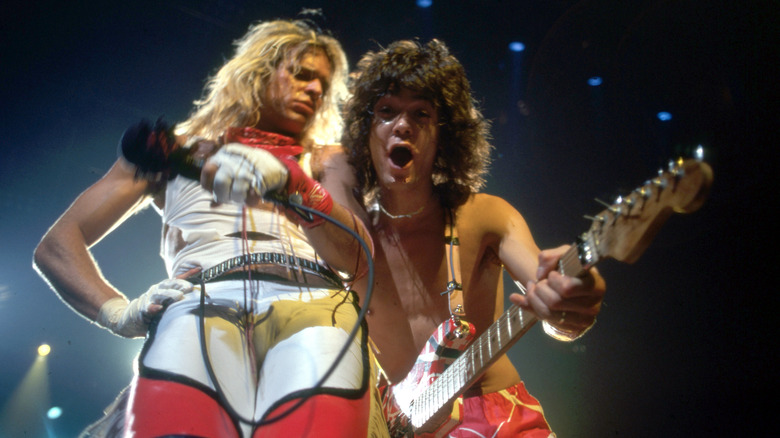
Where do we even start with Van Halen's "Jump"? The synth tone and the opening chords, perhaps. The non-stop, one-tone, eighth-note pulse underneath both the verse and chorus throughout the entire song, on and on (except for the blessed reprieve of the pre-chorus and solo). David Lee Roth's preening ham-and-cheese stage strutting (that's hammy and cheesy) and lippy, swaggering vocal tone. It's all packaged together right along with this selection's music video – an unavoidable '80s musical component — which is just an absolute, spandex-stretched, billowy-haired, self-aggrandizing embarrassment to humanity. And that's just one listen.
But, if you're one of those who got on board the "Jump" express early on, maybe you don't feel this way at all. After all, "Jump" stayed at No. 1 for five weeks when it released in 1984 on Van Halen's ingeniously-named album, "1984." The song also breached the elite one billion listens club on Spotify, in case you're hoping otherwise. "Jump" is and was Van Halen's biggest hit, outshining songs that contain some of the band's more annoying qualities, including Roth shrieks, like "Runnin' with the Devil," but are far less repetitive and overplayed. Heck, 1978's "Eruption" and its two-handed tapping revolutionized guitar playing, and rightfully so. Eddie Van Halen was a legend, one who sadly died in 2020.
So why did "Jump" turn out like it did? Is it possibly because Van Halen (the guy) forsook his six strings for the 61 black-and-white keys of an Oberheim OB-Xa synthesizer? Are we all now receiving an eternal punishment for this breach of sacred trust? No clue, but as it stands (or jumps into a mid-air leg split), "Jump" can jump on out of here.
I Do Know What Love Is
You've gotta' take a little time, a little time to think things over, do you, Foreigner once-vocalist Lou Gramm? In your life, there's been heartache and pain, has there, Mr. Gramm? Well, tell us: Have you finally figured it out? Do you now, after over 40 years of mulling since Foreigner released 1984's "Agent Provocateur," know what love is? Well, we're going to give Gramm a pass for any indecisiveness, because come 1997, doctors found a tumor "the size of a large egg" (per the Las Vegas Sun) in his brain that was miraculously lasered out of existence. Gramm, you can go. The rest of Foreigner, stay put. Why did you make such a good song that it got played so much?
Actually, it was Foreigner guitarist Mick Jones who drafted the initial idea for "I Want to Know What Love Is," which became a No. 1 hit. It came from a real place, too: Jones' divorce and band troubles amidst band success. You might be able to detect this sincerity in the song's music, no matter that it's drowned in gushy syrup, gospel choir and all. That choir, by the way, came about because Jones wanted to "enhance it [the song] in a spiritual way" because he felt it "was probably written entirely by a higher force," as Louder Sound quotes.
But, after hearing "I Want to Know What Love Is" for the 1.2 billionth time (judging by Spotify listens), we've had enough of its floaty synth, its shimmering guitars, its on-the-nose lyrics, and its strained emotionality. As Gramm says, we don't know if we can face it again.
Don't Take Me Down, Oh Don't Take Me Down
Please count how many times Axl Rose asks to be taken down to paradise city, where the grass is green and the girls are pretty, in the 1987 Guns N' Roses song, "Paradise City." Go ahead, we'll wait. What's that, you say? 50,000? Times a million instances of hearing the song, that equals infinity. We've heard Rose make this request infinity times, which means that we'll never stop hearing it. Maybe if "Paradise City" wasn't almost seven minutes of basically the same exact musical loop, plus some interludes and its double-time bridge, it wouldn't be so grating. Or if, you know, Rose had a totally different voice.
Alright, much like the rest of the songs on this list, "Paradise City" isn't a bad song. Slash's guitar licks, the song's core chord progression, its layered vocal harmonies in the chorus, its elongated intro and perfectly placed kicks and snares: All of this is fantastic. There's a reason why the song's album, 1987's "Appetite for Destruction," reached No. 1 on the Billboard 200, albeit a year after the album released. "Paradise City," "Welcome to the Jungle," and "Sweet Child O' Mine" all come from this one album, and they're all in the billion-listener club on Spotify ("Sweet Child O' Mine" is the highest, at over 2.5 billion).
But, with great success comes great overplayability. At this point, "Paradise City" was played so much, and all of "Appetite for Destruction," for that matter, that we need about 10 years of not hearing GNR to recalibrate. But that's probably not going to happen.