

5 Cover Songs That Sound Better Than The '70s Original Version
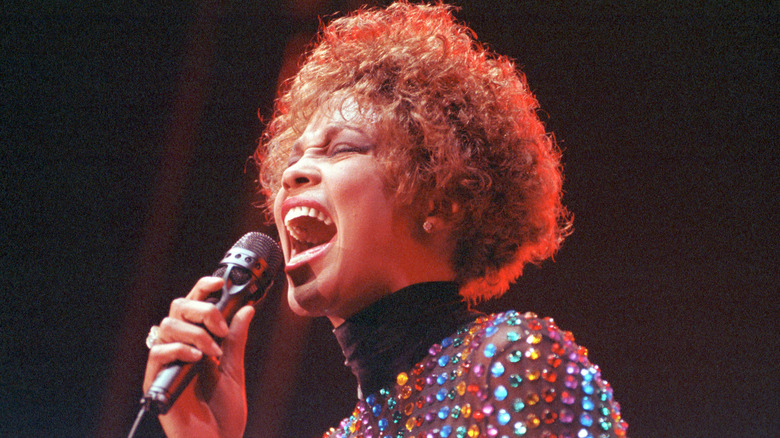
Covering another artist's song can be a risky choice. If you stay faithful to the original tone, why even bother? But if you add your own twist, changing the lyrics or melody, it could all go very wrong. In the best-case scenario, you get something like Whitney Houston's cover of "I Will Always Love You": It becomes the definitive version of the song, eclipsing the original. (And in this case, that original was written and performed by none other than Dolly Parton.) The worst-case scenario? You get Duran Duran's cover of "911 Is a Joke," one of the worst covers of all time.
Knowing that, you have to admire artists who take a song beloved by fans and remake it. Whether they're adding more (or just different) instruments, changing the tempo, or even taking it into a whole new genre, there are a lot of decisions that go into recording a cover. For this list of five cover songs that sound better than the '70s original, we combed through endless best-of lists and Reddit threads about such tracks. Like with our list of five cover songs that sound better than the '80s original version, pulled from a variety of artists, spaced throughout the decade.
Destiny's Child — Emotion
Destiny's Child's 2001 album "Survivor" includes a cover of "Emotion" by Australian singer Samantha Sang, originally released in 1978 and produced by Barry and Robin Gibb of the Bee Gees. (The Bee Gees later recorded their own version in 1994.) Where the original version is pure pop, Destiny's Child's cover slows things down and adds R&B stylings that really make the song shine. Instead of Sang's staccato-like delivery of lines like "In the words of a broken heart, it's just emotions taking me over," we get to hear Beyoncé, Kelly Rowland, and Michelle Williams harmonizing.
"Emotion" was released as a single in September 2001 (with a dramatic music video accompanying it) and peaked at No. 10 on the Billboard Hot 100, becoming the group's eighth top 10 hit. Critics liked the song, with Entertainment Weekly calling the cover "a solid slow jam" and NME praising it as a "tremendous" highlight of the album in an otherwise mixed review. Although far from being Destiny's Child's best-known song, it remains a beloved fan favorite today (and many don't even know that it's a cover).
Neko Case — Christmas Card from a Hooker in Minneapolis
Tom Waits' bluesy "Christmas Card from a Hooker in Minneapolis," from his 1978 album "Blue Valentine," was described by AllMusic as "one of [his] most beloved songs from one of his more obscure albums." The story-song reads as a letter from an unnamed sex worker to someone named Charlie. In the letter, the narrator describes how she's improving her life by getting sober, finding a new partner, and moving to Minneapolis. But then the last verse pulls the rug out from under you and reveals that the narrator was lying the whole time: She's actually in jail, and she's asking Charlie for money.
In 2000, indie songstress Neko Case recorded a cover for the Tom Waits tribute album "New Coat of Paint." Immediately, the gender swap makes the song feel more earnest and personal. Case's clear, melodic voice is very different from Waits' gravely one, and her delivery is far more earnest. Critics agreed, with AllMusic praising Case's "fragile but tough delivery."
Elvis Costello and the Attractions — (What's So Funny 'Bout) Peace, Love, and Understanding
This cover is proof that the way you sing the lyrics can totally change the meaning. The original version of "(What's So Funny 'Bout) Peace, Love, and Understanding" was written by Nick Lowe and released by his band Brinsley Schwarz in 1974. It's not a bad song, but it sounds like a lot of other folk-rock tunes of the era, and the echoey spoken word part is a little silly.
When Elvis Costello and the Attractions released a cover of "(What's So Funny 'Bout) Peace, Love, and Understanding" in 1979, the group sped it up, rocked it out, and added a sense of urgency that made the title question go from rhetorical to demanding. At the time, Rolling Stone wrote that the song is "delivered with a sincerity bordering on desperation." When Costello sings lines like, "So where are the strong and who are the trusted?" he sounds downright angry. The song's placement as the final track on Elvis Costello and the Attractions' 1979 album "Armed Forces" — which contains other socially charged songs like "Oliver's Army" — makes it even more empathic.
George Harrison — If Not for You
George Harrison might be the biggest-ever Bob Dylan fan in the history of the world. He was instantly entranced after listening to the 1964 album "The Freewheelin' Bob Dylan," and when The Beatles met the songwriter later that year, there was an instant connection. Dylan and Harrison's friendship lasted for decades, and they later both became part of the '80s supergroup the Traveling Wilburys.
In October 1970, Dylan released "If Not for You," a country-inspired love song about his then-wife Sara, on his album "New Morning." One month later, Harrison released a slowed-down cover version on his first solo album, "All Things Must Pass." (Dylan was apparently cool with it — he'd taught the song to Harrison earlier that year, and the two recorded an unreleased version together.) While Dylan's song is a sweet and simple ditty, Harrison amps up the romance with a slower tempo, more instrumentation, and a voice that can actually hit the notes. The way Harrison delivers them, lyrics like "If not for you / Babe, I couldn't even find the door / I couldn't even see the floor / I'd be sad and blue / If not for you" sound more sincere.
Whitney Houston — I Will Always Love You
Whitney Houston's "I Will Always Love You" tops almost every list of covers that are better than the original, and it tops this one too. We know, it's unsurprising, but it's just that good — Houston wasn't called "The Voice" for nothing. In this 1992 power ballad recorded for the soundtrack of "The Bodyguard," she shows off her vocal prowess in every phrase, from the a cappella start to the belt in the chorus. Add a groovy saxophone, a dramatic drumbeat, and plenty of raw emotion, and you've got an all-time classic.
The original was written and recorded by Dolly Parton in 1973. While it sounds like a love song, the real meaning of "I Will Always Love You" is business-related: Parton wrote it about leaving "The Porter Wagoner Show" to establish her own career. Her version is a country song, as opposed to Houston's R&B ballad. It's also much simpler, without the lavish instrumentation present in Houston's. Also, Parton delivers the last verse as spoken word. It's a cute song in its own right, but it doesn't hold up in comparison to Houston's. Parton knows it, too. "I could not believe how she did that," she said on an episode of The Oprah Conversation in 2020. "I mean, how beautiful it was that my little song had turned into that."